11.2.1 Uses of electrostatic charge
Charging a spray to control where it lands
Electrostatic sprayer
An electrostatic sprayer is a device that gives liquid droplets the same electric charge so that they repel one another and are attracted to an oppositely charged target.
- An uncharged spray relies on the nozzle alone, so each droplet travels in whatever direction it happens to leave the nozzle and much of the liquid misses the target.
- An electrostatic sprayer gives every droplet an electric charge as it forms, so the forces between charges then control where the spray goes.
- All of the droplets are given the same sign of charge, which makes them like charges, so they repel one another.
- That repulsion pushes the droplets apart, so they spread out into a fine, even cloud instead of joining together into large drops.
- Small, well separated droplets coat a surface more evenly and cover a larger area for the same volume of liquid.
- The target is given the opposite charge, either directly or by earthing it, so the droplets and the target are unlike charges and attract.
- Because that attraction is a non-contact force, the droplets curve towards the target instead of travelling in straight lines.
- Droplets are therefore pulled onto surfaces the nozzle is not pointing at, including the sides and the far face of the object.
- Once part of a surface is coated, the charge already sitting there repels further droplets towards the bare areas, so the coating tends to even itself out.
- The two forces have separate jobs: repulsion spreads the spray out, and attraction delivers it to the target.
Insecticide sprayers
- A crop sprayer charges the insecticide droplets as they leave the nozzle, so they repel one another and spread across the full width of the spray boom.
- The crop is connected to the ground through its stems and roots, so it behaves as though it carries the opposite charge to the droplets and attracts them.
- Droplets are pulled onto the undersides of the leaves as well as the top surfaces, which matters because many pests feed underneath.
- Less insecticide drifts away on the wind or falls onto the bare soil between the rows.
- A smaller volume of insecticide gives the same protection, so the cost to the farmer falls.
- Less chemical reaches the soil, hedgerows and nearby watercourses, so contamination of the environment is reduced.
- The spray still has to be used with care, because charge cannot hold onto droplets that have already drifted well away from the charged crop.
Paint sprayers
- In a spray booth the paint is broken into a mist of tiny droplets and each droplet is charged as it is formed.
- The droplets all carry the same sign of charge, so they repel one another and spread into an even mist rather than arriving as blobs.
- The metal object being painted, such as a car body or a bicycle frame, is earthed or given the opposite charge.
- The droplets are attracted to every part of that metal surface, including edges, curves and the back of each tube, which a directed spray would miss.
- Paint that would otherwise be lost as overspray is drawn onto the object instead of settling on the floor and walls of the booth.
- The layer of paint is more even in thickness, so fewer coats are needed and the finish is smoother.
- Wasting less paint saves material and reduces the volume of solvent released into the air of the workshop.
Photocopiers and laser printers
- A laser printer starts by giving a rotating drum an even coating of charge across its whole surface.
- A laser beam is then scanned across the drum and removes the charge from the areas that will be left blank on the page.
- The charged pattern left on the drum is an image of the print, held in place because the drum surface is a poor conductor.
- Toner powder is given the opposite charge to the drum, so it is attracted to the charged areas and stays away from the discharged ones.
- The paper is then charged more strongly than the drum, so the toner is attracted off the drum and onto the sheet as it passes.
- Heated rollers melt the toner so that it fuses into the paper fibres, and the image no longer depends on charge once it has cooled.
- The same rule does all of the work: unlike charges pull the powder to the places that should be printed, and like charges keep it away from the rest.
Explaining an even coat on a bicycle frame
- A bicycle frame is painted in a booth where the paint droplets are given a negative charge as they leave the nozzle.
- Every droplet carries the same sign of charge, so the droplets repel one another and spread out into a fine mist.
- The frame is earthed, so its surface behaves as though it is positively charged relative to the droplets.
- The droplets and the frame now carry unlike charges, so the droplets are attracted towards the metal.
- The attraction acts in every direction around each tube, so droplets reach the back of the tubes as well as the front.
- The result is an even coat of paint with very little lost as overspray, so less paint is needed for the whole frame.
Explaining an electrostatic use
- Split the answer into the two forces: repulsion between the droplets, and attraction between the droplets and the target.
- Say that the droplets are all given the same charge, then that they repel one another and spread out.
- Say that the target carries the opposite charge, then that the droplets are attracted to it.
- Add the practical benefit the question asks for, such as an even coating, coverage of hidden surfaces, or less waste.
- Keep the two roles the right way round, because swapping them so that the droplets attract each other loses both marks.
- Where the question names a use, answer in its own terms, writing crop and leaves for a sprayer or car body and overspray for a paint booth.
- Do not write that the droplets attract one another, because they all carry the same sign of charge and therefore repel.
- Do not say that the target repels the spray, because the target carries the opposite charge and attracts it.
- Do not answer only that static electricity is used, because the marks are for naming the forces and their effects.
- Do not claim that charging the spray removes the need for care with insecticides, because droplets still drift once they are far from the charged crop.
- Do not describe the droplets as being pushed towards the target, because the force on them there is a pull.
- State the sign of the charge given to the droplets in an electrostatic sprayer, compared with one another.
- Explain why charged droplets spread out into a fine mist.
- Explain why charged droplets are attracted to the crop or to the object being painted.
- Give two advantages of electrostatic spraying over spraying with an uncharged nozzle.
- Explain how a laser printer uses charge to place toner only where the print should appear.
11.2.2 Dangers of sparking
How a spark forms
Spark
A spark is a brief flow of charge through the air between two objects that have a large potential difference between them.
- Static charge builds up whenever insulating materials rub against each other, and it stays where it is because there is no conducting path away.
- Liquid fuel flowing quickly along a hose or pipe rubs against the inside wall, so electrons are transferred between the fuel and the pipe and both become charged.
- Powders such as flour, sugar or grain dust charge up in the same way as they are poured, tipped or blown along ducting.
- Clothing, plastic containers and vehicle bodywork all charge up through ordinary movement and contact.
- As the charge collects, the potential difference between the charged object and nearby earthed metal grows larger.
- When the potential difference across the air gap becomes large enough, the air stops behaving as an insulator and charge crosses it.
- That brief flow of charge through the air is a spark, and it lasts only a tiny fraction of a second.
- All of the stored energy is transferred in that very short time, so the air in the spark channel reaches a high temperature and glows.
Why sparks are dangerous
- A spark is dangerous mainly because it is a source of ignition in places where flammable substances are present.
- Petrol vapour, diesel vapour, solvents, aerosol propellants, methane and fine dusts all catch light readily once they are ignited.
- A vapour or dust mixed with air burns far more easily than the liquid or solid it came from, because the fuel is already spread through the oxygen it needs.
- Even a small spark can transfer enough energy to start that reaction.
- If the mixture burns inside an enclosed space, the hot gases expand rapidly and the result is an explosion rather than a steady fire.
- Filling a car with petrol is a familiar risk, because petrol evaporates easily and vapour collects around the open filler neck.
- Charge can build up on the driver, on the car body, on the nozzle or on a plastic fuel container during filling.
- Transferring fuel between a road tanker and an underground storage tank moves large volumes very quickly, so far more charge can be separated.
- Aircraft refuelling, solvent and paint handling, and grain, flour and sugar silos all carry the same hazard.
- Sparks are also a hazard around sensitive electronics, because a discharge through a microchip can destroy it permanently.
Preventing the build-up by earthing
Earthing
Earthing is connecting a charged object to the earth through a conductor so that electrons flow and the excess charge is removed.
- Earthing deals with the hazard at its source by stopping charge from collecting in the first place.
- A conducting path lets electrons flow to or from the earth as quickly as the charge is separated, so the charge never reaches a dangerous level.
- With no large build-up, the potential difference across any air gap stays small and no spark can form.
- A road tanker is connected to an earthed point with a bonding cable before any fuel is transferred, and the cable stays attached until the transfer is complete.
- Aircraft are earthed and bonded to the fuel tanker for the same reason before refuelling begins.
- Metal pipework, nozzles and filters in a fuel system are bonded together with conductors, so that no two parts of the system can sit at different potentials.
- Fuel must be dispensed into a metal container standing on the ground rather than a plastic one resting on a car boot, because the metal container can be earthed and the plastic one cannot.
- Drivers are advised to touch the metal bodywork before picking up the nozzle, so any charge on them is removed before they are close to the vapour.
- Antistatic additives in the fuel, conducting hoses and conducting flooring all do the same job by making otherwise insulating parts of the system slightly conducting.
- Limiting the flow rate of the fuel also helps, because slower flow rubs less and separates less charge.
- Humidifying the air in a factory reduces static build-up as well, because a thin film of moisture on surfaces lets charge leak away steadily.
Refuelling from a road tanker
- A road tanker delivers petrol into the underground tank at a filling station.
- Petrol flowing through the delivery hose rubs against the hose wall, so electrons are transferred and the tanker becomes charged.
- Without a conducting path the charge builds up, so the potential difference between the tanker and the earthed pipework rises.
- A large enough potential difference would drive charge across the air gap between them as a spark.
- Petrol vapour around the filler point burns easily once mixed with air, so a spark there could start a fire or an explosion.
- A bonding cable is therefore clipped from the tanker to an earthed point before the delivery begins.
- Electrons now flow away through the cable as fast as they are separated, so no large charge builds up and no spark can form.
Explaining a sparking hazard
- Write the chain in order: charge builds up, the potential difference rises, a spark crosses the gap, the spark ignites the vapour, and a fire or explosion follows.
- Name the flammable substance and use the word vapour or dust, because saying only that the petrol catches fire often misses the ignition mark.
- For a prevention question, say what earthing does to the charge rather than simply calling earthing safer.
- Link earthing to the outcome: no build-up of charge means no large potential difference, so no spark.
- Use the details the question gives you, such as the bonding cable on the tanker or the metal container standing on the ground.
- Where a question asks for a hazard and a precaution, keep them as two separate statements so both are easy to award.
- Do not say that the liquid fuel is ignited directly, because it is the vapour mixed with air that catches light.
- Do not describe earthing as removing the spark, because earthing prevents the charge that would have caused the spark.
- Do not write that protons flow along the bonding cable, because only electrons move.
- Do not suggest connecting the earthing cable after a transfer has started, because the dangerous charge builds up during the transfer.
- Do not confuse this spark with the mains supply, because the charge here comes from friction and not from a circuit.
- Explain how charge builds up when fuel flows quickly through a hose.
- Describe what must happen before charge can cross an air gap as a spark.
- Explain why a spark is dangerous near petrol vapour.
- Explain how connecting a bonding cable to a road tanker prevents a spark.
- State why petrol should be carried in a metal container standing on the ground rather than a plastic one.
11.2.3 Electric fields
What an electric field is
Electric field
An electric field is a region in which an electric charge experiences a force.
Electric field line
An electric field line is a line drawn on a field diagram whose arrow shows the direction of the force that would act on a positive charge placed at that point.
Point charge
A point charge is a charged object small enough for all of its charge to be treated as though it acts at a single point.
- A charged object changes the space around it, so that any other charge placed in that space experiences a force.
- That region of space is the object's electric field, and the field is there whether or not a second charge is present to feel it.
- The field is what explains how two charged objects can push or pull each other without touching.
- The field is strongest close to the charged object and becomes weaker as the distance from it increases.
- A field has a direction as well as a strength, so it is drawn on diagrams using arrows rather than shading.
- By agreement, the arrow on an electric field line shows the direction of the force that would act on a positive charge placed at that point.
- A negative charge placed at the same point feels a force in exactly the opposite direction to the arrow.
- Field lines are never drawn crossing one another, because a single point cannot have two different field directions.
- A charged object small enough for all of its charge to be treated as acting at one place is called a point charge.
Fields around point charges
Radial field
A radial field is a field whose field lines are straight and spread out evenly in all directions from a single point.
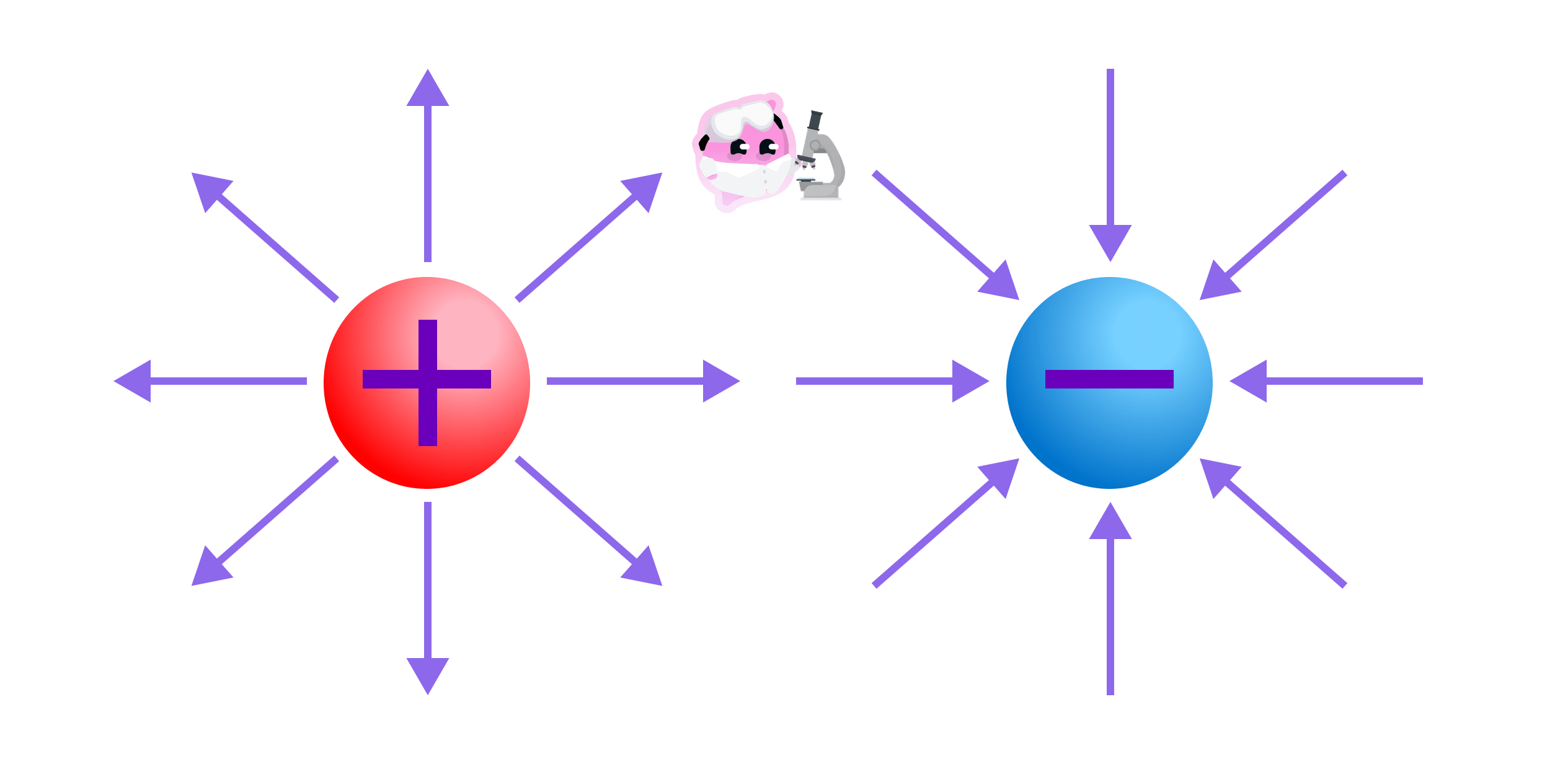
- The field around an isolated point charge is radial, which means the field lines are straight and spread out evenly in every direction.
- Around a positive point charge the lines point away from the charge, because a positive charge placed nearby would be repelled.
- Around a negative point charge the lines point towards the charge, because a positive charge placed nearby would be attracted.
- Every field line meets the surface of a charged sphere at right angles to that surface.
- Close to the charge the lines are packed tightly together, and further away they fan out so the gaps between them widen.
- That widening is how the diagram shows the field getting weaker with distance, which is why the force on a charge falls as it is moved away.
- The pattern is the same shape for both signs of charge, so only the arrows tell you whether the central charge is positive or negative.
- Putting more charge on the sphere strengthens its field at every distance, which is drawn as a larger number of field lines rather than longer ones.
Fields between parallel plates
Uniform electric field
A uniform electric field is a field that has the same strength and the same direction at every point, shown by straight, parallel, equally spaced field lines.
- Two flat metal plates placed parallel to one another and given opposite charges set up a field in the gap between them.
- Between the plates the field lines are straight, parallel to one another, equally spaced, and at right angles to the plate surfaces.
- The lines run from the positive plate towards the negative plate, matching the direction of the force on a positive charge.
- Equal spacing means the field has the same strength at every point in the gap, so it is a uniform electric field.
- A positive charge released between the plates is pushed towards the negative plate, in the same direction as the field lines.
- A negative charge released in the same gap is pushed the other way, towards the positive plate.
- The field is only uniform well inside the gap; near the edges of the plates the lines curve outwards and the field is weaker there.
- Increasing the potential difference between the plates, or moving the plates closer together, makes the uniform field stronger.

Reading field strength from a diagram
- The spacing of the field lines is what shows the strength of the field, and nothing else on the diagram does.
- Lines drawn close together show a strong field, so the force on a given charge placed there is large.
- Lines drawn far apart show a weak field, so the force on that same charge is smaller.
- Widely spaced lines still mean a field is present, only a weaker one; a region with no lines at all is the only region with no field.
- In a radial field the lines are closest at the surface of the charge, so that is where the field is strongest.
- In the uniform field between parallel plates the spacing never changes, so no point in the gap is stronger than any other.
- The length of a field line carries no meaning, and neither does the thickness of the line.
- When two diagrams are compared, the one with the more crowded lines at a given point represents the stronger field at that point.
Comparing two points in a radial field
- A negative point charge is drawn with radial field lines, and point PPP lies close to the charge while point QQQ lies three times as far away.
- All of the lines point towards the charge, because the field direction is the direction of the force on a positive charge.
- At PPP the lines are close together, so the field there is strong.
- At QQQ the same lines have fanned out, so the gaps between them are wider and the field there is weaker.
- A small positive charge placed at PPP is therefore pulled towards the central charge with a larger force than the same charge placed at QQQ.
- A small negative charge placed at PPP is pushed away from the central charge, because a negative charge feels a force opposite to the field arrows.
Describing and drawing field diagrams
- Answer three things every time: the shape of the lines, their direction, and what their spacing tells you about the strength.
- Use the word radial for a point charge, and straight, parallel and equally spaced for parallel plates.
- Put an arrowhead on every line you draw, because lines with no arrows score nothing for direction.
- Draw the lines meeting a charged surface at right angles, and keep the spacing even all the way round a point charge.
- Write “away from the positive charge” or “towards the negative charge” rather than “outwards”, so the direction cannot be misread.
- Link spacing to strength in words, for example that the lines are closest to the sphere so the field is strongest there.
- Do not treat the arrows as the direction a negative charge would move, because the arrows are defined using a positive charge.
- Do not draw field lines that cross one another or that stop part way across a gap.
- Do not describe a region of widely spaced lines as having no field, because the field is weaker there but still present.
- Do not draw the field between parallel plates as radial, or the field around a point charge as straight and parallel.
- Do not use the length of a line to show the strength of a field, because only the spacing of the lines carries that information.
- Define an electric field.
- State what the arrow on an electric field line represents.
- Describe the shape and the direction of the field around a positive point charge.
- Describe four features of the field lines between two oppositely charged parallel plates.
- Explain how a field diagram shows where the field is strongest.
- State the direction of the force on a negative charge placed in a field whose lines point to the right.
11.2.4 Electric fields and static electricity
Why the field model is needed
Non-contact force
A non-contact force is a force that acts between two objects that are not touching, through a gravitational, electrostatic or magnetic field.
Electric field
An electric field is a region in which an electric charge experiences a force.
- Every static effect involves a force between objects that are not touching, so it has to be a non-contact force.
- Saying only that charges attract or repel does not explain how one object can affect another across an empty gap.
- The electric field fills that gap: the first charge sets up a field in the space around it, and the second charge feels a force because it is sitting in that field.
- The size of the force on the second charge depends on its own charge and on the strength of the field where it sits, not on any contact between the objects.
- Because the field grows weaker further from its source, the force falls as the objects are separated, which is exactly what is observed.
- Both objects set up fields and both sit in the other's field, which is why the two forces always come in a pair of equal size.
- The field is a model, so it cannot be seen directly, but every prediction it makes about direction and strength can be tested.
Attraction and repulsion as field effects
- Near a positive charge the field points away from it, so a second positive charge placed there is pushed outwards and the two objects repel.
- A negative charge placed in that same field feels a force opposite to the arrows, so it is pulled inwards and the two objects attract.
- The like-and-unlike rule is therefore not a separate fact to memorise; it follows from the direction of the field and the sign of the charge placed in it.
- Moving a charged rod closer to another charged object moves it into a stronger part of the field, so the force it feels grows.
- Rubbing a rod for longer puts more charge on it, which makes its field stronger at every point and increases the force on anything nearby.
- The field also explains why the effect fades with distance rather than stopping abruptly, because the field lines fan out gradually.
Explaining attraction of uncharged objects
Induced charge separation
Induced charge separation is the small shift of electrons inside a neutral object when a charged object is brought close to it, making one side of the object negative and the other side positive while it stays neutral overall.
- A field acts on the charges inside a neutral object as well, even though that object carries no overall charge.
- Electrons in the neutral object are pushed one way by the field while the fixed positive nuclei are pushed the other way, which produces induced charge separation.
- The side of the object that ends up with the charge opposite to the nearby charged object is also the side closest to it.
- That near side sits in the stronger part of the field, so the force there is larger than the force on the far side.
- The attraction on the near side therefore beats the repulsion on the far side, and the neutral object is pulled towards the charged one.
- The field model explains this attraction, which the like-and-unlike rule on its own cannot do because the neutral object has no overall charge.
- The effect disappears as soon as the charged object is removed, because the field that separated the charges has gone and the electrons move back.
Explaining sparks and shocks
Ionisation of air
Ionisation of air is the removal of electrons from molecules in the air, leaving charged particles that allow the air to conduct electricity.
- As charge collects on an object, the electric field in the air around it becomes stronger.
- Air molecules contain charges of their own, so a strong enough field pulls electrons away from them, and this is ionisation of air.
- The freed electrons and the charged molecules left behind are both free to move, so the ionised air has become a conductor.
- Charge then flows through that narrow conducting channel all at once, which is the spark, and the object loses its charge.
- This is why a spark needs either a large build-up of charge or a small gap, because both of those make the field in the air stronger.
- Field lines crowd together at sharp points and thin edges, so the field is strongest there and sparks tend to start from corners and points rather than flat surfaces.
- The same reasoning covers every scale, from the click felt when touching a door handle to a lightning stroke several kilometres long.
Investigating attraction and repulsion between charged objects
- Aim: to investigate the forces of attraction and repulsion between charged objects, and how the force depends on the signs of the charges and on the separation between them.
- Apparatus: two polythene rods, one perspex or acetate rod, woollen duster, paper stirrup or wire cradle hung from nylon thread, retort stand with boss and clamp, or an upturned watch glass, protractor and metre rule taped to the bench, coulombmeter with collecting plate, dry cloth, and a dry, warm room.
- Variables, sign of the force: the material of the approaching rod is the independent variable, the direction in which the suspended rod turns is the dependent variable, and the duster, the number of strokes, the starting separation and the room conditions are controlled.
- Variables, effect of separation: the separation between the rods is the independent variable, the angle the suspended rod turns through is the dependent variable, and the charge on both rods, the suspension arrangement and the direction of approach are controlled.
- Method, set-up:
- Wipe both rods, the duster, the cradle and the thread with a dry cloth, and work in a dry room, because moisture on a surface lets charge leak away within seconds.
- Hang the stirrup from a length of nylon thread clamped to the retort stand and balance one polythene rod horizontally in it, so that a very small sideways force makes it turn. An upturned watch glass with the rod resting in the groove works just as well.
- Tape a protractor to the bench directly beneath the free end of the suspended rod, with its zero line along the rod's rest position, and tape a metre rule alongside so separations can be measured.
- Agree a fixed charging routine, for example ten firm strokes along the last 10 cm10\ \text{cm}10 cm of a rod, and use it every single time.
- Charge the suspended rod by rubbing one end with the duster, holding the rod by the end you are not rubbing, then let it settle before taking any reading.
- Method, finding the direction of the force:
- Charge the second polythene rod with the same duster and the same number of strokes.
- Bring it slowly towards the free end of the suspended rod, keeping the two rods horizontal and at the same height, and stop about 5 cm5\ \text{cm}5 cm away without letting them touch.
- Record whether the suspended rod turns away from the approaching rod or towards it.
- Move the approaching rod away, let the suspension settle, then repeat the test twice more, recharging both rods before each run.
- Replace the second polythene rod with the charged perspex rod and repeat the same three runs, recording the direction of turning each time.
- Method, finding the effect of separation:
- Recharge both polythene rods, hold the approaching rod at a measured separation of 20 cm20\ \text{cm}20 cm and record the angle the suspended rod turns through once it settles.
- Repeat at separations of 15 cm15\ \text{cm}15 cm, 10 cm10\ \text{cm}10 cm, 7 cm7\ \text{cm}7 cm and 5 cm5\ \text{cm}5 cm, recharging both rods before every reading so the charge stays as close to constant as possible.
- Take three readings at each separation and calculate a mean angle, investigating any reading that is far from the other two rather than deleting it.
- Use the coulombmeter between runs to check that each freshly charged rod carries a similar amount of charge.
- Results: two charged polythene rods repel, so the suspended rod turns away from the approaching rod. A charged perspex rod attracts the charged polythene rod, so the suspended rod turns towards it. The mean angle increases as the separation is reduced.
- Processing: plot the mean angle turned through on the vertical axis against separation on the horizontal axis. A larger angle means a larger force, so the curve rises steeply as the separation gets smaller, which shows that the force grows quickly as the charges are brought closer together.
- Watch out: charge leaks away in seconds, so take readings promptly and recharge often. Touching the rubbed end with bare fingers earths the charge through you. Letting the rods touch transfers charge and changes both rods, so the next reading is meaningless. Draughts, open windows and breathing on the apparatus move the suspended rod and look exactly like a force. Rubbing never produces the same charge twice, so angles should only be compared within one set of readings taken quickly.
- Improvements: use a longer thread so that a smaller force gives a measurable turn, enclose the suspension in a clear box to keep draughts out, read the protractor from directly above to avoid a parallax error, and use the coulombmeter to reject any run where the charge is clearly different.
- Safety: low risk. Keep the charged rods away from faces and eyes, keep them well clear of mains sockets and sensitive electronics, clamp the stand so it cannot topple, and clear the bench of anything the swinging rod could knock over.
Changing the distance between two charged rods
- A charged polythene rod hangs in a cradle so that it can turn freely, and a second charged polythene rod is held 20 cm20\ \text{cm}20 cm from its free end.
- Both rods carry the same sign of charge, so the suspended rod turns away and the force between them is repulsion.
- At 20 cm20\ \text{cm}20 cm the suspended rod sits in a weak part of the second rod's field, so it turns through only a small angle.
- The second rod is moved in to 5 cm5\ \text{cm}5 cm, which places the suspended rod in a much stronger part of the same field.
- The force on the suspended rod is now larger, so it turns through a much bigger angle.
- Neither charge has changed; only the strength of the field at the suspended rod's position has changed.
Using the field in an explanation
- Build the answer in three steps: the charged object sets up an electric field, a charge placed in that field experiences a force, and that force produces the effect described.
- Say where the field is stronger whenever the question changes a distance or an amount of charge, because that is what changes the force.
- For attraction of an uncharged object, state that the field causes induced charge separation and that the near side gains the opposite charge.
- For a spark, say that the field becomes strong enough to ionise the air so that the air conducts, then that charge flows through it.
- Use the word because to join each step to the next, so the chain of reasoning is easy to follow and easy to award.
- Avoid explaining a non-contact effect by contact of any kind, since the whole point of the field is that nothing has to touch.
- Do not say that objects must touch for an electrostatic force to act, because the field lets the force act across a gap.
- Do not write that positive electrons move, because electrons are always negatively charged.
- Do not say a neutral object gains an overall charge when it is attracted, because its charge has only been separated.
- Do not treat the field arrows as the path a negative charge takes, because a negative charge is forced the opposite way.
- Do not say that a spark happens because air conducts electricity normally, because air only conducts once the field has ionised it.
- Explain why the electric field model is needed to describe an electrostatic force.
- Explain, using the field, why two negatively charged rods repel each other.
- Explain why the force on a charged object grows as it is moved closer to another charged object.
- Explain how a field causes a neutral object to be attracted to a charged one.
- Explain how a strong electric field allows a spark to cross an air gap.
- Describe how you would show that two charged polythene rods repel each other.
