Question 12
FA student investigates how the number of layers of insulation around a beaker affects how quickly hot water in the beaker cools.
The Figure shows the side view of the apparatus.
Figure
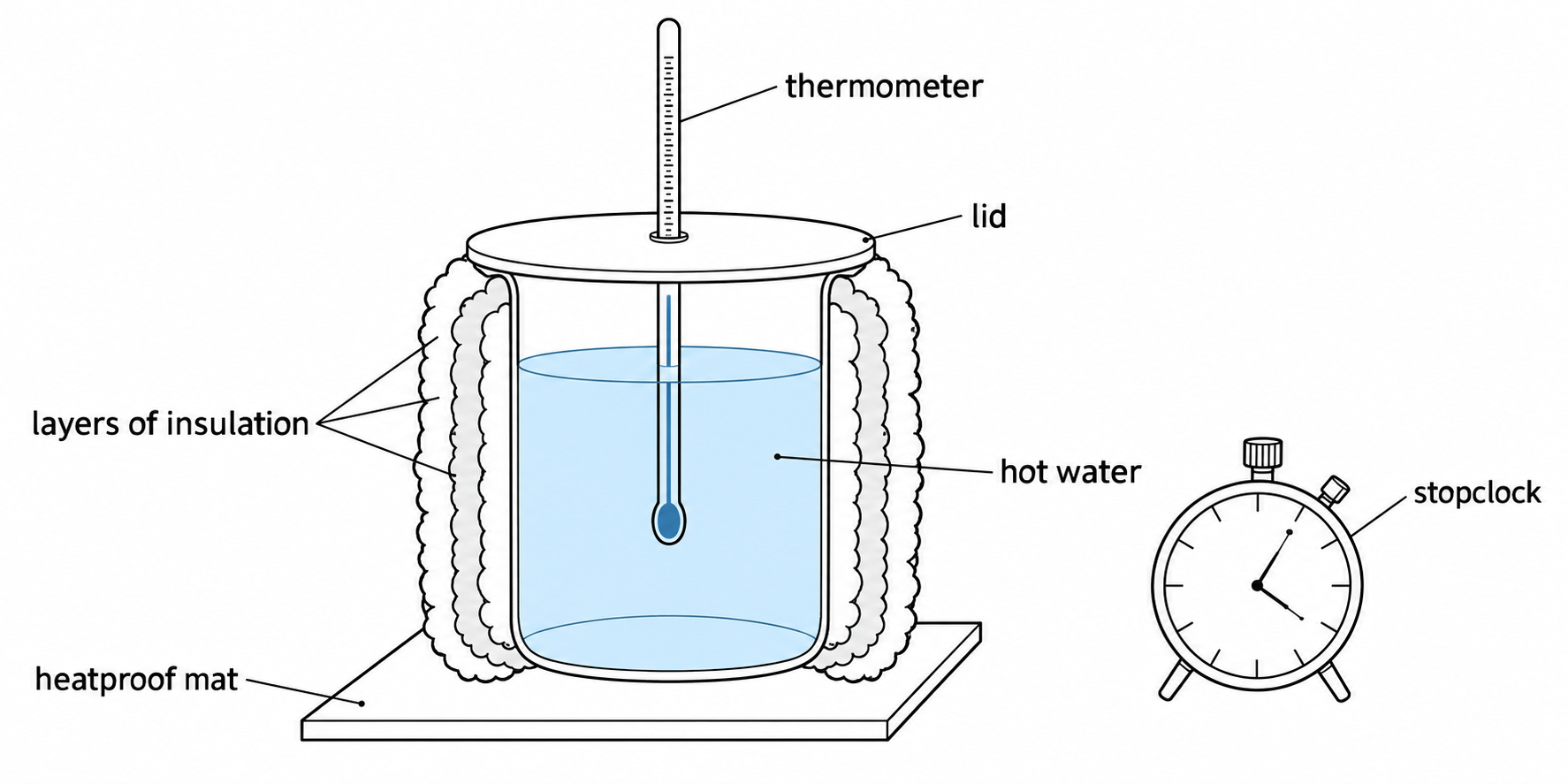
This is the student's method.
-
pour 200 cm3 of water at 80 ∘C80\ ^{\circ}\text{C}80 ∘C into the beaker
-
record the temperature of the water after 10 minutes
-
repeat with a different number of layers of insulation
The Table shows the results.
Table
| Number of layers of insulation | Temperature after 10 minutes in ∘C^{\circ}\text{C}∘C |
|---|---|
| 0 | 56 |
| 1 | 62 |
| 2 | 66 |
| 3 | 68 |
| 4 | 69 |
a.[2]
Give two variables the student should keep the same in each test.
b.[2]
Describe the relationship between the number of layers of insulation and the temperature after 10 minutes.
c.[2]
Explain, in terms of energy transfer, why the water with more layers of insulation cools more slowly.
d.[2]
Explain why the student should use the lid in every test.
3.2 Dissipation and efficiency Questions
100 exam-style questions on Edexcel GCSE Physics 3.2 Dissipation and efficiency, covering 3.2.1 Dissipation of energy, 3.2.2 Reducing unwanted energy transfers, 3.2.3 Efficiency, and 3.2.4 Increasing efficiency. Each one has a worked solution and a mark scheme showing where the marks go.