14.1.1 Kinetic theory and states of matter
The kinetic theory model
Kinetic theory
Kinetic theory is the model that explains the properties of solids, liquids and gases in terms of the separation, arrangement and movement of their particles.
State of matter
A state of matter is one of the three physical forms in which a substance can exist, namely solid, liquid or gas.
- Every substance is made of an enormous number of tiny particles, which are atoms or molecules.
- The model describes a substance using three features: how far apart the particles are, whether their arrangement is regular or irregular, and how they move.
- Each particle is held near its neighbours by forces of attraction, and the state of a substance depends on how strong those forces are compared with the movement of the particles.
- Particles are far too small to see, so a particle diagram is a model: the circles represent spacing and arrangement, not the true size or shape of an atom.
- The particles themselves are identical in all three states of one substance, so ice, liquid water and steam all contain the same water molecules.
- The model explains observable properties such as shape, volume and flow, and it works for any substance rather than only for one material.
Particles in a solid
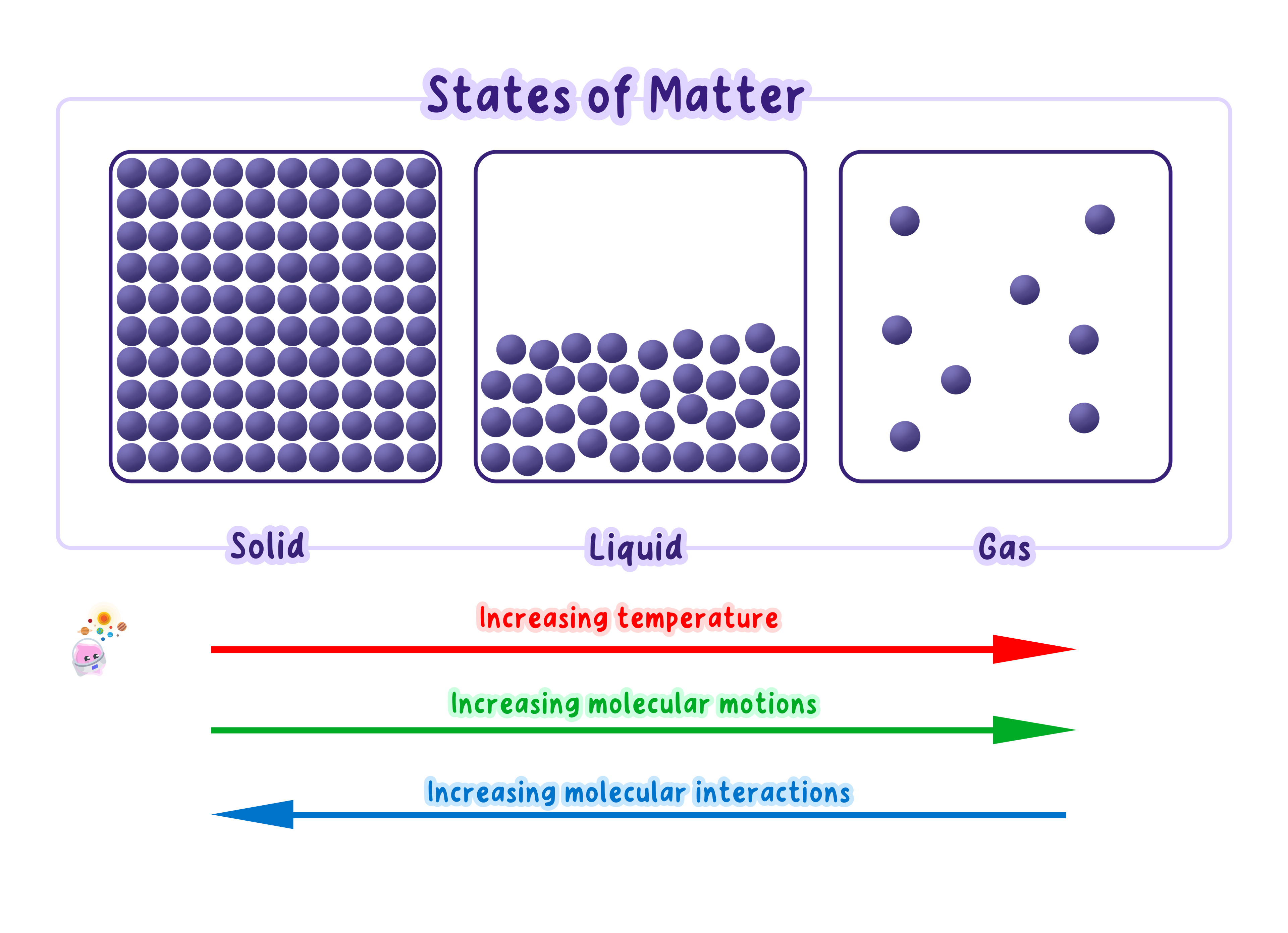
- The particles are packed very close together, so there is almost no empty space between them.
- Their arrangement is regular, which means they sit in a repeating pattern.
- Each particle stays in a fixed position relative to its neighbours and vibrates about that position.
- The forces of attraction between the particles are strong enough to stop the particles moving from place to place.
- A solid therefore has a fixed shape, because its particles cannot slide past one another.
- A solid also has a fixed volume, because the particles are already as close together as the forces between them allow.
- Ice, copper and glass are solids at room temperature.
Particles in a liquid
- The particles are still close together, usually only a little further apart than in the solid.
- Their arrangement is irregular, so there is no repeating pattern.
- The particles move continuously and slide past one another instead of staying in fixed positions.
- A liquid has a fixed volume, because the forces between the particles still hold them close together.
- A liquid has no fixed shape, so it flows and takes the shape of the part of the container it fills.
- Pouring a liquid into a wider container gives a shallower depth, but the volume of liquid is unchanged.
- Water and cooking oil are liquids at room temperature.
Particles in a gas
- The particles are widely spaced, so most of the volume occupied by a gas is empty space.
- Their arrangement is random and it changes from moment to moment.
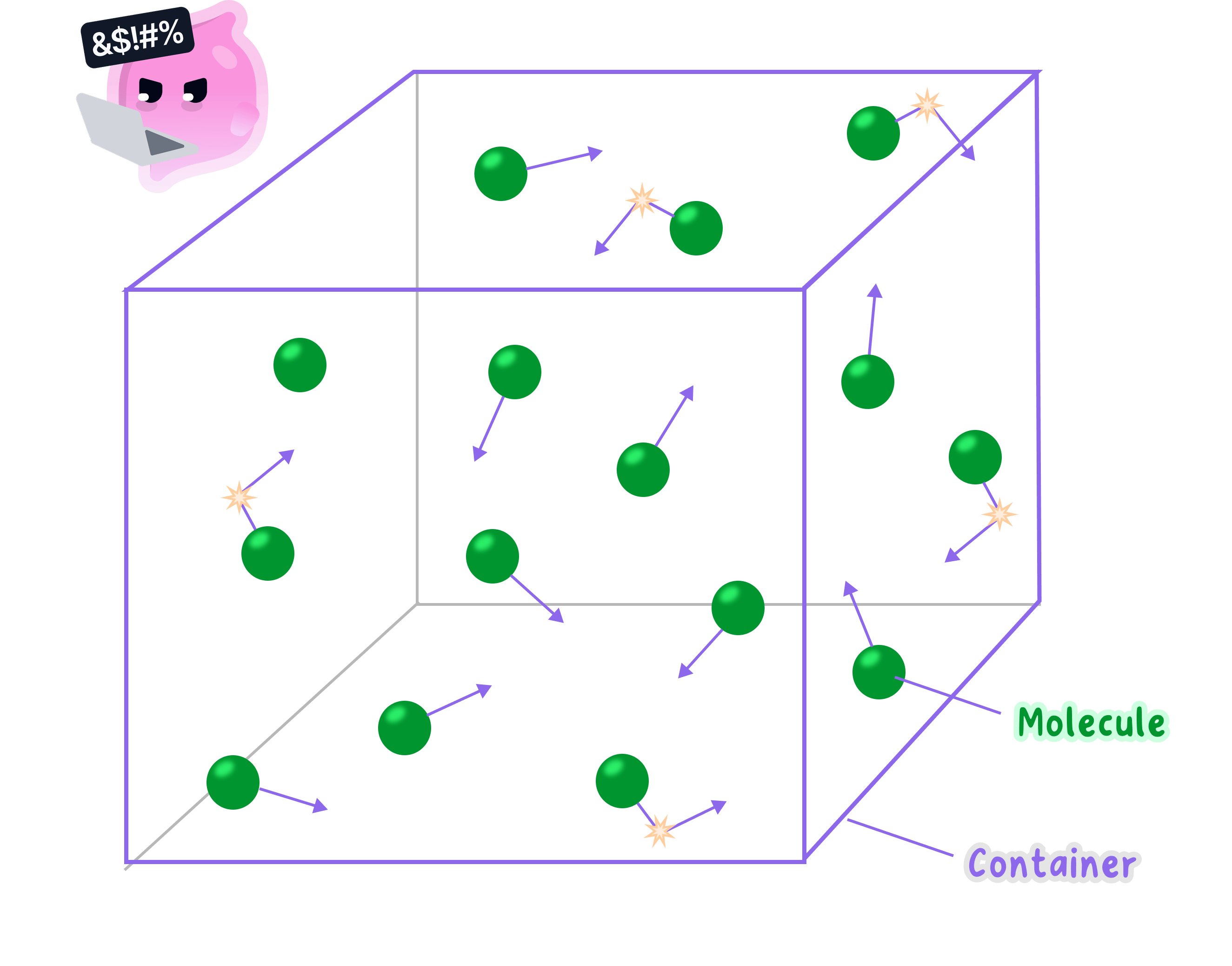
- The particles move rapidly and randomly in all directions, travelling in straight lines between collisions.
- The forces of attraction between the particles are very weak, because the particles spend most of their time far apart.
- A gas has no fixed shape and no fixed volume, so it spreads out until it fills the whole of its container.
- Oxygen and carbon dioxide are gases at room temperature.
Comparing the three states
- Separation increases from solid to liquid to gas, and the step from liquid to gas is much the larger of the two.
- Order falls from regular in a solid, to irregular in a liquid, to random in a gas.
- Movement changes from vibration about fixed positions, to sliding past neighbours, to free motion in all directions.
- A fixed shape needs particles locked in place, so only a solid has one.
- A fixed volume needs particles held close together, so solids and liquids have one but gases do not.
Explaining a property from particles
- A steel spanner keeps the same shape when it is picked up and put down.
- Its particles are close together in a regular arrangement and only vibrate about fixed positions, so they cannot move past one another.
- Water poured from a jug into a glass changes shape but not volume.
- Its particles stay close together, which fixes the volume, but they slide past one another, which lets the liquid take the shape of the glass.
- Air let out of a balloon spreads through the whole room.
- Its particles move rapidly and randomly in all directions and are only weakly attracted to one another, so they travel throughout the space available.
Answering particle questions
- Give both the arrangement and the movement of the particles, because a separate mark is usually available for each.
- Join the particle detail to the observable property with a linking word such as so or therefore, since the explanation mark depends on the link.
- Describe both states when a question asks you to compare, because an answer about only one state cannot reach full marks.
- Write vibrate about fixed positions for a solid, which is the wording that earns the movement mark.
- Label a particle diagram with the state it shows, and keep the circles the same size in all three diagrams.
- Do not write that the particles in a solid are stationary, because they vibrate about fixed positions.
- Do not draw gas particles bigger than solid particles, because it is the spacing that changes and not the particles.
- Do not write that a liquid has no fixed volume, because a liquid has a fixed volume and only its shape changes.
- Do not treat a particle diagram as a photograph, because it shows spacing and arrangement rather than real particle shapes.
- Name the three features of a substance that the kinetic theory model describes.
- Describe the arrangement and the movement of the particles in a liquid.
- Explain why a gas fills its container but a liquid does not.
- Explain why a solid has both a fixed shape and a fixed volume.
- State what a particle diagram represents and what it does not represent.
14.1.2 Density
What density means
Density
Density is the mass per unit volume of a substance.
- Density compares the mass of a substance with the volume that mass occupies.
- A denser material fits more mass into the same volume, so a 1 cm31\ \text{cm}^31 cm3 cube of lead has a far greater mass than a 1 cm31\ \text{cm}^31 cm3 cube of aluminium.
- Density is a property of the material rather than of the object, so a small steel bolt and a large steel girder have the same density.
- Two objects with equal volumes have different masses when their materials have different densities.
- Water has a density of about 1000 kg/m31000\ \text{kg/m}^31000 kg/m3, aluminium about 2700 kg/m32700\ \text{kg/m}^32700 kg/m3, lead about 11 300 kg/m311\,300\ \text{kg/m}^311300 kg/m3 and air about 1.2 kg/m31.2\ \text{kg/m}^31.2 kg/m3.
- An object floats in a fluid when the density of the object is lower than the density of the fluid, so a heavy steel ship floats while a small steel nail sinks.
The density equation
- The equation is ρ=mV\rho=\dfrac{m}{V}ρ=Vm, where ρ\rhoρ is density, mmm is mass and VVV is volume.
- In SI units, ρ\rhoρ is in kilograms per cubic metre, kg/m3\text{kg/m}^3kg/m3, mmm is in kilograms, kg\text{kg}kg, and VVV is in cubic metres, m3\text{m}^3m3.
- The symbol ρ\rhoρ is the Greek letter rho, and it is used for density so that ddd can be kept for distance.
- Rearranging for mass gives m=ρVm=\rho Vm=ρV.
- Rearranging for volume gives V=mρV=\dfrac{m}{\rho}V=ρm.
- The volume of a cuboid is V=l×w×hV=l\times w\times hV=l×w×h, and the volume of a cylinder is V=πr2hV=\pi r^{2}hV=πr2h.
Units and conversions
- Mass and volume units must match, so kilograms with cubic metres give kg/m3\text{kg/m}^3kg/m3 and grams with cubic centimetres give g/cm3\text{g/cm}^3g/cm3.
- Converting between the two density units uses 1 g/cm3=1000 kg/m31\ \text{g/cm}^3=1000\ \text{kg/m}^31 g/cm3=1000 kg/m3.
- Converting mass uses 1 g=0.001 kg1\ \text{g}=0.001\ \text{kg}1 g=0.001 kg, so 250 g=0.250 kg250\ \text{g}=0.250\ \text{kg}250 g=0.250 kg.
- Converting volume uses 1 cm3=1×10⁻⁶ m31\ \text{cm}^3=1\times10^{-6}\ \text{m}^31 cm3=1×10⁻⁶ m3, because there are 100100100 centimetres in a metre and 1003=1 000 000100^{3}=1\,000\,0001003=1000000.
- Liquid volumes are often measured in millilitres, and 1 ml=1 cm31\ \text{ml}=1\ \text{cm}^31 ml=1 cm3.
- Read the question to find which density unit is wanted, then convert the mass and the volume before substituting into the equation.
Density of a metal block
- A rectangular block measures 8.0 cm8.0\ \text{cm}8.0 cm by 5.0 cm5.0\ \text{cm}5.0 cm by 2.0 cm2.0\ \text{cm}2.0 cm and has a mass of 216 g216\ \text{g}216 g.
- The volume is V=8.0×5.0×2.0=80 cm3V=8.0\times5.0\times2.0=80\ \text{cm}^3V=8.0×5.0×2.0=80 cm3.
- Using ρ=mV\rho=\dfrac{m}{V}ρ=Vm gives ρ=21680=2.7 g/cm3\rho=\dfrac{216}{80}=2.7\ \text{g/cm}^3ρ=80216=2.7 g/cm3.
- Converting gives ρ=2.7×1000=2700 kg/m3\rho=2.7\times1000=2700\ \text{kg/m}^3ρ=2.7×1000=2700 kg/m3.
- The density of the block is 2700 kg/m32700\ \text{kg/m}^32700 kg/m3, which matches aluminium.
Finding a mass from a volume
- A tank holds 0.25 m30.25\ \text{m}^30.25 m3 of water, and the density of water is 1000 kg/m31000\ \text{kg/m}^31000 kg/m3.
- Rearranging ρ=mV\rho=\dfrac{m}{V}ρ=Vm gives m=ρVm=\rho Vm=ρV.
- Substituting gives m=1000×0.25=250 kgm=1000\times0.25=250\ \text{kg}m=1000×0.25=250 kg.
- The mass of water in the tank is 250 kg250\ \text{kg}250 kg.
Density from displaced water
- A stone of mass 96 g96\ \text{g}96 g is lowered into a measuring cylinder, and the water level rises from 45 cm345\ \text{cm}^345 cm3 to 85 cm385\ \text{cm}^385 cm3.
- The volume of the stone is the increase in the reading, V=85−45=40 cm3V=85-45=40\ \text{cm}^3V=85−45=40 cm3.
- Using ρ=mV\rho=\dfrac{m}{V}ρ=Vm gives ρ=9640=2.4 g/cm3\rho=\dfrac{96}{40}=2.4\ \text{g/cm}^3ρ=4096=2.4 g/cm3.
- In SI units this is ρ=2400 kg/m3\rho=2400\ \text{kg/m}^3ρ=2400 kg/m3.
Investigating the densities of solids and liquids
- Aim: to determine the density of a regular solid, an irregular solid and a liquid by measuring mass and volume and using ρ=mV\rho=\dfrac{m}{V}ρ=Vm.
- Apparatus: digital balance, 30 cm30\ \text{cm}30 cm ruler, vernier calipers, regular solid such as a metal cuboid, irregular solid such as a stone, measuring cylinder, displacement can, beaker, water, the liquid under test, paper towel and a heatproof tray to catch spills.
- Variables: the material being tested is the independent variable, the calculated density is the dependent variable, and the temperature of the samples, the measuring instruments used and the method of reading the scales are controlled.
- Method, regular solid:
- Check that the balance reads zero with nothing on the pan, then place the solid on it and record the mass.
- Measure the length, width and height with a ruler, or with calipers for a small dimension, taking each measurement in three different places.
- Calculate a mean for each dimension, then calculate the volume from the appropriate geometric formula.
- Calculate the density from ρ=mV\rho=\dfrac{m}{V}ρ=Vm, keeping the mass and volume units consistent.
- Method, irregular solid:
- Measure and record the mass of the dry solid on the balance.
- Part fill a measuring cylinder with water and record the initial volume V1V_{1}V1, reading the bottom of the meniscus with your eye level with the scale.
- Lower the solid gently on a thread until it is fully submerged, avoiding splashes and shaking out any trapped air bubbles.
- Record the new volume V2V_{2}V2, so the volume of the solid is V=V2−V1V=V_{2}-V_{1}V=V2−V1.
- Use a displacement can instead if the solid will not fit in the cylinder: fill the can until it stops dripping, submerge the solid, collect the overflow in a measuring cylinder and read its volume.
- Dry the solid before repeating any mass measurement, then calculate the density.
- Method, liquid:
- Measure the mass m1m_{1}m1 of an empty, dry measuring cylinder.
- Pour in a measured volume of the liquid and record that volume.
- Measure the combined mass m2m_{2}m2 of the cylinder and liquid, so the mass of liquid is m=m2−m1m=m_{2}-m_{1}m=m2−m1.
- Repeat for at least five different volumes of the same liquid, recording mass and volume each time.
- Results: each material gives a value of density that stays the same whatever size of sample is used, which is what makes density useful for identifying a material.
- Maths: plot mass on the vertical axis against volume on the horizontal axis for the liquid, draw a line of best fit through the origin, and take the gradient as the density.
- Watch out: parallax when reading the meniscus, trapped air bubbles on the solid, water splashed out of the cylinder, a porous solid that soaks up water, and a balance that has not been zeroed all shift the result.
- Improvements: read every scale at eye level, use a larger sample so the percentage uncertainty in each reading falls, use calipers for small dimensions, repeat each measurement and take a mean, and hold a floating solid under the surface with a sinker whose own volume is then subtracted.
- Safety: stand glass measuring cylinders on a tray so they cannot topple, lower dense solids gently rather than dropping them, mop up spills at once to prevent slips, and wear eye protection if the liquid is anything other than water.
Density calculation method
- Write ρ=mV\rho=\dfrac{m}{V}ρ=Vm before substituting, because the equation itself often carries a mark.
- Show the volume calculation as a separate line when the volume has to be worked out from measured dimensions.
- Give the unit with the final answer, since a correct number with no unit loses the last mark.
- Name both measuring instruments when a question asks how density was found, then say which quantity each one measures.
- State the subtraction explicitly for a displacement method, writing V=V2−V1V=V_{2}-V_{1}V=V2−V1 rather than describing it in words alone.
- Name the change and its effect when asked for an improvement, such as reading at eye level so the meniscus is not misread.
- Do not treat density as the same thing as mass, because a large object made of a low density material can still be heavier than a small dense one.
- Do not use the final measuring cylinder reading as the volume of an irregular solid, because the volume is the increase in the reading.
- Do not include the mass of the container in the mass of a liquid, because the empty container must be weighed and subtracted.
- Do not mix units, because grams divided by cubic metres gives a value that is wrong by a factor of a million.
- State the density equation and give the SI unit of each quantity in it.
- Calculate the density of a 0.50 kg0.50\ \text{kg}0.50 kg sample that occupies 2.0×10⁻⁴ m32.0\times10^{-4}\ \text{m}^32.0×10⁻⁴ m3.
- Convert 7.8 g/cm37.8\ \text{g/cm}^37.8 g/cm3 into kilograms per cubic metre.
- Describe how to measure the volume of an irregular solid that is too large for a measuring cylinder.
- Explain how the mass of a liquid is obtained in the density practical.
- Explain what the gradient of a mass against volume graph represents.
14.1.3 Density and changes of state
Why density differs between states
Density
Density is the mass per unit volume of a substance.
- Density measures how much mass is packed into a volume, so it depends on how closely the atoms or molecules of a substance are spaced.
- In a solid the particles touch one another in a regular arrangement, so a given mass takes up the smallest volume and the density is the highest of the three states.
- In a liquid the particles are still close together but irregularly arranged, so the same mass usually occupies a slightly larger volume and the density is a little lower.
- In a gas the particles are widely separated with large gaps between them, so the same mass occupies a volume hundreds of times larger and the density is far lower.
- Water shows the pattern clearly: liquid water has a density of about 1000 kg/m31000\ \text{kg/m}^31000 kg/m3, while steam at atmospheric pressure has a density of well under 1 kg/m31\ \text{kg/m}^31 kg/m3.
- Water is unusual in one respect, because its molecules form an open structure when it freezes, so ice has a density of about 920 kg/m3920\ \text{kg/m}^3920 kg/m3 and floats on liquid water.
- The mass of each individual particle is the same in every state, so any change in density comes from a change in volume.
Naming the changes of state
Change of state
A change of state is a physical change in which a substance changes between the solid, liquid and gas states without becoming a different substance.
Sublimation
Sublimation is the change of state in which a solid turns directly into a gas without first becoming a liquid.
- Melting turns a solid into a liquid, and it happens at the melting point of the substance.
- Freezing turns a liquid into a solid, and for a given substance it occurs at the same temperature as melting.
- Evaporation turns a liquid into a gas at the surface only, and it can happen at any temperature below the boiling point.
- Boiling turns a liquid into a gas throughout the whole liquid, and it happens at one fixed temperature called the boiling point.
- Condensation turns a gas into a liquid, which is why droplets form on a cold window.
- Sublimation turns a solid straight into a gas, as solid carbon dioxide does at room temperature.
- Heating drives melting, evaporation, boiling and sublimation, while cooling drives freezing and condensation.
- Every one of these changes alters the spacing, arrangement and movement of the particles without altering the particles themselves.
Mass is conserved
Conservation of mass
Conservation of mass is the principle that the total mass of a system stays the same because particles are neither created nor destroyed.
- The number and the type of particles are unchanged by a change of state, so the total mass afterwards equals the total mass beforehand.
- A sealed container placed on a balance shows no change in reading while the substance inside melts, boils or freezes.
- An open container shows a falling reading while a liquid evaporates or boils, because vapour leaves the container and is no longer being weighed.
- That vapour still exists in the surrounding air, so the mass has been transferred out of the container rather than destroyed.
- The reading of an open container can also rise, because water vapour already in the air condenses onto a cold outer surface.
- Density can change while mass stays the same, because ρ=mV\rho=\dfrac{m}{V}ρ=Vm and only the volume has altered.
- For a fixed mass this means density is inversely proportional to volume, so doubling the volume halves the density.
Physical and chemical changes
Physical change
A physical change is a change in which no new substance is formed, so the material recovers its original properties when the change is reversed.
- A change of state is a physical change, because no new substance is produced.
- Reversing the conditions recovers the original properties, so ice that has melted and then been refrozen has the same melting point and the same density as before.
- The chemical formula is unchanged by a change of state, so ice, liquid water and steam are all H2O\text{H}_{2}\text{O}H2O.
- Some chemical changes behave differently, because new substances with different properties are formed and cooling the products does not bring the original substances back.
- Magnesium burning in air is one such change, since the white magnesium oxide powder left behind cannot be turned back into shiny magnesium simply by letting it cool.
- Mass is conserved in both kinds of change, so conservation of mass on its own does not tell you whether a change is physical or chemical.
Density change when water boils
- A sealed container holds 0.018 kg0.018\ \text{kg}0.018 kg of liquid water occupying 1.8×10⁻⁵ m31.8\times10^{-5}\ \text{m}^31.8×10⁻⁵ m3.
- Its density is ρ=0.0181.8×10−5=1000 kg/m3\rho=\dfrac{0.018}{1.8\times10^{-5}}=1000\ \text{kg/m}^3ρ=1.8×10−50.018=1000 kg/m3.
- All of the water is then boiled, and the steam produced occupies 0.030 m30.030\ \text{m}^30.030 m3.
- The new density is ρ=0.0180.030=0.60 kg/m3\rho=\dfrac{0.018}{0.030}=0.60\ \text{kg/m}^3ρ=0.0300.018=0.60 kg/m3.
- The mass in the calculation is the same both times, because the same water molecules are still present in the sealed container.
- The density has fallen by a factor of about 170017001700 purely because the molecules have moved much further apart and the volume has increased.
Explaining a density change
- Start with the separation of the particles, because that is the first marking point in this kind of answer.
- Move on to the volume of the fixed mass, saying whether it increases or decreases.
- Finish with the density, using wording such as the same mass now occupies a larger volume, so the density is lower.
- Write that particles are not created or destroyed whenever a question asks about conservation of mass.
- Say where the escaped vapour has gone when the container is open, since the mark is for identifying that the system has changed rather than the mass.
- Give the reason when you classify a change as physical, naming both the absence of a new substance and the recovery of the original properties.
- Do not write that particles become bigger, smaller, heavier or lighter during a change of state, because only their spacing, arrangement and movement change.
- Do not write that mass is lost when a pan of water boils dry, because the mass is now in the water vapour spread through the room.
- Do not use evaporation and boiling as though they mean the same thing, because evaporation happens only at the surface and at any temperature.
- Do not assume water follows the usual pattern, because solid ice is less dense than liquid water and so floats on it.
- Do not call melting or boiling a chemical change, because the substance keeps its identity throughout.
- Explain in terms of particle arrangement why a gas has a much lower density than a liquid.
- Name the change of state that turns a solid directly into a gas.
- State the difference between evaporation and boiling.
- Explain why the balance reading falls when an open beaker of water is left in a warm room.
- Explain how a change of state can alter density while conserving mass.
- Give one reason why melting ice is a physical change rather than a chemical change.
