Question 8
FA student puts some ice cubes into a flask and seals the flask with a stopper.
The student places the flask on a top-pan balance.
The Figure shows the flask on the balance.
Figure
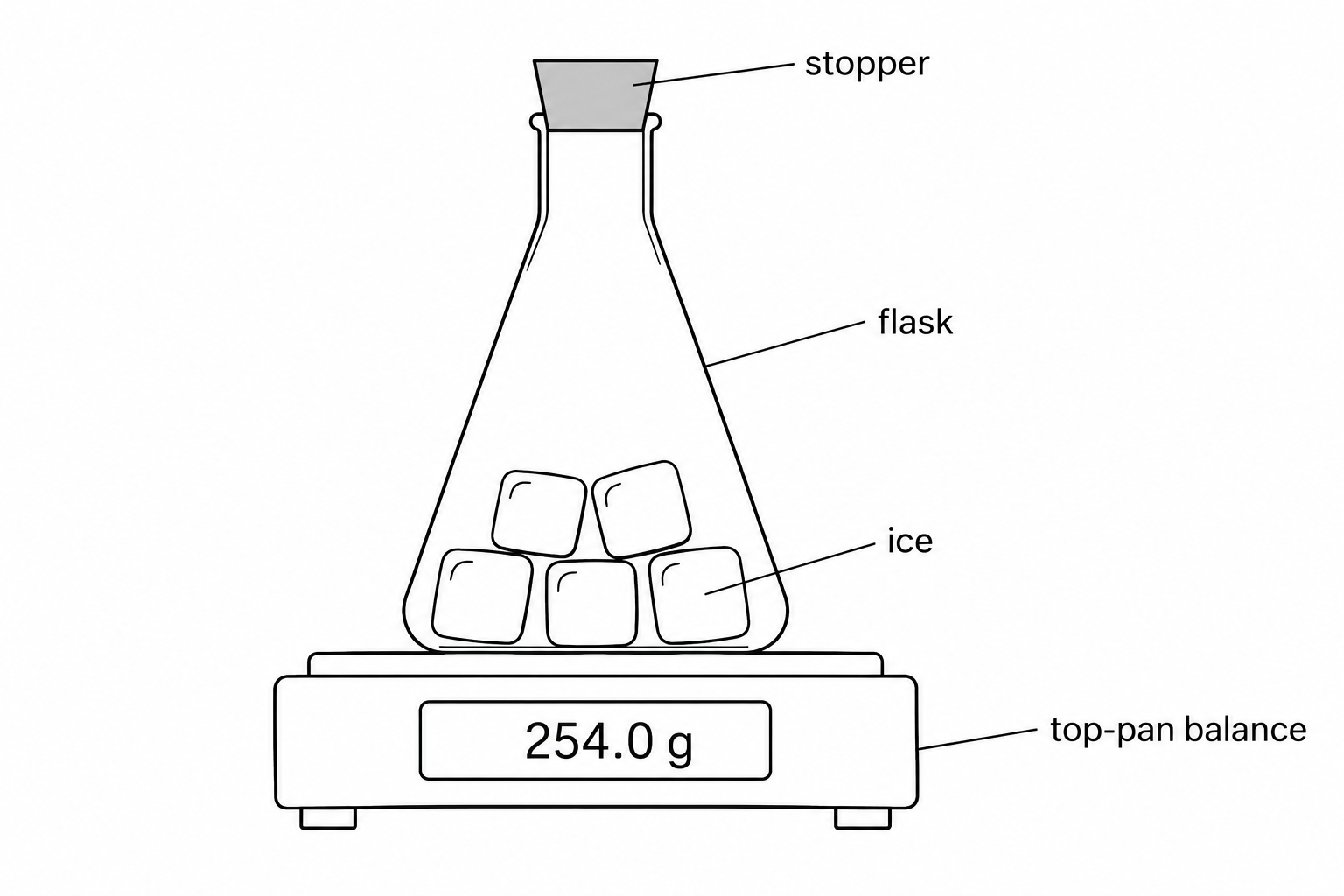
a.[2]
After one hour, all the ice in the flask has melted.
State the reading on the balance.
Give a reason for your answer.
b.[1]
The student then heats an open beaker of water until it boils.
The mass of the beaker and water falls from 312.0 g to 287.0 g.
Calculate the mass of water that turned into steam.
c.[2]
The student says:
'Boiling destroys some of the water.'
Explain why the student is wrong.
d.[2]
Melting ice is a physical change. Burning magnesium in air is a chemical change.
Explain one way a physical change is different from a chemical change.
e.[2]
The student repeats the experiment in (a) in a warm, humid room. Water droplets form on the outside of the cold flask.
Explain the effect of the droplets on the reading on the balance.
14.1 Density and states of matter Questions
87 exam-style questions on Edexcel GCSE Physics 14.1 Density and states of matter, covering 14.1.1 Kinetic theory and states of matter, 14.1.2 Density, and 14.1.3 Density and changes of state. Each one has a worked solution and a mark scheme showing where the marks go.