Current in a series circuit
Definition
Conservation of charge
Conservation of charge is the rule that charge is never created or destroyed in a circuit, so the total current entering a junction equals the total current leaving it.
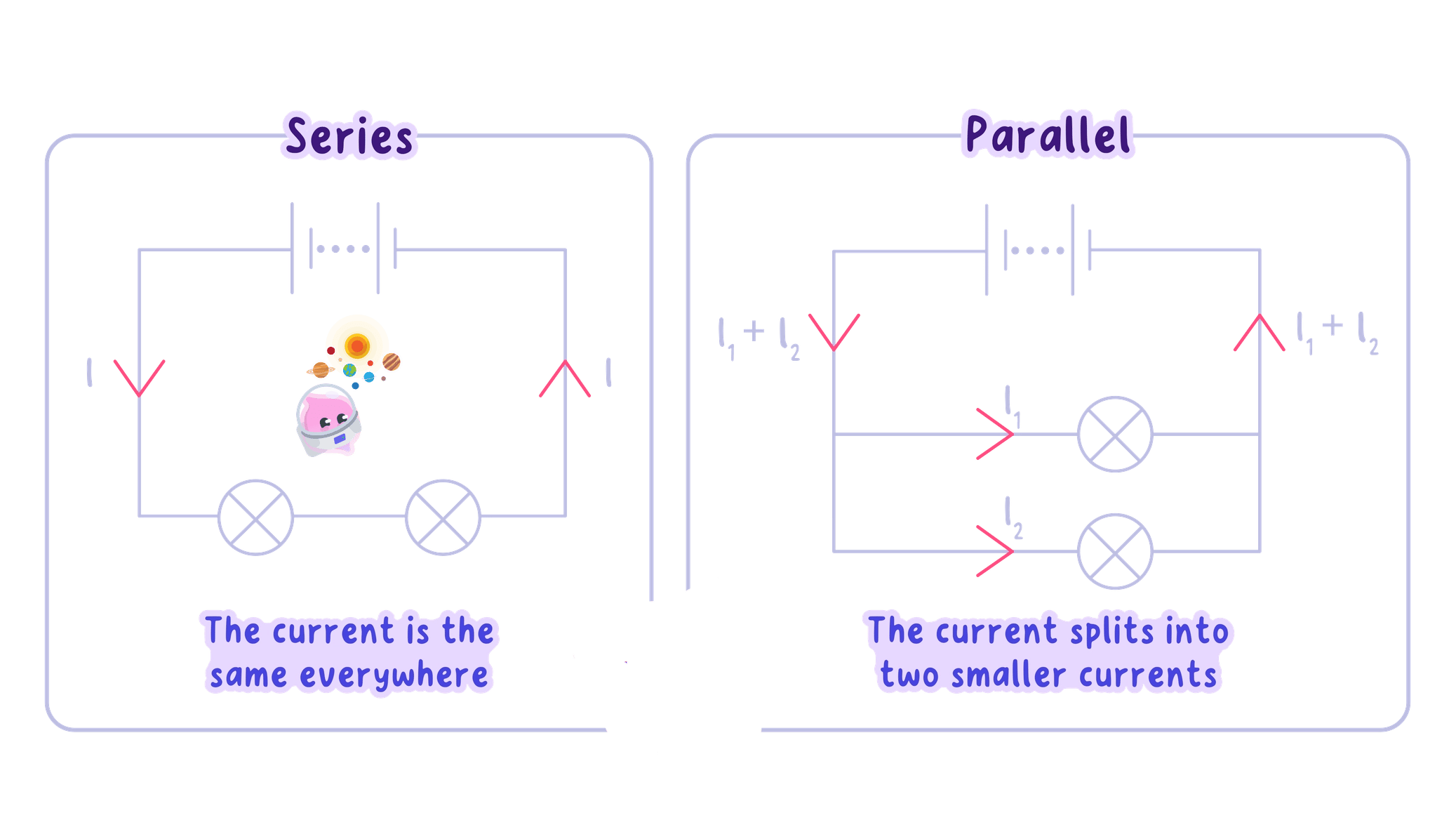
- A series circuit is a single loop, so there is only one path available and every charge carrier that leaves the supply must travel through every component in turn.
- Current is the rate at which charge passes a point in the circuit, and in a metal wire the moving charge is the delocalised electrons.
- Charge cannot leak out through the insulation of a wire, and it cannot pile up inside a wire or inside a component, because charge is conserved.
- Every coulomb of charge that passes one point in the loop must therefore pass every other point in the same loop, so the current is the same at every point in a series circuit.
- Edexcel answers earn credit for the reason as well as the statement, so the wording to use is that the current is the same everywhere because charge is conserved and cannot be used up.
- A component does not use up current. A filament lamp takes energy from the charge passing through it, which is why there is a potential difference across the lamp, but exactly as many electrons leave the lamp each second as enter it.
- An ammeter gives the same reading wherever it is placed in a series loop, so a meter reading 0.25 A0.25\ \text{A}0.25 A before a lamp will still read 0.25 A0.25\ \text{A}0.25 A after that lamp.
Key Idea
The current is the same at every point in a series circuit because charge is conserved: it is not created, destroyed or stored anywhere in the loop.
Junctions in a circuit
Definition
Junction
A junction is a point in a circuit where three or more wires meet, so the path for the charge either divides or joins together again.
- A junction is a point where three or more wires meet, so a single path divides into branches or several branches combine into one.
- Charge arriving at a junction has nowhere to collect, because a wire and a junction cannot store charge.
- The total current into a junction is equal to the total current out of it, and this statement is called the junction rule.
- Written with symbols the rule is Iin=IoutI_{\text{in}}=I_{\text{out}}Iin=Iout, so a current III that divides into two branch currents obeys I=I1+I2I=I_{1}+I_{2}I=I1+I2.
- The rule is a direct consequence of the conservation of charge, since no charge is created or destroyed at the meeting point.
- The rule works in both directions, so where two branches rejoin, the currents add again to give I1+I2=II_{1}+I_{2}=II1+I2=I in the wire returning to the supply.
Example
Currents at a junction
- A wire carries a current of 0.90 A0.90\ \text{A}0.90 A into a junction, and three branches lead away from it. Two of the branch ammeters read 0.30 A0.30\ \text{A}0.30 A and 0.25 A0.25\ \text{A}0.25 A, and the third branch current I3I_{3}I3 is unknown.
- The junction rule states Iin=IoutI_{\text{in}}=I_{\text{out}}Iin=Iout, which gives 0.90=0.30+0.25+I30.90=0.30+0.25+I_{3}0.90=0.30+0.25+I3.
- Rearranging for the unknown gives I3=0.90−0.30−0.25I_{3}=0.90-0.30-0.25I3=0.90−0.30−0.25.
- Substitution gives I3=0.35 AI_{3}=0.35\ \text{A}I3=0.35 A.
- The ammeter in the third branch therefore reads 0.35 A0.35\ \text{A}0.35 A.
Current in parallel branches
- In a parallel circuit the charge leaving the supply reaches a junction and divides between the branches, with each branch taking a share of the total.
- The shares recombine at the junction on the far side of the branches, and the recombined current returns to the supply.
- The branch currents add to give the total, so Itotal=I1+I2+…I_{\text{total}}=I_{1}+I_{2}+\dotsItotal=I1+I2+… for any number of branches.
- An ammeter placed in the main branch, between the supply and the first junction, reads ItotalI_{\text{total}}Itotal.
- An ammeter moved into one branch reads only that branch's current, which is always smaller than the main-branch reading whenever more than one branch is connected.
- Each branch is itself a small series path, so two ammeters placed on either side of the same lamp within one branch give identical readings.
- For example, if two branches carry 0.40 A0.40\ \text{A}0.40 A and 0.60 A0.60\ \text{A}0.60 A, then the main branch carries Itotal=0.40+0.60=1.00 AI_{\text{total}}=0.40+0.60=1.00\ \text{A}Itotal=0.40+0.60=1.00 A.
Unequal branches
- The current only divides equally between parallel branches when the branches are identical, which is not the general case.
- Every branch of a parallel section has the same potential difference across it, equal to the potential difference of the supply.
- With the same potential difference across each branch, I=VRI=\dfrac{V}{R}I=RV shows that a branch's current is fixed by that branch's own resistance and by nothing else.
- The branch of lower resistance therefore carries the larger current, and the branch of higher resistance carries the smaller current.
- With a 12 V12\ \text{V}12 V supply, a branch of resistance 6 Ω6\ \Omega6 Ω carries I=126=2.0 AI=\dfrac{12}{6}=2.0\ \text{A}I=612=2.0 A while a branch of resistance 24 Ω24\ \Omega24 Ω carries I=1224=0.50 AI=\dfrac{12}{24}=0.50\ \text{A}I=2412=0.50 A, giving Itotal=2.5 AI_{\text{total}}=2.5\ \text{A}Itotal=2.5 A.
- Three identical lamps in parallel across one supply each carry one third of the main-branch current, so a main-branch reading of 0.60 A0.60\ \text{A}0.60 A means 0.20 A0.20\ \text{A}0.20 A in each branch.
- A break in one branch stops the current in that branch alone. The surviving branches keep exactly the current they had, and the junction rule then gives a smaller total current in the main branch.
Common Mistake
- Do not write that a component uses up current, because the same charge per second leaves a lamp as enters it.
- Do not assume the current splits equally at a junction, since equal shares only occur when the branches have equal resistance.
- Do not add readings together for components in series, because a single loop has one path and therefore one current.
- Do not treat a branch ammeter reading as the total, as only a meter in the main branch reads ItotalI_{\text{total}}Itotal.
Predicting ammeter readings
- Mark every junction on the diagram with a dot, then write on each current that is already known together with an arrow showing its direction.
- Fill in any series section next, because one reading in a series section fixes every other reading in that same section.
- At a junction with one unknown, subtract the known outgoing currents from the incoming current, or add the branch currents to find the incoming one.
- Quote each reading to the resolution of the meter, so a meter reading to the nearest 0.01 A0.01\ \text{A}0.01 A gives an answer such as 0.35 A0.35\ \text{A}0.35 A rather than 0.4 A0.4\ \text{A}0.4 A.
- Finish by checking that the junction rule balances at every junction in the circuit, not only at the one used to find the unknown.
Exam technique
Answering current questions
- State the rule being used before any numbers appear, such as that the current is the same at every point in a series loop.
- Give the reason as well as the statement, because the mark for the explanation sits on conservation of charge.
- Convert milliamps to amps before adding branch currents, so 250 mA250\ \text{mA}250 mA is written as 0.250 A0.250\ \text{A}0.250 A.
- Say which ammeter a value belongs to, since a main-branch reading and a branch reading are different quantities.
- When asked to compare branches, name the resistance of each branch as the cause of the difference in current.
Self review
- State what happens to the current at each point in a series circuit and give the reason.
- State the junction rule in words and in symbols.
- A main branch carries 1.20 A1.20\ \text{A}1.20 A into two branches, one of which carries 0.45 A0.45\ \text{A}0.45 A. Find the other branch current.
- Explain why the branch with the lower resistance carries the larger current.
- Explain what happens to the current in the remaining branches when one parallel branch breaks.
