Question 51
FA student uses a falling mass to pull a trolley along a level bench.
The Figure shows the apparatus.
Figure
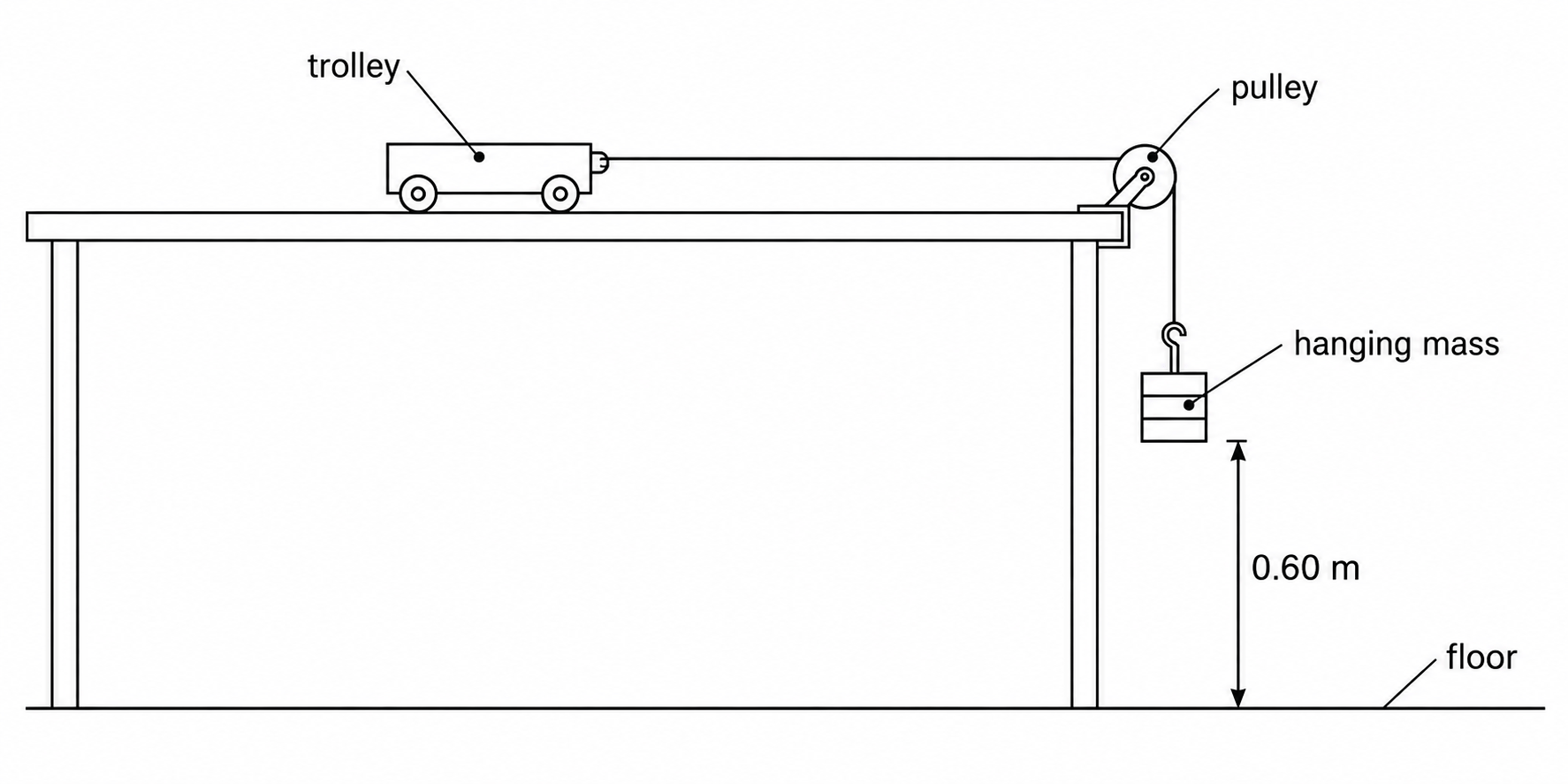
The trolley starts from rest. The hanging mass falls 0.60 m before it hits the floor.
The mass of the hanging mass is 0.20 kg. The mass of the trolley is 0.80 kg.
Gravitational field strength (ggg) = 10 N/kg
a.[2]
Calculate the decrease in gravitational potential energy of the hanging mass as it falls 0.60 m.
b.[3]
Just before the hanging mass hits the floor, the trolley and the hanging mass are both moving at 1.2 m/s.
Calculate the total kinetic energy of the trolley and the hanging mass at this moment.
c.[2]
Explain why the total kinetic energy is less than the decrease in gravitational potential energy.
d.[3]
Show that, if no energy were dissipated, the speed of the trolley just before the hanging mass hits the floor would be about 1.5 m/s.