11.1.1 Charging insulators by friction
Charge, insulators and static electricity
Electric charge
Electric charge is a property of particles such as protons and electrons that makes them attract or repel one another, measured in coulombs.
Electrical insulator
An electrical insulator is a material with almost no free charges, so it does not allow a current to flow through it.
Static electricity
Static electricity is electric charge that has built up on an object and stays in place instead of flowing away.
- Every atom contains protons, which carry positive charge, electrons, which carry negative charge, and neutrons, which carry no charge at all.
- Charge is measured in coulombs, symbol C\text{C}C, and one proton and one electron carry equal amounts of charge with opposite signs.
- An atom with as many electrons as protons is neutral, so an object built from neutral atoms has no overall charge.
- Electrons sit in the outer parts of an atom and some of them can be pulled away, while protons are locked inside the nucleus and never leave during charging.
- Only electrons move, so every explanation of static electricity is written in terms of electron transfer and never in terms of moving protons.
- In an insulator such as polythene, perspex, rubber, nylon or dry hair there are almost no free charges, so charge that arrives at one part of the surface stays at that part.
- Charge trapped in this way is static electricity, and it is why an insulator can stay charged for many seconds after it has been rubbed.
- A metal held in your bare hand never appears charged, because a metal is a conductor and any charge given to it flows away through your body.
Charging by friction
Charging by friction
Charging by friction is the transfer of electrons between two insulating materials that are rubbed together, leaving one negatively charged and the other with an equal positive charge.
- Two insulating surfaces touch only at a small number of high points, and rubbing them together repeats that close contact thousands of times.
- At each contact, electrons on the surface of one material are held less tightly than the atoms of the other material would hold them, so those electrons are transferred across.
- Rubbing supplies the energy needed to pull the electrons away from one surface, but it does not make any new charge.
- The transfer always runs the same way for a given pair of materials, so the same pair always ends up charged the same way round.
- A polythene rod rubbed with a woollen duster gains electrons, so the rod becomes negatively charged and the duster is left positively charged.
- A perspex or acetate rod rubbed with the same duster loses electrons, so the rod becomes positively charged and the duster is left negatively charged.
- Which material becomes negative depends only on the pair chosen, which is why a question always tells you the materials or tells you the final charge on one of them.
- Rubbing harder or for longer transfers more electrons, so the charge on the rod is larger, although the sign of that charge does not change.
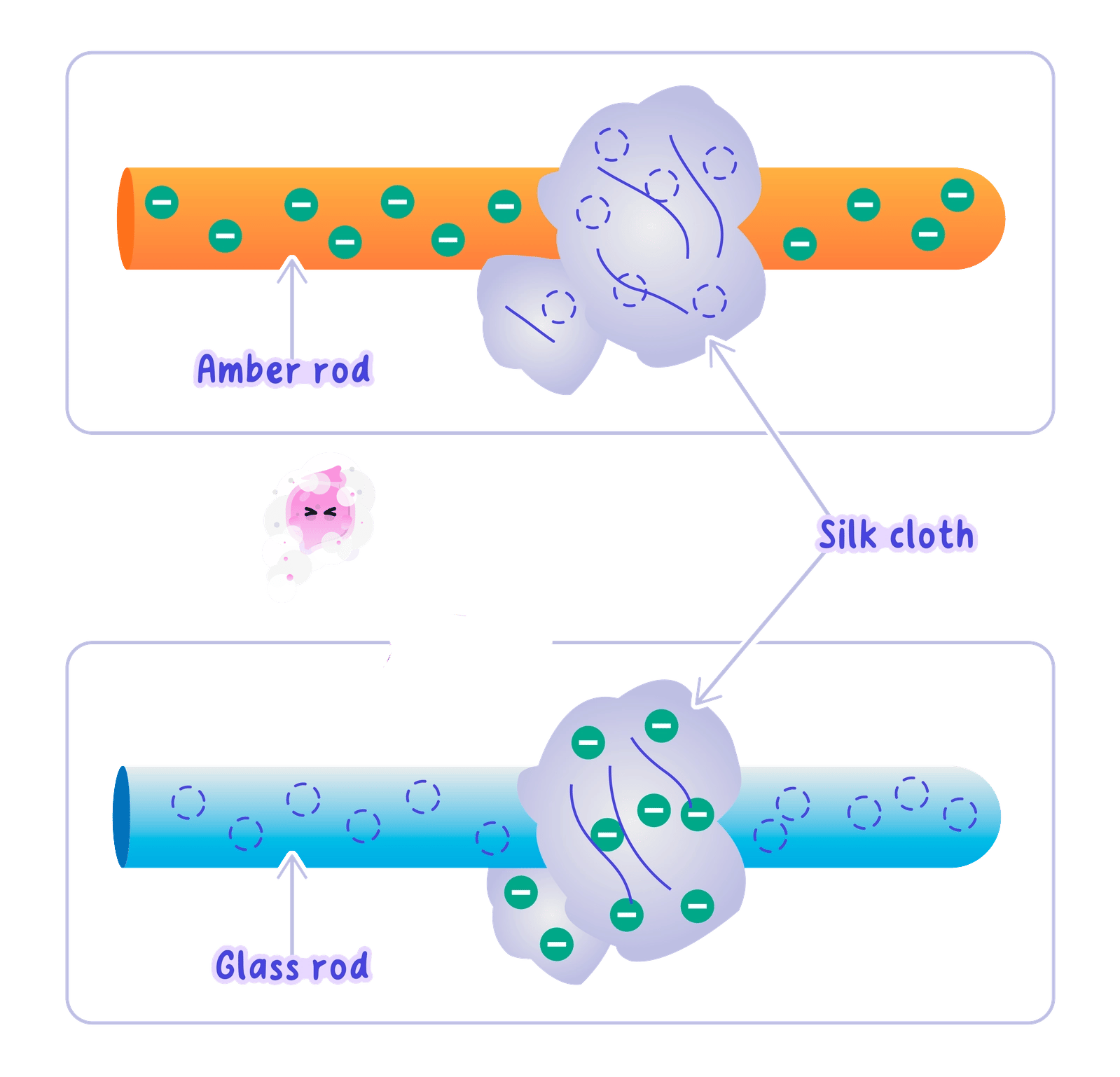
Charging insulating rods by friction
- Aim: to charge insulating rods by friction and show that the rod and the duster end up with equal and opposite charges.
- Apparatus: polythene rod, perspex or acetate rod, woollen duster or dry paper towel, coulombmeter with a metal collecting plate, insulating stand for the plate, connecting lead to earth the plate, dry cloth, and a dry, warm room.
- Variables: the material being rubbed is the independent variable, the sign and size of the charge measured is the dependent variable, and the duster, the number and firmness of strokes, the length of rod rubbed and the room conditions are controlled.
- Method, set-up:
- Wipe both rods, the duster and the collecting plate with a dry cloth, because a film of moisture on a surface conducts charge away.
- Connect the coulombmeter to the metal collecting plate and set it to its most sensitive range, in nanocoulombs.
- Zero the coulombmeter, then touch the plate briefly to an earthed point so it starts each test uncharged.
- Decide in advance how the rods will be rubbed, for example ten firm strokes along the last 10 cm10\ \text{cm}10 cm of the rod, and keep to that every time.
- Method, charging and measuring the rod:
- Hold the polythene rod at one end and rub the other end with the duster, using the agreed number of strokes, and keep your fingers off the rubbed end.
- Hold the rubbed end just above the collecting plate without touching it, and read the sign and size of the charge.
- Record the reading straight away, because charge leaks from the rod within a few seconds.
- Earth the plate, rezero the meter, recharge the rod and repeat twice more, then take a mean of the three readings.
- Repeat the whole sequence with the perspex rod, using the same duster and the same number of strokes.
- Method, measuring the duster:
- Recharge the polythene rod with the duster, then put the rod down without touching its rubbed end.
- Hold the duster just above the earthed and rezeroed plate and read the sign and size of its charge.
- Repeat for the duster used on the perspex rod, so that both pairs of readings can be compared.
- Results: the polythene rod reads negative and its duster reads positive, while the perspex rod reads positive and its duster reads negative, and the two readings in each pair are close to equal in size.
- Processing: compare the mean magnitude of the charge on each rod with the mean magnitude on its duster, and compare the two signs. Readings that are equal in size and opposite in sign show that electrons have been transferred from one material to the other rather than created.
- Watch out: charge leaks away quickly in damp air, so take readings promptly and recharge often. Touching the rubbed end earths the charge through you. Leaving the plate charged from a previous test makes the next reading too large or too small, so earth and rezero every time. Rubbing with a different force each time changes the size of the charge, so the magnitudes only match closely when the routine is kept identical.
- Safety: low risk. Keep the charged rods away from faces and eyes, keep them well clear of mains sockets and sensitive electronics, and clear the bench so nothing can be knocked over.
Equal and opposite charges
- Before rubbing, both materials are neutral, so each holds as much negative charge as positive charge.
- Rubbing transfers a number of electrons off one material, and exactly that number of electrons arrives on the other material.
- The material that gains electrons now has more negative charge than positive charge, so its overall charge is negative.
- The material that loses electrons is left with more positive charge than negative charge, so its overall charge is positive.
- Because the electrons lost by one object are the same electrons gained by the other, the two charges are equal in size and opposite in sign.
- Calling the charge on one object −Q-Q−Q and the charge on the other +Q+Q+Q makes this clear, since (−Q)+(+Q)=0(-Q)+(+Q)=0(−Q)+(+Q)=0 and the pair together is still neutral.
- No charge has been made or destroyed anywhere in the process; charge has only been separated between the two objects.
- This is why a question that gives the charge on the rod as −6 nC-6\ \text{nC}−6 nC expects the charge on the cloth to be +6 nC+6\ \text{nC}+6 nC.
Charging a polythene rod
- A dry polythene rod is rubbed along one end with a woollen duster, and a charge detector shows the rod carries −4 nC-4\ \text{nC}−4 nC.
- The reading is negative because electrons have been transferred from the duster onto the rod.
- The rod now holds more electrons than it needs to balance its protons, so its overall charge is negative.
- The duster has lost exactly those electrons, so it is left with more positive charge than negative charge.
- The charge on the duster is therefore positive and equal in size, which is +4 nC+4\ \text{nC}+4 nC.
- Nothing was created: the 4 nC4\ \text{nC}4 nC of negative charge on the rod is the charge that used to be on the duster.
Writing a charge transfer answer
- Name the particle that moves. Write electrons, not protons and not simply charge.
- Give the direction of the transfer, for example from the duster to the rod, rather than saying that charge moves.
- Link the transfer to the sign in the same sentence: gaining electrons makes an object negative, losing electrons leaves it positive.
- Add that the two charges are equal in size and opposite in sign whenever the question mentions both objects.
- Use the names given in the question, such as rod and cloth, instead of writing “it”, so the examiner can see which object you mean.
- If a value is given for one object, quote the matching value for the other, such as −6 nC-6\ \text{nC}−6 nC and +6 nC+6\ \text{nC}+6 nC.
- Do not write that protons move between the materials, because protons are held in the nucleus and stay where they are.
- Do not write that friction creates or makes charge, because rubbing only separates charge that was already present.
- Do not give both objects the same sign of charge, because the object that gains electrons and the object that loses them always end up with opposite signs.
- Do not describe an object as having gained protons when it becomes positive, because it has lost electrons instead.
- Do not try to charge a metal rod held in your bare hand by rubbing it, because the charge flows away through you as fast as it is produced.
- Name the only particle that is transferred when an insulator is charged by friction.
- Explain why a polythene rod rubbed with a woollen duster becomes negatively charged.
- Explain why the duster is left with a positive charge of exactly the same size.
- Explain why charge stays where it is placed on an insulator but not on a metal rod held in the hand.
- Describe how you would use a coulombmeter to show that a rod and the duster used to charge it carry opposite charges.
11.1.2 Forces between charges
Forces between charged objects
Electrostatic force
An electrostatic force is the non-contact force of attraction or repulsion that acts between charged objects.
Non-contact force
A non-contact force is a force that acts between two objects that are not touching, through a gravitational, electrostatic or magnetic field.
Like charges
Like charges are two charges of the same sign, either both positive or both negative.
Unlike charges
Unlike charges are two charges of opposite sign, one positive and one negative.
- Any two charged objects exert an electrostatic force on each other, even when there is a gap between them.
- The force is a non-contact force, so the objects do not have to be touching for it to act.
- The force acts on both objects at once, equal in size and opposite in direction, so a charged rod that pushes a charged balloon away is pushed away by the balloon just as hard.
- Whether that force is a push or a pull is decided only by the signs of the two charges.
- Like charges repel, so two positive charges are pushed apart and two negative charges are pushed apart.
- Unlike charges attract, so a positive charge and a negative charge are pulled together.
- The rule works either way round: a negative charge next to a positive charge attracts in exactly the same way as a positive charge next to a negative one.
- Repel means the force pushes the objects apart, and attract means the force pulls them towards each other, so an answer must name one of these rather than just saying that a force acts.
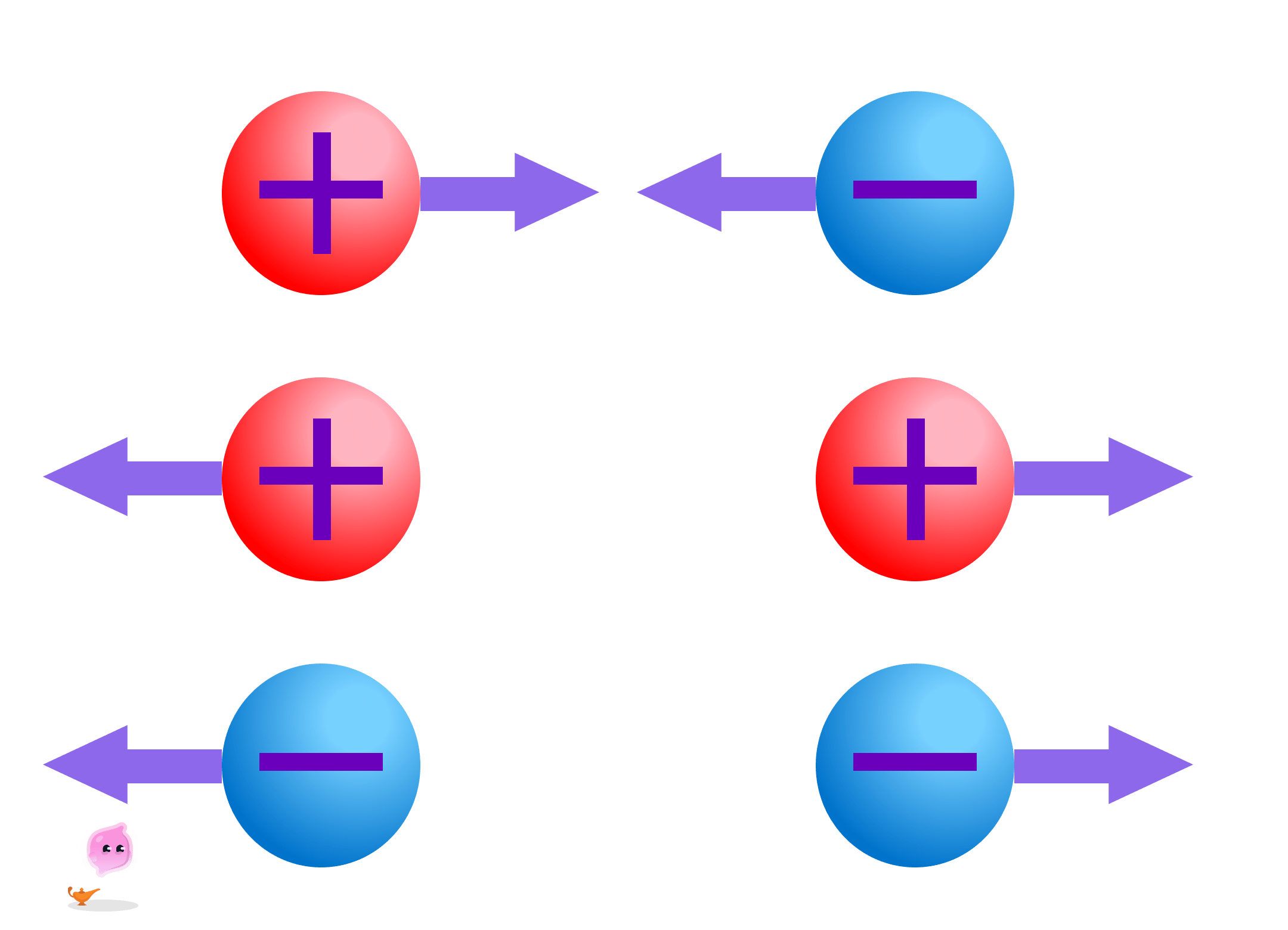
What changes the size of the force
- The sign of each charge decides the direction of the force, while the size of each charge and the separation between the objects decide how large that force is.
- Increasing the charge on either object increases the force, which is why a rod that has been rubbed for longer makes a suspended rod swing further.
- Increasing the separation decreases the force, which is why a charged rod has no measurable effect from the far side of the bench.
- The decrease with separation is steep, so halving the gap between two charged objects makes a much larger difference than doubling one of the charges.
- Both objects always feel the same size of force, even when one of them carries far more charge than the other.
- At this level you are asked to state the direction of the force and whether it becomes larger or smaller, rather than to calculate a value in newtons.
Using the rule to work out charges
- Repulsion is the reliable test for charge, because only two charged objects can push each other apart.
- If two suspended objects move apart when brought close, both must be charged and both charges must have the same sign.
- If two charged objects move together, their charges must have opposite signs.
- Attraction on its own does not prove that both objects are charged, because a charged object can also attract an object that carries no overall charge.
- Two rods of the same material, rubbed with the same cloth in the same way, always repel each other, because identical treatment gives them the same sign of charge.
- A rod that repels a known negative rod must itself be negative, and a rod that attracts it must be positive, so a rod of known charge can be used to identify an unknown one.
Predicting attraction and repulsion
- Sphere A carries a charge of +3 nC+3\ \text{nC}+3 nC and sphere B carries a charge of +8 nC+8\ \text{nC}+8 nC.
- Both charges have the same sign, so A and B are like charges.
- Like charges repel, so each sphere is pushed away from the other.
- Sphere B is now replaced by a sphere carrying −8 nC-8\ \text{nC}−8 nC.
- The two charges now have opposite signs, so they are unlike charges and the spheres attract.
- In both cases the force on A is the same size as the force on B, even though the two charges are different sizes.
- Moving the spheres from 10 cm10\ \text{cm}10 cm apart to 5 cm5\ \text{cm}5 cm apart leaves the direction unchanged but makes both forces much larger.
Stating and explaining the force
- Give the effect first: write attract or repel, because “there is a force” does not say which.
- Add the reason using the phrase like charges or unlike charges whenever the command word is explain.
- Name the two objects, since “they repel” leaves the examiner to guess which pair you mean.
- If the question provides a diagram, draw a force arrow on each object, pointing apart for repulsion and towards each other for attraction.
- Do not describe the movement in place of the force; saying the rod swings away earns nothing unless you also state that the rods repel.
- For a one-mark question the single word attract or repel is often enough, so save the full explanation for questions that ask for one.
- Do not assume that any two charged objects attract, because two charges of the same sign always repel.
- Do not reverse the rule; like charges never attract and unlike charges never repel.
- Do not use attraction on its own as proof that an object is charged, because an uncharged object can be attracted as well.
- Do not confuse the sign of a charge with its size, because only the signs decide whether the force is a push or a pull.
- Do not say that the larger charge feels the larger force, because the two forces are always equal in size.
- State what happens when two negatively charged spheres are brought close together.
- State what happens when a positively charged sphere is brought close to a negatively charged sphere.
- Explain why repulsion is a more reliable test for charge than attraction.
- Describe how the size of the electrostatic force changes as two charged objects are moved further apart.
- Two identical rods are rubbed with the same cloth in the same way. Explain whether they attract or repel.
11.1.3 Electrostatic phenomena
One cause behind every static effect
Electrostatic discharge
An electrostatic discharge is the sudden movement of electrons that removes a build-up of static charge from an object.
Induced charge separation
Induced charge separation is the small shift of electrons inside a neutral object when a charged object is brought close to it, making one side of the object negative and the other side positive while it stays neutral overall.
- Every effect in this topic comes from the same cause: electrons have moved, either from one object to another or from one side of an object to the other.
- When electrons move between objects, one object is left negative and the other positive, so the two objects can then attract or repel.
- When electrons only shift within an object, the object stays neutral overall but one side becomes negative and the other becomes positive.
- Charge that has built up on an insulator has no easy path away, so it stays there until something provides one.
- When a path does appear, the charge moves all at once rather than gradually, and this electrostatic discharge is felt as a shock or seen as a flash.
- The size of the effect depends on how much charge has built up, which is why static effects are strongest in dry air and on good insulators.
Shocks from everyday objects
- Walking across a nylon carpet rubs your shoe soles against the carpet fibres, so electrons are transferred between them.
- Your body ends up with an overall charge, and because your shoes and clothing are insulators that charge cannot flow away to the ground.
- The charge keeps building as you walk, so the potential difference between you and any earthed metal object grows steadily.
- Reaching for an earthed metal door handle gives the excess electrons a conducting path, so they move very quickly indeed.
- That rapid movement of electrons is a brief current through your fingertip, and the nerve endings in your skin register it as a sharp shock.
- If the charge is large enough, the electrons cross the last few millimetres of air before you touch the metal, which gives a small spark and an audible click.
- The direction the electrons move depends on the sign of your charge: they flow from you to the handle if you are negative, and from the handle to you if you are positive.
- The same sequence explains the crackle heard when a jumper is pulled off over the head, and the shock felt when sliding off a car seat and touching the door frame.
- Shocks are worse in winter, because cold indoor air holds little moisture and a dry surface lets less charge leak away as it builds up.
Lightning
- Inside a thundercloud, powerful updraughts carry water droplets, hail and ice crystals rapidly past one another.
- Collisions between these particles transfer electrons from one particle to another, so charge becomes separated within the cloud.
- The heavier particles that fall tend to carry negative charge downwards, so the base of the cloud becomes negatively charged while the top is left positively charged.
- The negatively charged cloud base repels electrons in the ground below it, so the ground surface is left positively charged.
- The charge continues to build up because both the cloud and the air beneath it are very poor conductors.
- The potential difference between the cloud base and the ground therefore rises to many millions of volts.
- Once the build-up is large enough, electrons are driven suddenly through the air along a narrow channel between the cloud and the ground.
- This very large electrostatic discharge is the lightning stroke, and all of that charge moves in a small fraction of a second.
- The moving charge heats the air in the channel until it glows brightly, which is the flash that is seen.
- The same heating makes the air expand explosively, and the shock wave that spreads out from the channel is heard as thunder.
- Discharges also occur between the negative base and the positive top of the same cloud, which is why some lightning is seen inside clouds and never reaches the ground.
Attraction by induction
- A neutral object holds equal amounts of positive and negative charge, so it has no overall charge.
- Bringing a charged object close does not add any charge to the neutral object, but it does make the electrons inside it shift position slightly.
- If the charged object is negative, it repels electrons in the neutral object, and those electrons move to the far side.
- The near side of the neutral object is then short of electrons, so it becomes slightly positive.
- The near positive side is closer to the negative object than the far negative side is, and the electrostatic force is larger over a shorter distance.
- The attraction from the near side therefore beats the repulsion from the far side, and the overall result is attraction.
- If the charged object is positive, electrons in the neutral object are pulled towards it instead, so the near side becomes slightly negative and the object is attracted again.
- This is why a charged object attracts a neutral object whichever sign of charge the charged object carries.
- The shift of charge inside the neutral object is induced charge separation, and it disappears as soon as the charged object is taken away.
- A balloon rubbed on a jumper and held against a wall causes this separation in the wall surface, and the resulting attraction is strong enough to hold the balloon up against its weight.
- A comb rubbed through dry hair picks up small pieces of paper for the same reason: the side of each piece nearest the comb gains the opposite charge and is pulled towards it.
- The pieces of paper have to be small, because the electrostatic force here is only a fraction of a newton and can lift only a very small weight.
- Paper sometimes jumps off the comb again shortly after touching it, because electrons transfer on contact and the paper is then left with the same sign of charge as the comb, so it is repelled.
A balloon held on a wall
- A balloon is rubbed on a woollen jumper, gains electrons and becomes negatively charged.
- Held against a plaster wall, the negative balloon repels electrons in the surface layer of the wall.
- Those electrons move a short distance further into the wall, so the surface nearest the balloon is left positively charged.
- The balloon and the wall surface now carry unlike charges, so they attract each other.
- The attraction presses the balloon against the wall, and the friction this creates supports the weight of the balloon so it stays in place.
- The wall is still neutral overall, because no charge has entered it or left it; the charge inside it has only been separated.
Explaining a static effect
- Begin with the electrons, saying whether they are transferred between objects or shifted within a single object.
- State which object, or which side of an object, gains electrons and which loses them, then give the sign of charge that results.
- Finish with the observation the question is about, such as the shock, the flash, the click, or the paper being lifted.
- For attraction of a neutral object, the marks depend on saying that the near side gains the opposite charge, not just that the charges move.
- For lightning, describe both stages: charge separates inside the cloud, and then charge moves suddenly through the air.
- Say that the neutral object stays neutral overall, because examiners look for that detail in the better answers.
- Do not write that positive electrons move, because electrons always carry negative charge.
- Do not say that a neutral object becomes charged during attraction by induction, because it stays neutral overall.
- Do not explain a shock by writing only that static builds up, because the mark is for the sudden movement of electrons through a conducting path.
- Do not describe lightning as protons falling out of a cloud, because the particles that move are electrons.
- Do not say that the charged comb has to touch the paper to charge it, because the paper is attracted before any contact is made.
- Name the particle whose movement explains every effect in this topic.
- Describe the sequence of events that gives you a shock when you touch an earthed metal door handle.
- Explain how charge becomes separated inside a thundercloud.
- Explain why a charged comb attracts a small piece of paper that carries no overall charge.
- Explain why the wall remains neutral overall even though it attracts a charged balloon.
11.1.4 Earthing and removing charge
Earthing needs a conducting path
Earthing
Earthing is connecting a charged object to the earth through a conductor so that electrons flow and the excess charge is removed.
Electrical conductor
An electrical conductor is a material containing charges that are free to move, so it allows a current to flow through it.
- A charged object has an imbalance of electrons: either more electrons than it needs to be neutral, or fewer.
- The positive charge in a solid sits in the protons inside atomic nuclei, and those nuclei are fixed in the structure of the material.
- The only charge that can travel through a solid is therefore the electrons, so every explanation of earthing is written in terms of electron flow.
- The earth acts as an enormous reservoir of charge: it can accept or supply huge numbers of electrons without its own charge changing noticeably.
- Earthing removes excess charge only if a conductor joins the object to the ground, because electrons need free charges in order to move.
- A copper wire, a metal chain, a metal water pipe or a person's body all provide such a path, while dry plastic, rubber or glass does not.
- Once the path exists, electrons flow until the object has no excess charge left, and the flow then stops on its own.
- The object is now neutral, which means the number of electrons again balances the number of protons.
Earthing a negatively charged object
- A negatively charged object has gained electrons, so it holds more electrons than it needs to balance its protons.
- Connecting it to earth through a conductor gives those extra electrons a route away from the object.
- The extra electrons repel one another, so they flow from the object to the earth.
- As they leave, the amount of negative charge on the object falls.
- The flow stops when the electrons again balance the protons, so the object ends up neutral.
- The electrons have not been destroyed; they are now spread through the earth, where the effect of adding them is far too small to measure.
Earthing a positively charged object
- A positively charged object has lost electrons, so it holds fewer electrons than it needs to balance its protons.
- It does not have extra protons, and no protons move at any stage.
- Connecting it to earth lets electrons flow from the earth to the object.
- Each electron that arrives cancels part of the positive charge, because it replaces a missing electron.
- The flow stops once enough electrons have arrived for the object to be neutral.
- Electrons therefore flow towards a positive object and away from a negative one, so you must state the sign of the charge before you state the direction of flow.
Earthing a charged metal sphere
- A metal sphere on an insulating stand is given a charge of +12 nC+12\ \text{nC}+12 nC.
- The sphere is positive because electrons have been removed from it, leaving it short of electrons.
- A copper wire is then connected between the sphere and an earthed metal water pipe.
- Electrons flow from the earth, along the copper wire, and onto the sphere.
- The flow continues until the sphere has no excess charge, so its charge falls from +12 nC+12\ \text{nC}+12 nC to 000.
- Had the sphere instead been charged to −12 nC-12\ \text{nC}−12 nC, electrons would have flowed along the same wire in the opposite direction, from the sphere to the earth.
Why insulators are harder to discharge
- Charge on an insulator cannot travel through the material, so touching an earthed wire to one point removes charge from that point only.
- The rest of the charge stays where it was placed, which is why a charged polythene rod is still charged after being held at one end.
- A conductor discharges completely and almost instantly when it is earthed, because its free electrons can move throughout the whole object.
- This difference is why a metal object held in the hand never appears charged, while a plastic one does.
- Charge does leak away slowly from an insulator in damp air, because a thin film of moisture on the surface behaves as a weak conductor.
- Warming and drying an insulator before charging it therefore makes static effects last longer and appear stronger.
Writing an earthing answer
- State the sign of the charge on the object first, and say whether it has too many or too few electrons.
- Say that a conductor connects the object to earth, because the conducting path is a marking point in its own right.
- Give the direction of electron flow explicitly, either from the object to earth or from earth to the object.
- Finish by stating that the object becomes neutral, or that the excess charge has been removed.
- Match the direction to the sign, since the most commonly dropped mark is giving the wrong direction of flow for a positively charged object.
- Avoid the phrase “charge flows to earth” on its own, because it does not say which particle moves or which way it goes.
- Do not write that protons or positive charges travel along the earthing wire, because they stay inside the nuclei.
- Do not say that the earth destroys the charge, because the electrons simply move to or from a very large object.
- Do not claim that electrons always flow to earth, because they flow from earth onto an object that is positively charged.
- Do not expect a whole insulator to discharge from a single point of contact, because charge cannot move through it.
- Do not describe a positively charged object as gaining protons when it is earthed, because it gains electrons instead.
- Define earthing.
- State which particle moves when an object is earthed, and explain why the other charged particles do not.
- Describe the direction of electron flow when a negatively charged object is earthed.
- Describe the direction of electron flow when a positively charged object is earthed.
- Explain why earthing one point on a charged plastic rod does not remove all of its charge.
