6.1.1 Structure of the atom
Atoms have a tiny, massive nucleus
Atom
The smallest particle of an element that can exist while retaining the properties of that element.
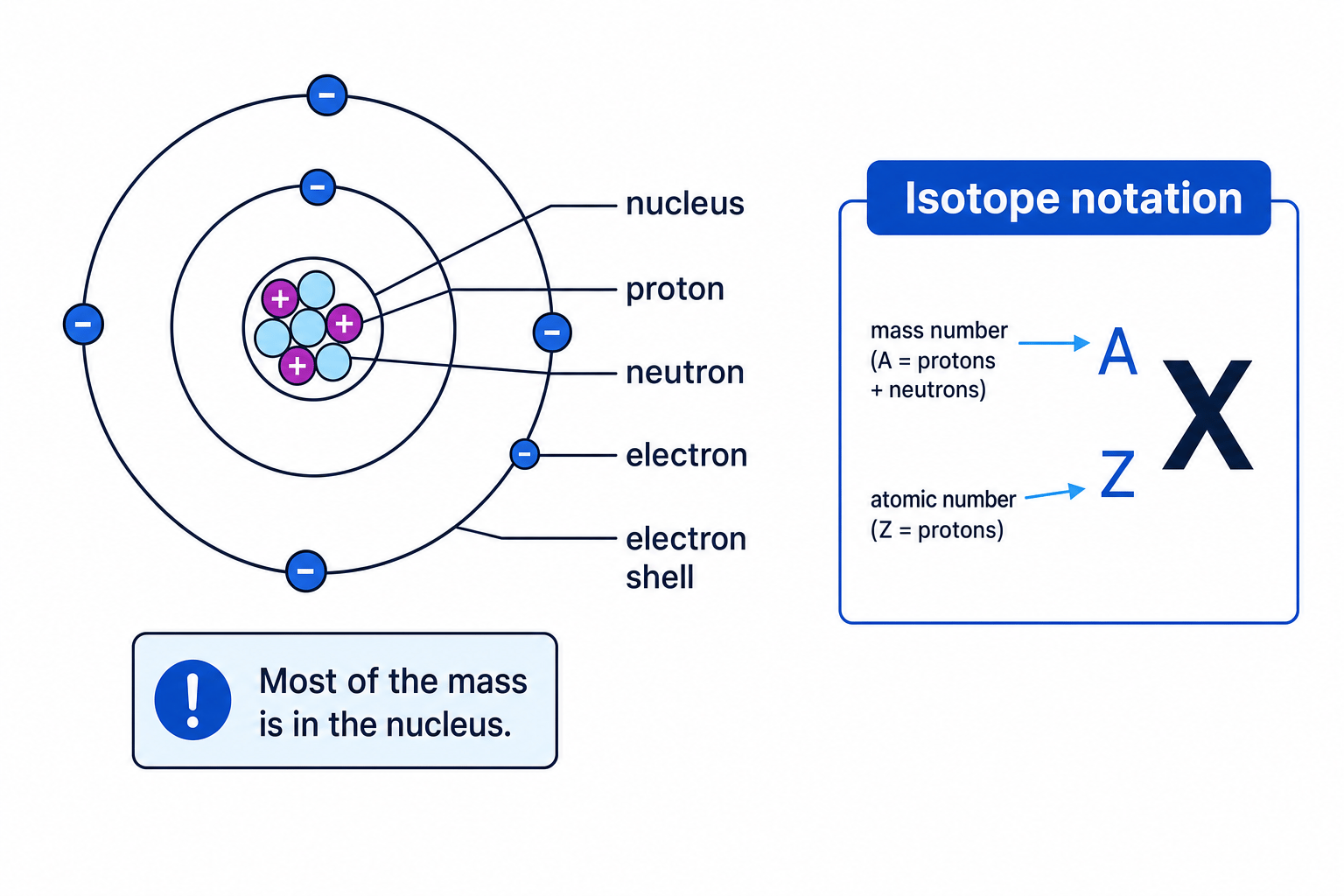
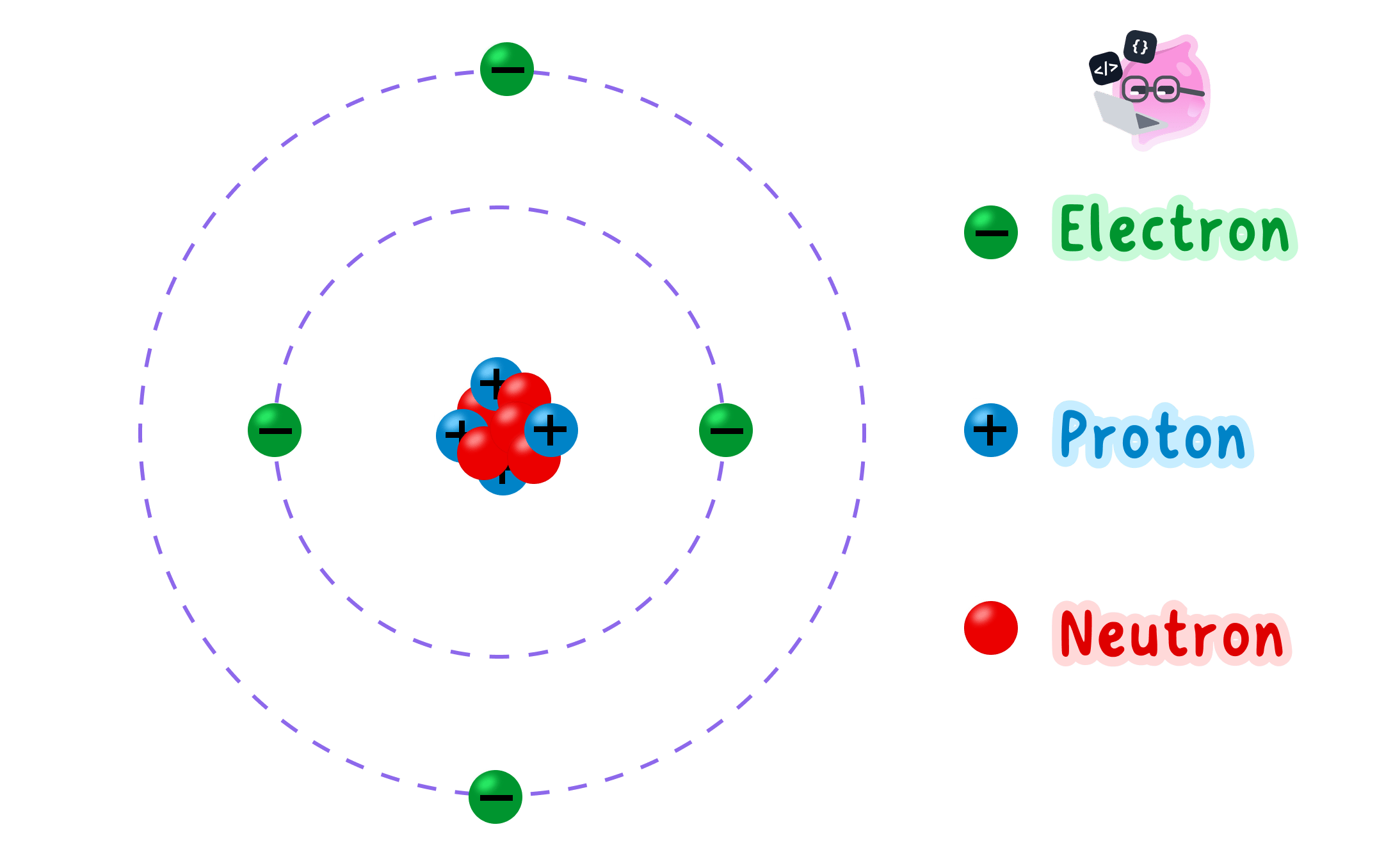
- An atom has a very small, positively charged nucleus at its centre.
- The nucleus contains protons and neutrons.
- Negatively charged electrons surround the nucleus at distances that determine the overall size of the atom.
- The positive charge of the nucleus comes from its protons because neutrons have no electric charge.
- Almost all the atom's mass is concentrated in the nucleus because protons and neutrons are far more massive than electrons.
- The nuclear radius is much smaller than the radius of the whole atom, so most of an atom's volume lies outside its nucleus.
- Do not write that the whole atom is positively charged; the nucleus is positive, while a neutral atom has equal positive and negative charge overall.
- Do not confuse mass with volume; the nucleus contains almost all the mass but occupies only a tiny fraction of the atom.
Atomic size is about one ten-billionth of a metre
Order of magnitude
The nearest power of ten used to show the approximate size of a quantity.
- The typical size of an atom or small molecule is of order 10−10 m10^{-10}\,\text{m}10−10m.
- This is 0.0000000001 m0.0000000001\,\text{m}0.0000000001m or 0.1 nm0.1\,\text{nm}0.1nm.
- An order of magnitude is an estimate, so different atoms do not all have exactly the same radius.
Converting atomic size to standard form
- Move the decimal point ten places to write 0.0000000001 m=1×10⁻¹⁰ m0.0000000001\,\text{m}=1\times10^{-10}\,\text{m}0.0000000001m=1×10⁻¹⁰m.
- The order of magnitude is therefore 10−10 m10^{-10}\,\text{m}10−10m.
A complete description links structure, charge and scale
- Name the nucleus and state that it contains protons and neutrons.
- State that negatively charged electrons surround the nucleus.
- Add that the nucleus is much smaller than the atom but contains almost all its mass.
Writing an atomic-structure answer
- Use nucleus, proton, neutron and electron precisely
- Keep the negative exponent in 10−10 m10^{-10}\,\text{m}10−10m because 1010 m10^{10}\,\text{m}1010m is twenty orders of magnitude larger.
- Which particles are found in the nucleus?
- Why is the nucleus positively charged?
- Where is almost all the mass of an atom?
- How does the nuclear radius compare with the atomic radius?
- What is the order of magnitude of the size of an atom?
6.1.2 Isotopes: atomic and mass number
Proton and mass numbers describe a nucleus
Atomic number
The number of protons in the nucleus of an atom.
- The atomic number, also called the proton number, identifies the element because every atom of one element has the same number of protons.
- A nucleus containing six protons is carbon, and its positive nuclear charge is +6+6+6 in relative units.
Mass number
The total number of protons and neutrons in the nucleus of an atom.
- The mass number, also called the nucleon number, counts all nucleons in the nucleus.
- The relationship is A=Z+NA=Z+NA=Z+N, where AAA is mass number, ZZZ is atomic number and NNN is number of neutrons.
- Rearranging gives N=A−ZN=A-ZN=A−Z.
Isotopes share protons but differ in neutrons
Isotopes
Atoms of the same element with the same number of protons but different numbers of neutrons.
- Isotopes have the same atomic number and the same positive nuclear charge because they contain the same number of protons.
- They have different mass numbers because their nuclei contain different numbers of neutrons.
- Changing the neutron number makes a different isotope, while changing the proton number makes a different element.
- Carbon-12 has six protons and six neutrons, while carbon-13 has six protons and seven neutrons.
- Do not say that isotopes have different proton numbers; atoms with different proton numbers are different elements.
- Do not use mass number as the number of neutrons; it is the total number of protons and neutrons.
Nuclear notation places both numbers on the left
- An isotope is written as ZAX{}^{A}_{Z}\mathrm{X}ZAX, where X\mathrm{X}X is the element symbol.
- The mass number AAA is the upper-left number and the atomic number ZZZ is the lower-left number.
- For carbon-13, 613C{}^{13}_{6}\mathrm{C}613C shows thirteen nucleons in total and six protons.
Reading a nuclear symbol
- For 1123Na{}^{23}_{11}\mathrm{Na}1123Na, the atomic number gives 111111 protons.
- The neutron number is N=A−Z=23−11=12N=A-Z=23-11=12N=A−Z=23−11=12.
- A neutral sodium-23 atom also has 111111 electrons.
Comparisons must name both similarities and differences
- Two nuclei are isotopes when their lower-left numbers are equal and their upper-left numbers are different.
- A full explanation states that they have the same number of protons but different numbers of neutrons.
Explaining isotope notation
- Read the lower-left number first to identify the element, then subtract it from the upper-left number to find the neutron number.
- When comparing isotopes, give both required links: same proton number and different neutron number.
- What does atomic number count?
- What does mass number count?
- How do you calculate neutron number?
- Why do isotopes have the same nuclear charge?
- What do AAA, ZZZ and X\mathrm{X}X represent in ZAX{}^{A}_{Z}\mathrm{X}ZAX?
6.1.3 Sub-atomic particles: masses and charges
Relative values compare particle mass and charge
Relative mass
The mass of a particle compared with the mass of a proton, which is assigned a value of 111.
Relative electric charge
The charge of a particle compared with the magnitude of a proton's charge, which is assigned a value of +1+1+1.
- A proton has relative mass 111 and a neutron has relative mass 111.
- An electron and a positron each have relative mass about 11840\dfrac{1}{1840}18401, so their contribution to atomic mass is very small.
- A proton has relative charge +1+1+1, a neutron has 000, an electron has −1-1−1 and a positron has +1+1+1.
- Relative mass and relative charge are ratios, so they have no units.
Each sub-atomic particle has a distinct combination
- Proton: relative mass 111, relative charge +1+1+1 and located in the nucleus.
- Neutron: relative mass 111, relative charge 000 and located in the nucleus.
- Electron: relative mass about 11840\dfrac{1}{1840}18401, relative charge −1-1−1 and found outside the nucleus.
- Positron: relative mass about 11840\dfrac{1}{1840}18401 and relative charge +1+1+1.
- A positron is the electron's antiparticle, so it has the same mass as an electron but the opposite charge.
- Do not confuse a positron with a proton; both have charge +1+1+1, but a positron has about 11840\dfrac{1}{1840}18401 of the proton's mass.
- Do not give relative mass or relative charge a unit because each value is a comparison.
Equal proton and electron numbers make an atom neutral
Neutral atom
An atom with no overall electric charge because it contains equal numbers of protons and electrons.
- Each proton contributes +1+1+1 and each electron contributes −1-1−1, so equal numbers give a total charge of 000.
- Neutrons do not affect overall charge because each neutron has relative charge 000.
- The total relative charge can be found from Q=Np−NeQ=N_{p}-N_{e}Q=Np−Ne, where NpN_pNp and NeN_eNe are the numbers of protons and electrons.
Calculating overall charge
- An atom with eleven protons and eleven electrons has Q=11−11=0Q=11-11=0Q=11−11=0, so it is neutral.
- If it loses one electron, Q=11−10=+1Q=11-10=+1Q=11−10=+1, so it becomes a positive ion.
Recalling particle properties
- Give both the relative mass and the relative charge when a question asks for particle properties.
- Use the exact particle name required; Edexcel distinguishes a proton, positron, electron and neutron.
- What are the relative mass and charge of a proton?
- What are the relative mass and charge of a neutron?
- How do an electron and a positron differ?
- Why is an atom neutral?
- Why do neutrons not affect an atom's overall charge?
6.1.4 Electron orbits and energy changes
Electrons occupy set orbits around the nucleus
Electron orbit
One of the allowed set distances from the nucleus at which an electron can exist.
- Electrons occupy orbits at set distances from the nucleus rather than any distance between them.
- An electron in an orbit farther from the nucleus has more energy than one in an orbit closer to the nucleus.
- A change of orbit requires a fixed energy transfer equal to the energy difference between the two orbits.
Absorption moves an electron farther out
Absorption
The transfer of energy from electromagnetic radiation to a material when the radiation is taken in rather than reflected or transmitted.
- When an atom absorbs electromagnetic radiation, energy is transferred to an electron.
- The electron gains energy and moves to an allowed orbit farther from the nucleus.
- The electron can make the change only when the absorbed radiation supplies the correct energy difference.
Emission moves an electron closer in
Emission
The transfer of energy away from an atom as electromagnetic radiation when an electron moves to an orbit closer to the nucleus.
- When an electron moves to an allowed orbit closer to the nucleus, it loses energy.
- The atom emits the energy difference as electromagnetic radiation.
- The electron remains in the atom after emission; it has changed orbit rather than being used up.
Following an electron transition
- An electron absorbs 4.0×10⁻¹⁹ J4.0\times10^{-19}\,\text{J}4.0×10⁻¹⁹J and moves to a higher-energy orbit.
- If it returns directly to its original orbit, the atom emits 4.0×10⁻¹⁹ J4.0\times10^{-19}\,\text{J}4.0×10⁻¹⁹J as electromagnetic radiation.
- If it returns in smaller steps, it emits radiation in more than one energy amount whose total is 4.0×10⁻¹⁹ J4.0\times10^{-19}\,\text{J}4.0×10⁻¹⁹J.
- Do not reverse the orbit changes; absorption moves an electron farther from the nucleus, while emission moves it closer.
- Do not say that the electron is emitted when the atom emits radiation; the electron stays in the atom.
Losing outer electrons forms a positive ion
Positive ion
An atom that has lost one or more electrons and therefore has more protons than electrons.
- Outer electrons can be removed from an atom, but the number of protons in the nucleus does not change.
- Losing a negatively charged electron leaves an excess of positive charge.
- If a neutral atom loses one electron, its relative charge becomes +1+1+1, and losing two electrons gives +2+2+2.
- Ion formation changes the number of electrons, not the identity of the element, because the proton number remains fixed.
Linking orbit changes to energy
- For absorption, state that the electron gains energy and moves farther from the nucleus.
- For emission, state that the electron moves closer to the nucleus and electromagnetic radiation carries energy away.
- For a positive ion, state that the atom loses outer electrons and is left with more protons than electrons.
- What is meant by a set electron orbit?
- What happens to an electron during absorption?
- What happens to an electron during emission?
- Why must an electron absorb a particular amount of energy to change orbit?
- Why does losing an outer electron form a positive ion?