What an electric field is
Definition
Electric field
An electric field is a region in which an electric charge experiences a force.
Definition
Electric field line
An electric field line is a line drawn on a field diagram whose arrow shows the direction of the force that would act on a positive charge placed at that point.
Definition
Point charge
A point charge is a charged object small enough for all of its charge to be treated as though it acts at a single point.
- A charged object changes the space around it, so that any other charge placed in that space experiences a force.
- That region of space is the object's electric field, and the field is there whether or not a second charge is present to feel it.
- The field is what explains how two charged objects can push or pull each other without touching.
- The field is strongest close to the charged object and becomes weaker as the distance from it increases.
- A field has a direction as well as a strength, so it is drawn on diagrams using arrows rather than shading.
- By agreement, the arrow on an electric field line shows the direction of the force that would act on a positive charge placed at that point.
- A negative charge placed at the same point feels a force in exactly the opposite direction to the arrow.
- Field lines are never drawn crossing one another, because a single point cannot have two different field directions.
- A charged object small enough for all of its charge to be treated as acting at one place is called a point charge.
Fields around point charges
Definition
Radial field
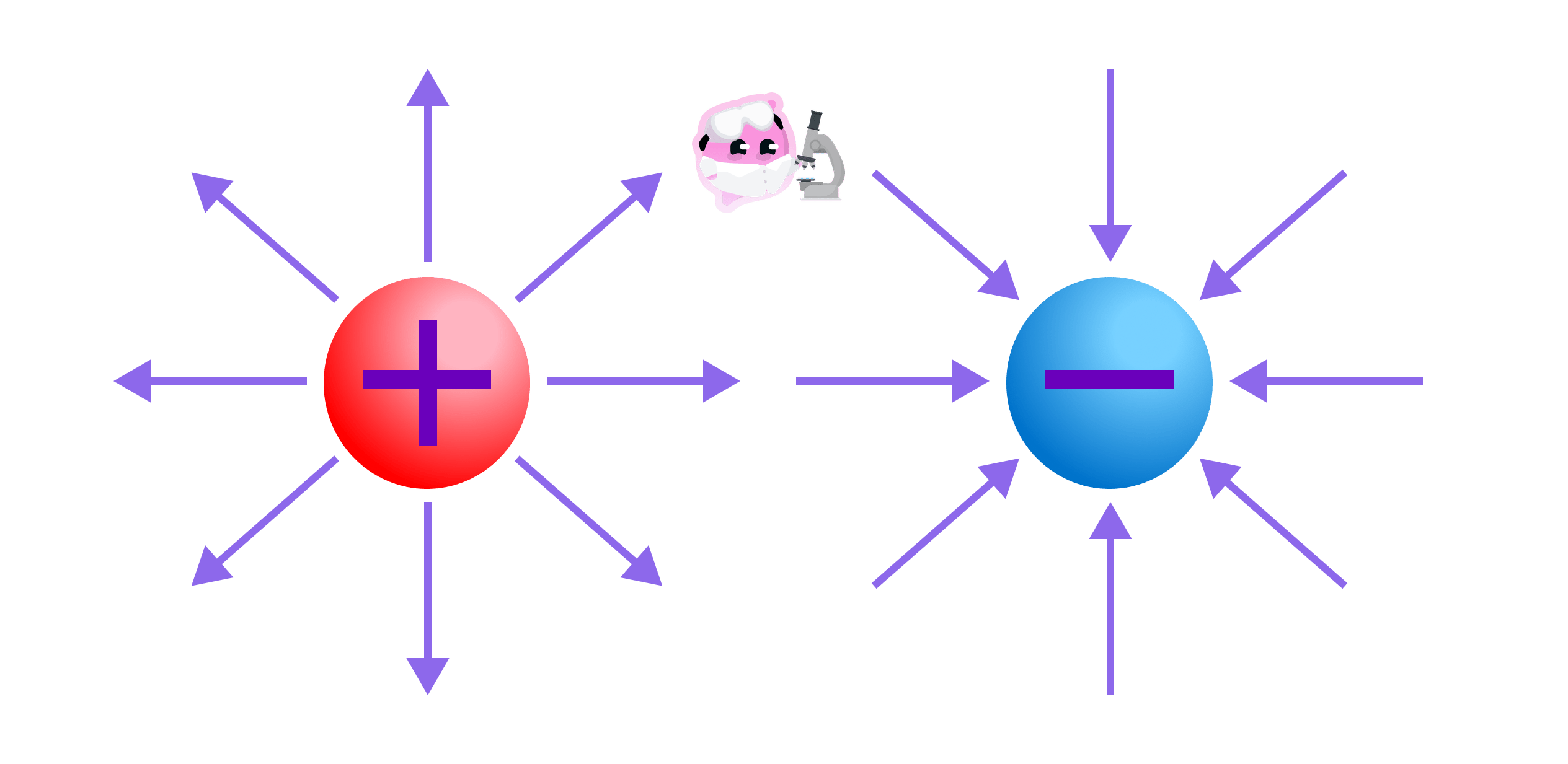
A radial field is a field whose field lines are straight and spread out evenly in all directions from a single point.
- The field around an isolated point charge is radial, which means the field lines are straight and spread out evenly in every direction.
- Around a positive point charge the lines point away from the charge, because a positive charge placed nearby would be repelled.
- Around a negative point charge the lines point towards the charge, because a positive charge placed nearby would be attracted.
- Every field line meets the surface of a charged sphere at right angles to that surface.
- Close to the charge the lines are packed tightly together, and further away they fan out so the gaps between them widen.
- That widening is how the diagram shows the field getting weaker with distance, which is why the force on a charge falls as it is moved away.
- The pattern is the same shape for both signs of charge, so only the arrows tell you whether the central charge is positive or negative.
- Putting more charge on the sphere strengthens its field at every distance, which is drawn as a larger number of field lines rather than longer ones.
Fields between parallel plates
Definition
Uniform electric field
A uniform electric field is a field that has the same strength and the same direction at every point, shown by straight, parallel, equally spaced field lines.
- Two flat metal plates placed parallel to one another and given opposite charges set up a field in the gap between them.
- Between the plates the field lines are straight, parallel to one another, equally spaced, and at right angles to the plate surfaces.
- The lines run from the positive plate towards the negative plate, matching the direction of the force on a positive charge.
- Equal spacing means the field has the same strength at every point in the gap, so it is a uniform electric field.
- A positive charge released between the plates is pushed towards the negative plate, in the same direction as the field lines.
- A negative charge released in the same gap is pushed the other way, towards the positive plate.
- The field is only uniform well inside the gap; near the edges of the plates the lines curve outwards and the field is weaker there.
- Increasing the potential difference between the plates, or moving the plates closer together, makes the uniform field stronger.

Reading field strength from a diagram
- The spacing of the field lines is what shows the strength of the field, and nothing else on the diagram does.
- Lines drawn close together show a strong field, so the force on a given charge placed there is large.
- Lines drawn far apart show a weak field, so the force on that same charge is smaller.
- Widely spaced lines still mean a field is present, only a weaker one; a region with no lines at all is the only region with no field.
- In a radial field the lines are closest at the surface of the charge, so that is where the field is strongest.
- In the uniform field between parallel plates the spacing never changes, so no point in the gap is stronger than any other.
- The length of a field line carries no meaning, and neither does the thickness of the line.
- When two diagrams are compared, the one with the more crowded lines at a given point represents the stronger field at that point.
Example
Comparing two points in a radial field
- A negative point charge is drawn with radial field lines, and point PPP lies close to the charge while point QQQ lies three times as far away.
- All of the lines point towards the charge, because the field direction is the direction of the force on a positive charge.
- At PPP the lines are close together, so the field there is strong.
- At QQQ the same lines have fanned out, so the gaps between them are wider and the field there is weaker.
- A small positive charge placed at PPP is therefore pulled towards the central charge with a larger force than the same charge placed at QQQ.
- A small negative charge placed at PPP is pushed away from the central charge, because a negative charge feels a force opposite to the field arrows.
Exam technique
Describing and drawing field diagrams
- Answer three things every time: the shape of the lines, their direction, and what their spacing tells you about the strength.
- Use the word radial for a point charge, and straight, parallel and equally spaced for parallel plates.
- Put an arrowhead on every line you draw, because lines with no arrows score nothing for direction.
- Draw the lines meeting a charged surface at right angles, and keep the spacing even all the way round a point charge.
- Write “away from the positive charge” or “towards the negative charge” rather than “outwards”, so the direction cannot be misread.
- Link spacing to strength in words, for example that the lines are closest to the sphere so the field is strongest there.
Common Mistake
- Do not treat the arrows as the direction a negative charge would move, because the arrows are defined using a positive charge.
- Do not draw field lines that cross one another or that stop part way across a gap.
- Do not describe a region of widely spaced lines as having no field, because the field is weaker there but still present.
- Do not draw the field between parallel plates as radial, or the field around a point charge as straight and parallel.
- Do not use the length of a line to show the strength of a field, because only the spacing of the lines carries that information.
Self review
- Define an electric field.
- State what the arrow on an electric field line represents.
- Describe the shape and the direction of the field around a positive point charge.
- Describe four features of the field lines between two oppositely charged parallel plates.
- Explain how a field diagram shows where the field is strongest.
- State the direction of the force on a negative charge placed in a field whose lines point to the right.
