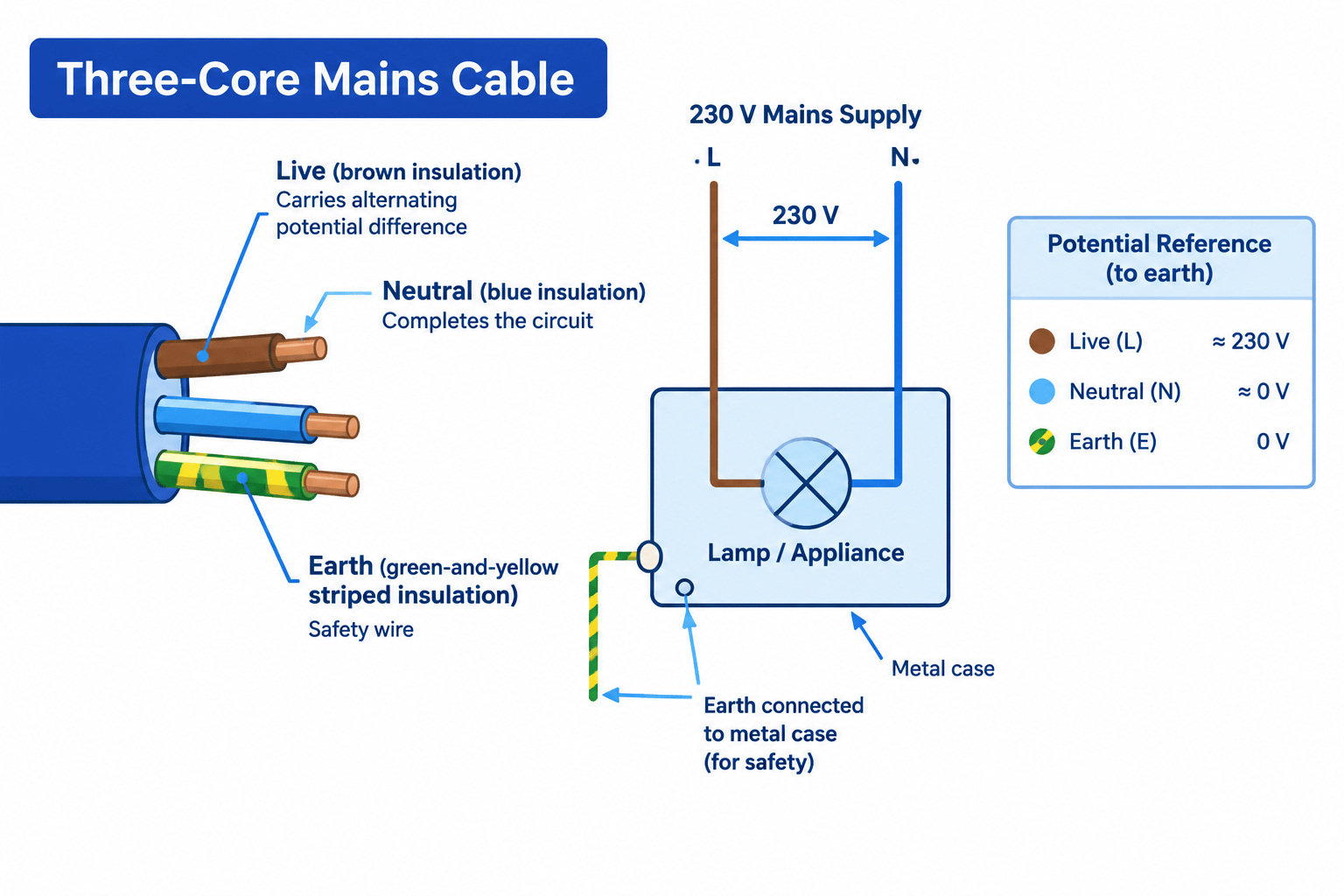
2.3.2a Mains electricity and three-core cable
Three-core cable: three wires, three jobs
Mains electricity
The electricity supplied to homes and buildings from the national electricity supply.
- Most electrical appliances connect to the mains through a three-core cable.
- Three-core means the cable holds three separate conducting wires inside one outer covering.
- Each wire is usually made of copper so that charge flows through it easily when the appliance works.
- The three wires are the live wire, the neutral wire and the earth wire, and each does a different job.
- Every wire carries its own coloured insulation so you can tell the wires apart and connect them correctly.
Colour coding: brown, blue, green-and-yellow
Insulation
A material that does not let charge flow through it easily, used here to cover each wire for safety and identification.
- The live wire insulation is brown.
- The neutral wire insulation is blue.
- The earth wire insulation has green and yellow stripes.
- The colours matter because each wire must reach the correct part of the plug and appliance; a wrong connection can stop the appliance working and make it unsafe.
Live is brown, neutral is blue, earth is green and yellow stripes. Learn these exactly.
The live wire: it carries the alternating supply
Live wire
The wire that carries the alternating potential difference from the supply to the appliance.
- The live wire brings the alternating potential difference from the supply, so its potential keeps changing direction as the mains alternates.
- This makes the live wire the dangerous one: if a fault lets you touch a live part while you also provide a path to earth, charge can flow through your body and give you an electric shock.
- The key point is simply that the live wire carries the alternating potential difference from the supply.
The neutral wire: it completes the circuit
Neutral wire
The wire that completes the circuit.
- An appliance only works if there is a complete circuit through it.
- The live and neutral wires together connect the appliance across the mains supply, and the neutral wire completes that circuit.
- Avoid saying the neutral wire does nothing: without it there is no complete circuit, so no charge flows and the appliance will not work.
The earth wire: a safety wire
Earth wire
A safety wire that stops the appliance case becoming live.
- Many appliances have a metal case.
- If a fault let the live wire touch that case, the case could become live and give a shock to anyone who touched it.
- The earth wire gives a safe path to earth, which stops the case staying live.
- The essential point is that the earth wire is a safety wire whose job is to stop the appliance becoming live.
- Do not swap the colours: the live wire is not blue, and the neutral wire is not brown.
- Do not forget the earth wire is green and yellow stripes.
- Do not say the earth wire is needed for the appliance to work normally; it is there for safety, while the wire that completes the circuit is the neutral wire.
- How many separate wires are in a three-core cable, and what are they called?
- Give the colour of the live, neutral and earth wires.
- What does the live wire carry?
- What is the job of the neutral wire?
- Why is the earth wire described as a safety wire?
2.3.2b Mains electricity: potential differences and safety
Potentials in mains wiring: live at 230 V, neutral and earth near 0 V
Potential difference
The energy transferred per unit charge between two points, measured in volts (V\text{V}V).
- The three wires in a mains cable sit at different potentials compared with the Earth.
- The live wire is at about 230 V230\ \text{V}230 V relative to earth.
- The neutral wire is at, or close to, earth potential, so it is roughly 0 V0\ \text{V}0 V.
- The earth wire is at 0 V0\ \text{V}0 V.
- So there is a potential difference of about 230 V230\ \text{V}230 V between the live wire and either the earth wire or the ground, and that potential difference can drive a dangerous current if a conducting path forms.
The earth wire normally carries no current. It only carries a current when a fault creates a conducting path between the live wire and earth.
An open switch does not always make a wire safe
- An open switch breaks the normal circuit, so current cannot flow around that circuit.
- Breaking the circuit does not remove the potential difference between the live wire and earth.
- The live wire on the supply side of the switch can stay connected to the mains, so it may remain at about 230 V230\ \text{V}230 V relative to earth even though no current flows through the appliance.
- If you then touch that live wire while also connected to the ground, your body becomes a conducting path between live and earth, and the potential difference drives a current through you, giving an electric shock.
- Do not assume no current means no danger: an open switch stops the current in the normal circuit, but a live wire can still sit at about 230 V230\ \text{V}230 V relative to earth.
- Do not say the earth wire normally carries current; it only does so during a fault.
Why a live-to-earth connection is dangerous
- A connection between the live wire and earth has about 230 V230\ \text{V}230 V across it, and that potential difference can drive a current through the connection.
- The connection could be a person touching the live wire while standing on the ground.
- It could be a fault that lets the live wire touch an earthed part of the appliance.
- It could be any other conducting object joining live to earth.
- A person who becomes part of this path can receive a serious or fatal electric shock.
- A low-resistance fault path can also allow a very large current to flow, which produces dangerous heating and a fire risk.
- During such a fault the earth wire carries current because it provides the path to earth; with no fault it stays at 0 V0\ \text{V}0 V and carries none.
- Give the full chain rather than stopping at the live wire has a high voltage.
- State that the live wire is about 230 V230\ \text{V}230 V relative to earth.
- Identify the conducting path between live and earth.
- Say the potential difference drives a current, and finish with the consequence: a current through a person causes an electric shock.
- What is the potential difference between the live wire and earth?
- What are the potentials of the neutral and earth wires?
- When does the earth wire carry a current?
- Why can a live wire still be dangerous when the switch is open?
- Why is any connection between live and earth dangerous?