Revision notes for AQA GCSE Physics Forces, accelerations and Newton's Laws of motion. Open the guide for explanations and worked examples. Written against the AQA GCSE Physics (8463) specification, so the content matches what's examinable rather than general Physics background.
Forces, accelerations and Newton's Laws of motion
What you'll learn
- How to decide whether forces are balanced or unbalanced.
- Why a resultant force causes an object to accelerate.
- How to use Newton’s First, Second and Third Laws.
- How the required practical links force, mass and acceleration.
Starting point: forces and motion
A force is a push or pull on an object. Forces are measured in newtons (N).
Forces are vectors, which means they have both a size and a direction. So when you combine forces, direction matters.
Common forces you will see in this topic include:
- weight: the force due to gravity, acting downwards
- normal contact force: the support force from a surface, acting perpendicular to the surface
- friction: a resistive force between surfaces
- air resistance: a resistive force from moving through air
- driving force: a forward force produced by an engine, motor, or push
Definition
Resultant force
The resultant force is the single overall force that has the same effect as all the forces acting on an object combined.
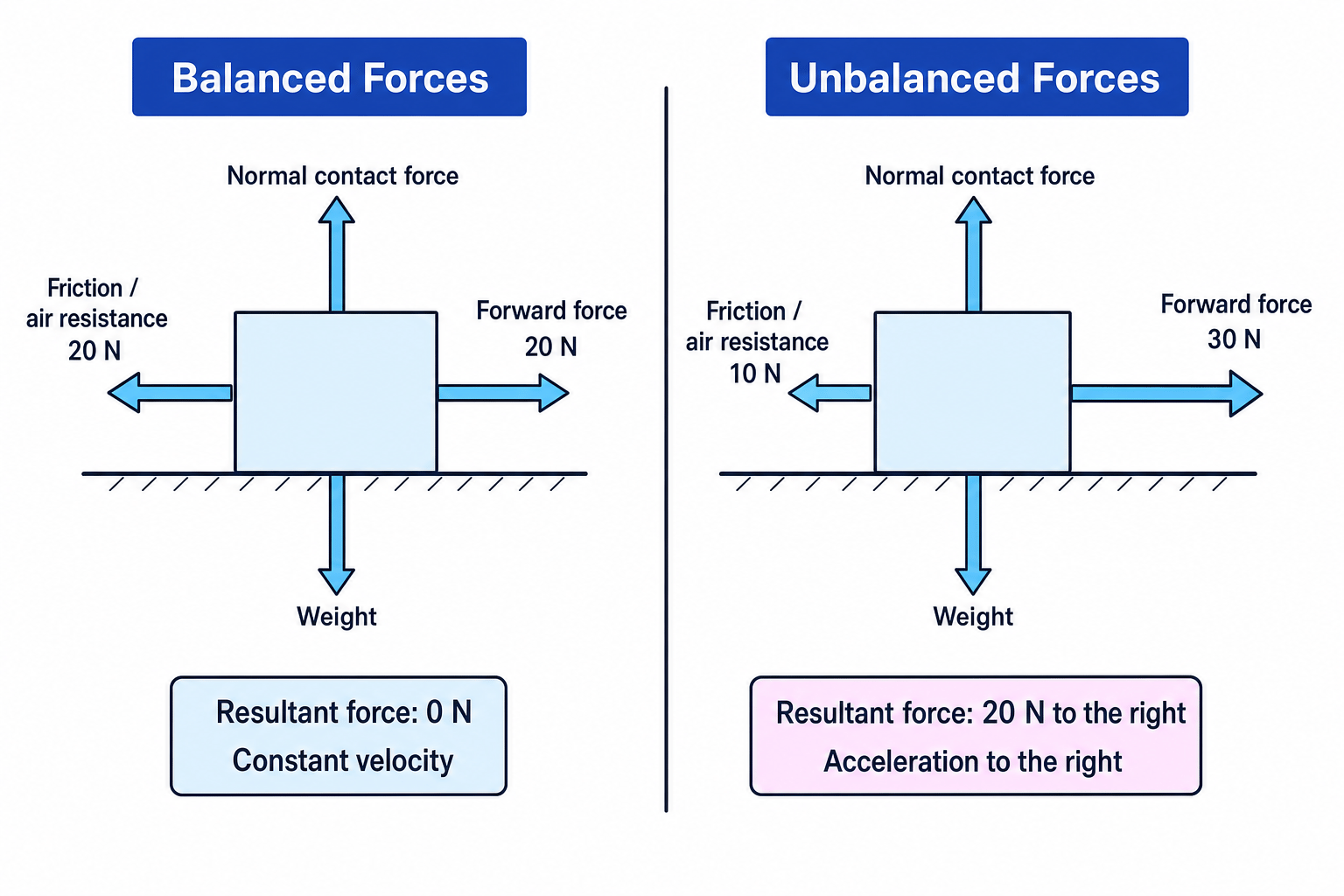
If forces are equal in size and opposite in direction, they are balanced. If they are not balanced, there is a non-zero resultant force.
Example
Calculating a resultant force
A box has a forward force of 45 N and a friction force of 18 N acting backwards. Find the resultant force.
- Choose the forward direction as positive, so the forward force is positive and friction is negative.
- Subtract the opposing force from the forward force: Fresultant=45 N−18 N=27 NF_{\text{resultant}} = 45\ \text{N} - 18\ \text{N} = 27\ \text{N}Fresultant=45 N−18 N=27 N.
- The resultant force is 27 N forwards, so the box will accelerate forwards if its mass stays the same.
Common Mistake
Forces can exist even when the resultant is zero
A resultant force of zero does not mean “there are no forces”. It means the forces cancel overall.
Velocity and acceleration
Speed tells you how fast something is moving. Velocity means speed in a stated direction, so velocity is also a vector.
Definition
Acceleration
Acceleration is the rate of change of velocity. An object accelerates if it speeds up, slows down, or changes direction.
The equation for acceleration is:
a=Δvta = \frac{\Delta v}{t}a=tΔvwhere:
- aaa is acceleration in m/s²
- Δv\Delta vΔv is change in velocity in m/s
- ttt is time in seconds (s)
Example
Calculating acceleration
A cyclist’s velocity increases from 2.0 m/s to 8.0 m/s in 3.0 s. Calculate the acceleration.
- Find the change in velocity: Δv=8.0 m/s−2.0 m/s=6.0 m/s\Delta v = 8.0\ \text{m/s} - 2.0\ \text{m/s} = 6.0\ \text{m/s}Δv=8.0 m/s−2.0 m/s=6.0 m/s.
- Substitute into the acceleration equation: a=6.0 m/s3.0 sa = \frac{6.0\ \text{m/s}}{3.0\ \text{s}}a=3.0 s6.0 m/s.
- Calculate the acceleration: a=2.0 m/s2a = 2.0\ \text{m/s}^2a=2.0 m/s2.
Tip
Direction matters
If an object is travelling at constant speed in a circle, it is still accelerating because its direction is changing.
Newton’s First Law: what happens when forces balance
Newton’s First Law describes what happens when the resultant force on an object is zero.
Key Idea
Newton’s First Law
If the resultant force on an object is zero, a stationary object stays stationary, and a moving object continues at the same velocity.
This means an object does not need a forward resultant force to keep moving at constant velocity. It only needs a resultant force to change its velocity.
For example, a car travelling at steady speed has a driving force forwards and resistive forces backwards. At steady speed, these forces are balanced.
Definition
Inertia
Inertia is the tendency of an object to keep doing what it is already doing: staying still or moving at constant velocity.
Example
Explaining steady speed
A car travels along a straight road at constant velocity. The engine provides a driving force of 900 N. What is the total resistive force?
- Constant velocity means the car is not accelerating, so Newton’s First Law tells us the resultant force is zero.
- For the resultant force to be zero, the forward and backward forces must be equal in size.
- The total resistive force is therefore 900 N backwards.
Common Mistake
Constant speed is not always constant velocity
If the direction changes, the velocity changes. So an object moving round a bend at constant speed still has a non-zero resultant force.
Newton’s Second Law: force, mass and acceleration
Newton’s Second Law links the resultant force on an object to its mass and acceleration.
Key Idea
Newton’s Second Law
The acceleration of an object is proportional to the resultant force and inversely proportional to its mass.
The equation is:
F=maF = m aF=mawhere:
- FFF is the resultant force in newtons (N)
- mmm is mass in kilograms (kg)
- aaa is acceleration in m/s²
So:
- if you increase the resultant force, acceleration increases
- if you increase the mass, acceleration decreases for the same force
- the acceleration is in the same direction as the resultant force
Example
Using Newton’s Second Law
A 1.5 kg trolley has a resultant force of 6.0 N acting on it. Calculate its acceleration.
- Use Newton’s Second Law: F=maF = m aF=ma.
- Rearrange for acceleration: a=Fma = \frac{F}{m}a=mF.
- Substitute the values: a=6.0 N1.5 kg=4.0 m/s2a = \frac{6.0\ \text{N}}{1.5\ \text{kg}} = 4.0\ \text{m/s}^2a=1.5 kg6.0 N=4.0 m/s2.
Common Mistake
Use the resultant force
In F=maF = m aF=ma, FFF means the resultant force, not just any single force shown in the question.
Inertial mass
You have already met inertia as the tendency to keep moving as before. Inertial mass gives this idea a number.
Definition
Inertial mass
Inertial mass is a measure of how difficult it is to change an object’s velocity. It is found from the ratio of resultant force to acceleration.
From Newton’s Second Law:
m=Fam = \frac{F}{a}m=aFA larger inertial mass means a larger force is needed to produce the same acceleration.
Tip
Sanity check for mass
For the same resultant force, a more massive object should have a smaller acceleration. If your answer says the heavier object accelerates more, check your rearranging.
Investigating force and acceleration
In the required practical, you investigate how changing the force affects the acceleration of a system.
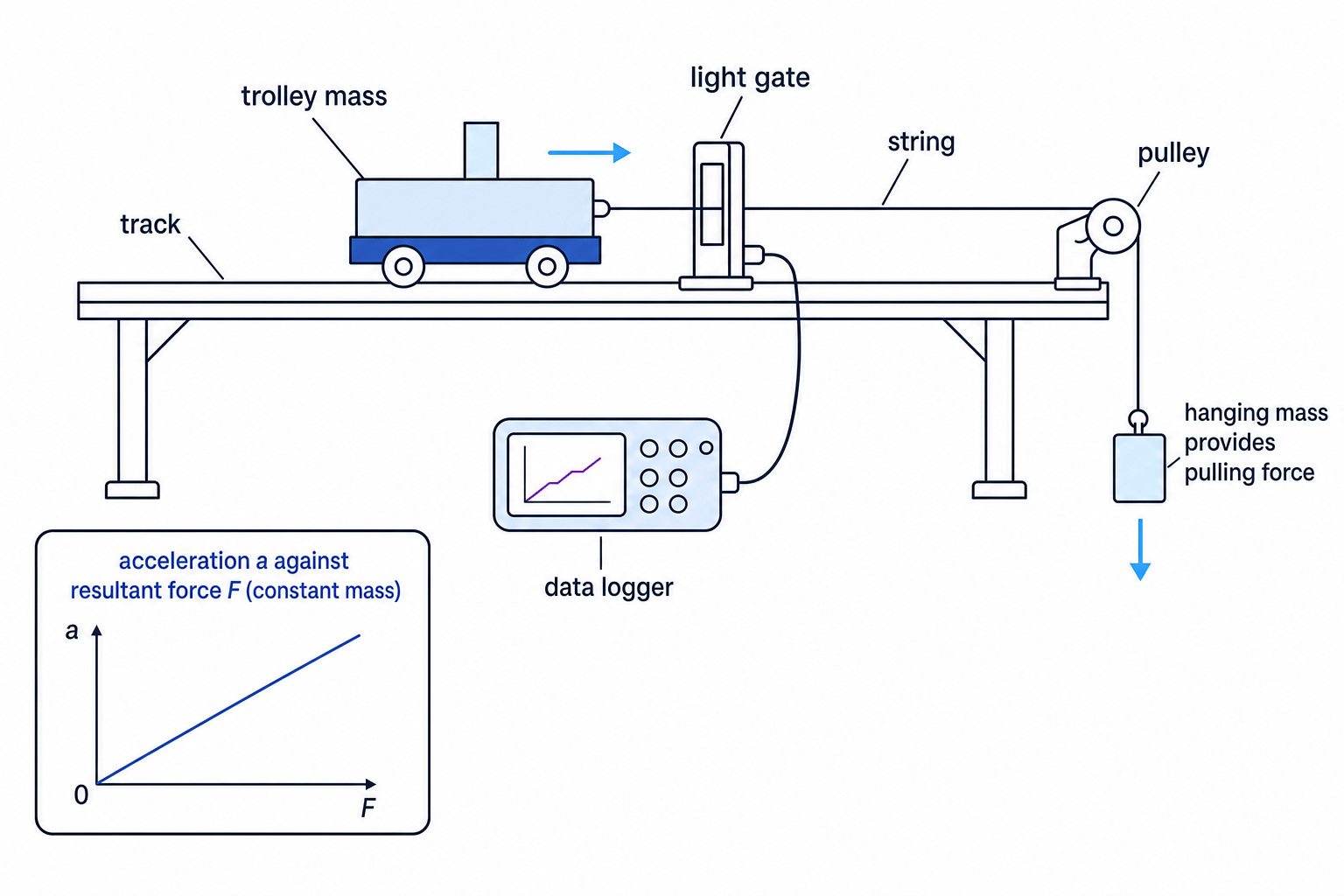
A common setup uses a trolley on a track connected by a string over a pulley to a hanging mass. The hanging mass provides the pulling force. A light gate and data logger can measure the trolley’s acceleration.
Method idea
To test how force affects acceleration:
- Set up the trolley, string, pulley and hanging mass.
- Use a light gate or data logger to measure acceleration.
- Increase the pulling force while keeping the total mass of the moving system constant.
- Repeat readings and calculate a mean.
- Plot acceleration against resultant force.
For a constant mass, the graph should be a straight line through the origin: acceleration is directly proportional to resultant force.
Common Mistake
Keeping mass constant
If you increase the hanging mass by adding extra masses from nowhere, you have changed both force and total mass. A better method is to transfer masses from the trolley to the hanger, so the total moving mass stays constant.
Newton’s Third Law: pairs of forces
Newton’s Third Law is about what happens when two objects interact.
Key Idea
Newton’s Third Law
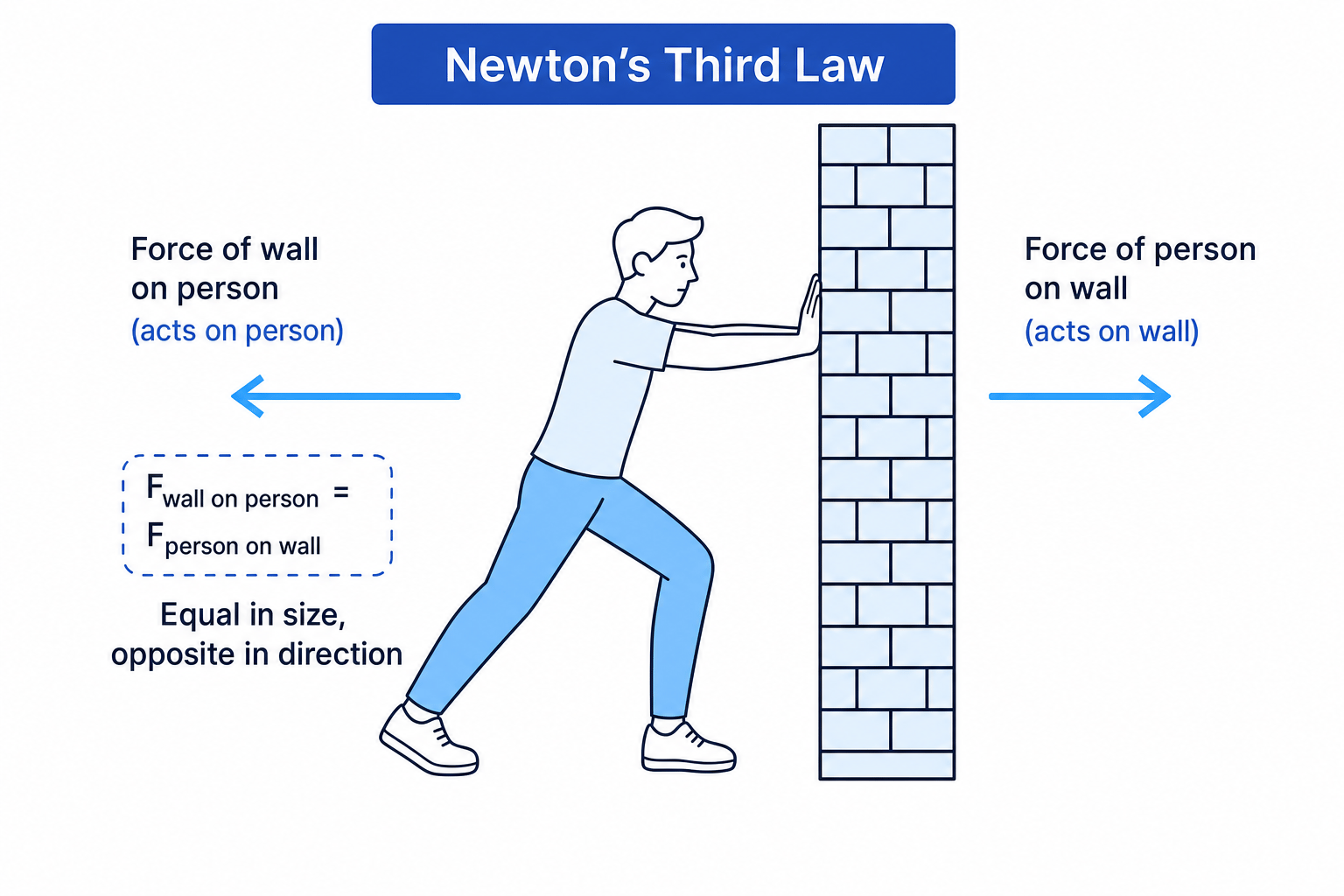
Whenever two objects interact, they exert equal and opposite forces on each other.
The two forces in a Newton’s Third Law pair:
- are equal in size
- act in opposite directions
- are the same type of force
- act on different objects
For example, if you push a wall, your hand pushes the wall and the wall pushes your hand back with an equal and opposite force.
Example
Identifying a force pair
A book rests on a table. Identify the Newton’s Third Law pair for the contact force of the table on the book.
- Identify the interaction: the book and table are pressing on each other.
- If the table exerts an upward contact force on the book, the paired force is the book exerting a downward contact force on the table.
- These forces are equal and opposite, but they act on different objects, so they do not cancel each other for one object.
Common Mistake
Third Law pairs do not cancel on one object
Balanced forces act on the same object. Newton’s Third Law pairs act on different objects, so do not describe them as cancelling each other.
Bringing the laws together
Here is the big picture:
- Newton’s First Law tells you what happens when resultant force is zero.
- Newton’s Second Law tells you how much acceleration you get when resultant force is not zero.
- Newton’s Third Law tells you that forces between interacting objects come in equal and opposite pairs.
In exam questions, always ask: “Which object am I focusing on?” Then consider the forces acting on that object only.
Exam technique
In the exam
- Draw or imagine a free-body diagram, then calculate the resultant force before using F=maF = m aF=ma.
- Check whether the object is stationary, at constant velocity, or accelerating; this tells you which law is most useful.
- For Newton’s Third Law, name both objects clearly: “force of A on B” and “force of B on A”.
Self review
Check yourself
- What does it mean if the resultant force on an object is zero?
- A 2.0 kg object accelerates at 3.0 m/s². What resultant force acts on it?
- Why do Newton’s Third Law force pairs not cancel each other out?
You've reached the end
Test yourself on this topic, or move on to the next guide.
How was this guide?