Distance
Definition
Distance
Distance is how far an object moves along its path; it does not include direction.
- Distance is a scalar quantity: it has magnitude but no direction. A runner who completes 100 m100\ \text{m}100 m of a race has travelled a distance of 100 m100\ \text{m}100 m, whatever the direction.
- The SI unit is the metre (m\text{m}m); distance can also be given in kilometres (km\text{km}km) or centimetres (cm\text{cm}cm).
- The total distance for a journey is the sum of the lengths of all parts of the route.
- Distance cannot be negative: even if an object moves back towards its start, every part of the journey adds to the total.
Displacement
Definition
Displacement
Displacement is the straight-line distance from an object’s start point to its finish point, together with the direction of that straight line.
- Displacement is a vector quantity with both a magnitude (the straight-line distance between start and finish) and a direction (such as north, south, east or west).
- Its magnitude is measured in metres (m\text{m}m).
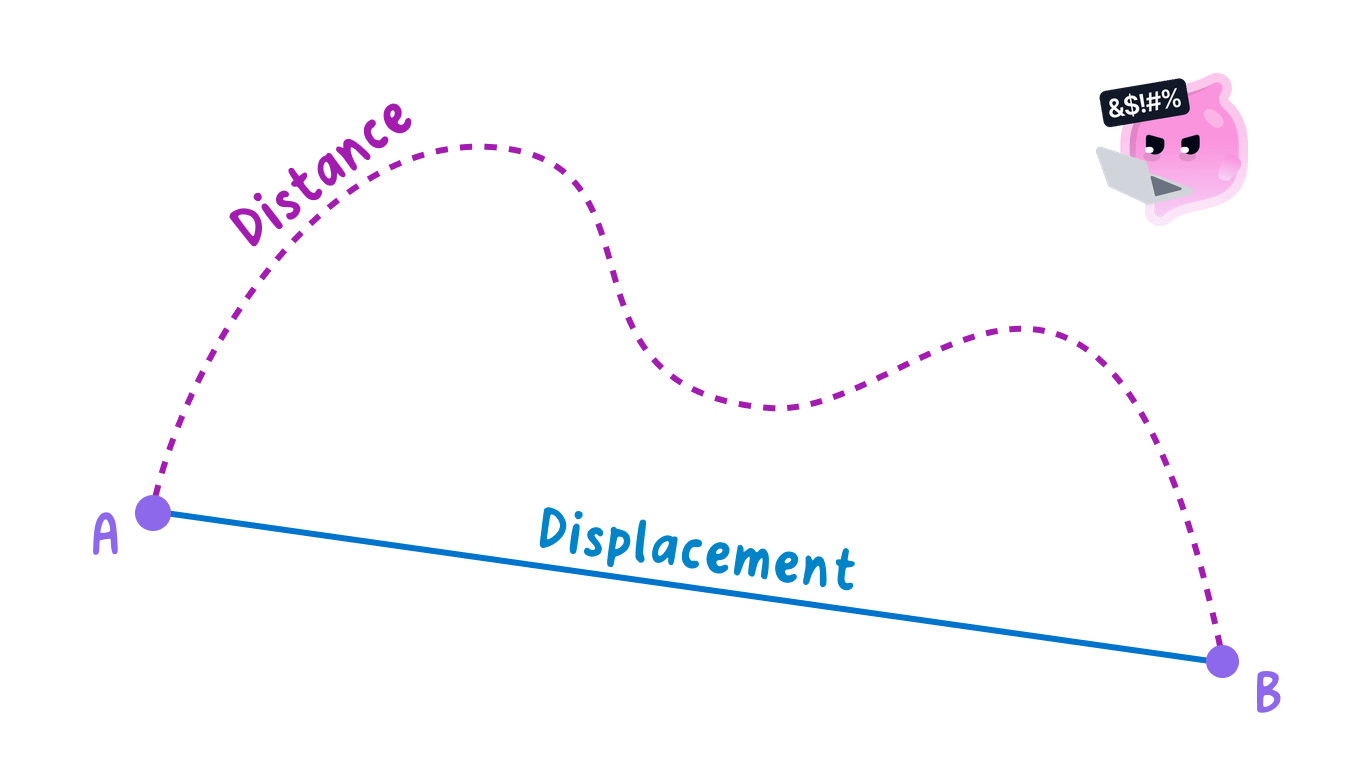
- The route does not affect displacement; only the start and finish positions matter, so an object can travel a large distance but have a small displacement.
- If an object finishes where it started, its displacement is zero, even though it may have travelled a considerable distance.
Comparing distance and displacement
- Distance adds up the actual route travelled; displacement compares the final position with the start and includes a direction.
Example
A student walks 40 m40\ \text{m}40 m east and then 15 m15\ \text{m}15 m west. Calculate the distance travelled and state the displacement.
- Find the distance by adding the lengths: distance=40 m+15 m=55 m\text{distance} = 40\ \text{m} + 15\ \text{m} = 55\ \text{m}distance=40 m+15 m=55 m.
- Taking east as positive, find the displacement magnitude: 40 m−15 m=25 m40\ \text{m} - 15\ \text{m} = 25\ \text{m}40 m−15 m=25 m.
- Add the direction: the student finishes east of the start, so displacement = 25 m25\ \text{m}25 m east.
- So the student travels a distance of 55 m55\ \text{m}55 m but has a displacement of 25 m25\ \text{m}25 m east.
Exam technique
- Do not assume distance and displacement are always equal: distance follows the actual route, displacement is the straight line from start to finish.
- A displacement answer is incomplete with only a magnitude; always give the direction.
- Returning to the start gives zero displacement, not zero distance.
- Match the command word: for distance, give the full route length with no direction; for displacement, give the straight-line change with magnitude and direction.
- In a comparison, use the terms scalar and vector: distance is a scalar, displacement is a vector.
Self review
- Define distance.
- Why is distance a scalar?
- What two things must a displacement include?
- What is the displacement of an object that finishes at its start point?
- Can an object’s distance be greater than the magnitude of its displacement?
