Revision notes for AQA GCSE Physics Describing motion along a line. Open the guide for explanations and worked examples. Written against the AQA GCSE Physics (8463) specification, so the content matches what's examinable rather than general Physics background.
Describing motion along a line
What you'll learn
- How to describe motion using distance, displacement, speed, velocity and acceleration.
- How to calculate average speed and acceleration using GCSE equations.
- How to interpret distance-time graphs and velocity-time graphs.
- How to use graph gradients and areas to find useful motion quantities.
The starting idea: motion in one dimension
In this topic, we simplify motion by looking at objects moving along a line. That might mean a car moving along a straight road, a runner on a straight track, or a trolley moving along a bench.
Definition
Motion along a line
Motion along a line means the object’s position changes along one straight path, so directions can be described simply as forwards/backwards, left/right, or positive/negative.
To describe motion clearly, you need to know both how far something moves and sometimes which direction it moves in.
Scalars and vectors
Some quantities only need a size. Others need a size and a direction.
Definition
Scalars and vectors
- A scalar quantity has size only, such as distance or speed.
- A vector quantity has size and direction, such as displacement, velocity or acceleration.
For motion along a line, direction is often shown using signs. For example, if forwards is chosen as positive, backwards can be negative.
Distance and displacement
Distance is the total length of the path travelled. It is a scalar, so it does not include direction.
Displacement is how far an object is from its starting point in a particular direction. It is a vector, so direction matters.
Example
Comparing distance and displacement
A student walks 6 m forwards, then 2 m backwards.
- The total path length is found by adding both parts of the journey: 6 m plus 2 m, so the distance travelled is 8 m.
- The final position compared with the start is 6 m forwards minus 2 m backwards, giving 4 m forwards.
- The displacement is therefore 4 m forwards, or +4 m+4\ \text{m}+4 m if forwards is the positive direction.
Key Idea
Distance is not the same as displacement
Distance counts the whole route travelled. Displacement only compares the final position with the starting position, including direction.
Speed: how quickly distance is covered
Speed tells you how fast something is moving. More precisely, it is the distance travelled per unit time.
The GCSE equation is:
v=stv = \frac{s}{t}v=tswhere:
- vvv is speed in metres per second, m/s
- sss is distance in metres, m
- ttt is time in seconds, s
This gives the average speed over the journey. The object may have sped up or slowed down during the journey, but the calculation spreads the motion evenly over the whole time.
Example
Calculating average speed
A cyclist travels 300 m in 50 s. Calculate the average speed.
- Choose the speed equation because you are given distance and time: v=stv = \frac{s}{t}v=ts.
- Substitute the values with units: v=300 m50 sv = \frac{300\ \text{m}}{50\ \text{s}}v=50 s300 m.
- Calculate the result: v=6 m/sv = 6\ \text{m/s}v=6 m/s, so the cyclist’s average speed is 6 m/s.
Common Mistake
Mixing up minutes and seconds
If the time is given in minutes, convert it to seconds before using v=stv = \frac{s}{t}v=ts. For example, 2 minutes is 120 s.
Typical speeds
You are not expected to memorise every possible speed, but you should have a feel for sensible values. A walking speed is about 1.5 m/s, running is a few metres per second, and the speed of sound in air is about 330 m/s.
Tip
Sanity check your answer
If you calculate a walking speed of 80 m/s, something has probably gone wrong with units or arithmetic.
Velocity: speed in a stated direction
Velocity is speed in a particular direction. It is a vector.
For motion along a line, velocity can be positive or negative depending on the direction chosen. If forwards is positive, then:
- v=+10 m/sv = +10\ \text{m/s}v=+10 m/s means 10 m/s forwards
- v=−10 m/sv = -10\ \text{m/s}v=−10 m/s means 10 m/s backwards
A change in velocity can happen because the object changes speed, changes direction, or both.
Acceleration: changing velocity
Acceleration is the rate of change of velocity. In simpler words, it tells you how quickly the velocity changes.
The GCSE equation is:
a=Δvta = \frac{\Delta v}{t}a=tΔvYou may also see this written as:
a=v−uta = \frac{v - u}{t}a=tv−uwhere uuu is the initial velocity and vvv is the final velocity.
Acceleration is measured in metres per second squared, m/s². This unit means “metres per second, per second”: the velocity changes by that many m/s every second.
Example
Calculating acceleration
A car’s velocity increases from 4 m/s to 20 m/s in 8 s. Calculate its acceleration.
- Find the change in velocity: Δv=20 m/s−4 m/s=16 m/s\Delta v = 20\ \text{m/s} - 4\ \text{m/s} = 16\ \text{m/s}Δv=20 m/s−4 m/s=16 m/s.
- Substitute into the acceleration equation: a=16 m/s8 sa = \frac{16\ \text{m/s}}{8\ \text{s}}a=8 s16 m/s.
- Calculate the acceleration: a=2 m/s2a = 2\ \text{m/s}^2a=2 m/s2, so the car’s velocity increases by 2 m/s every second.
Deceleration
Deceleration usually means slowing down. In physics, this is often acceleration in the opposite direction to the motion.
If forwards is positive, a car moving forwards and slowing down has a negative acceleration.
Common Mistake
Acceleration does not always mean speeding up
Acceleration means changing velocity. An object can accelerate by speeding up, slowing down, or changing direction.
Distance-time graphs
A distance-time graph shows how the distance travelled changes with time.
Time goes on the horizontal axis. Distance goes on the vertical axis.
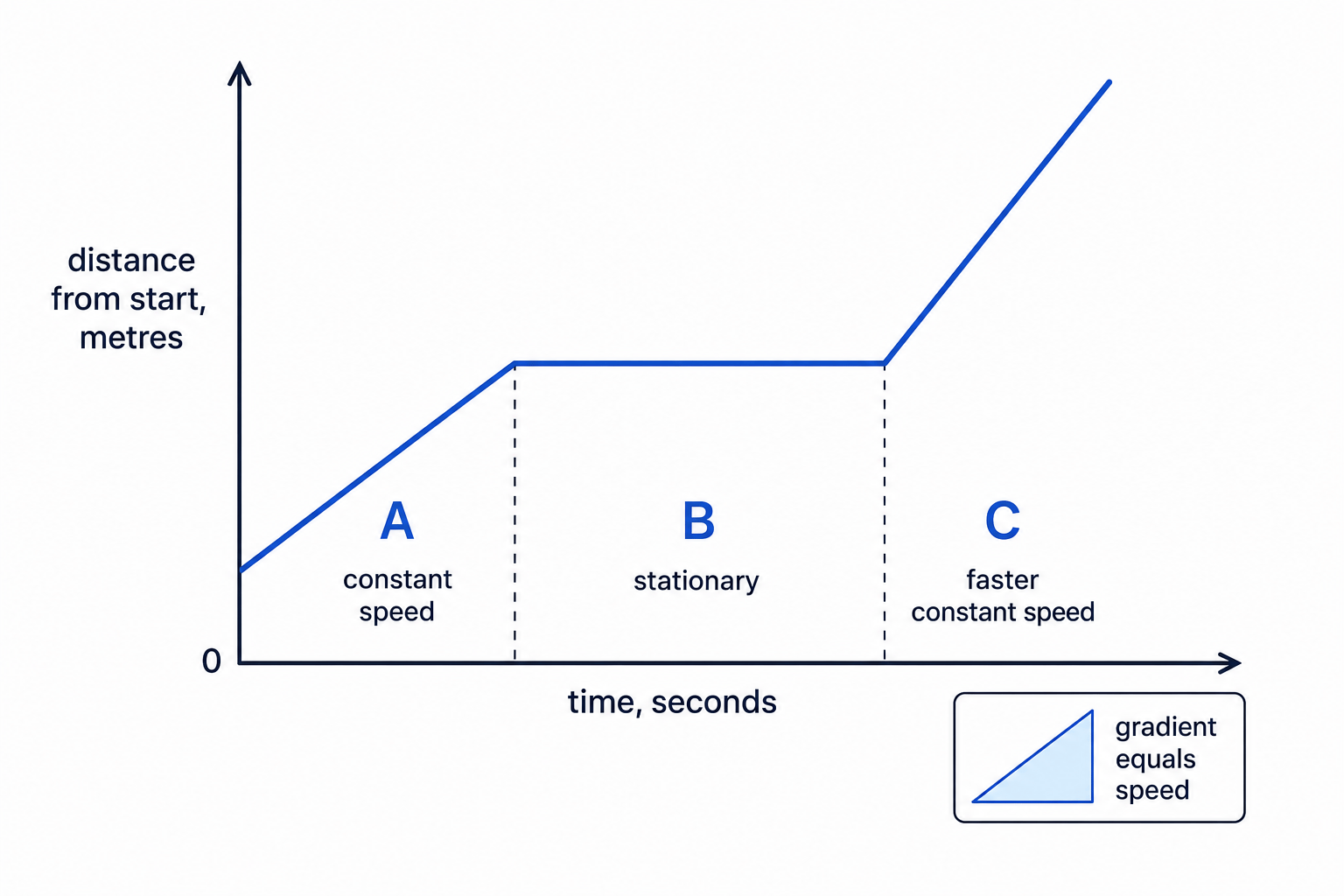
The key rule is:
speed=gradient of a distance-time graph\text{speed} = \text{gradient of a distance-time graph}speed=gradient of a distance-time graphOn a distance-time graph:
- A straight sloping line means constant speed.
- A horizontal line means the object is stationary.
- A steeper line means a greater speed.
- A curve means the speed is changing.
Example
Finding speed from a distance-time graph
On a distance-time graph, an object moves from 20 m at 5 s to 80 m at 17 s. Calculate its speed during this straight-line section.
- Find the change in distance: 80 m−20 m=60 m80\ \text{m} - 20\ \text{m} = 60\ \text{m}80 m−20 m=60 m.
- Find the change in time: 17 s−5 s=12 s17\ \text{s} - 5\ \text{s} = 12\ \text{s}17 s−5 s=12 s.
- Use gradient: speed=60 m12 s=5 m/s\text{speed} = \frac{60\ \text{m}}{12\ \text{s}} = 5\ \text{m/s}speed=12 s60 m=5 m/s.
Tip
Use a large gradient triangle
When finding a gradient from a graph, use two clear points far apart on the line. This reduces the effect of small reading errors.
Common Mistake
Reading the height as the speed
On a distance-time graph, the vertical value is distance, not speed. Speed comes from the gradient.
Velocity-time graphs
A velocity-time graph shows how velocity changes with time.
Time goes on the horizontal axis. Velocity goes on the vertical axis.
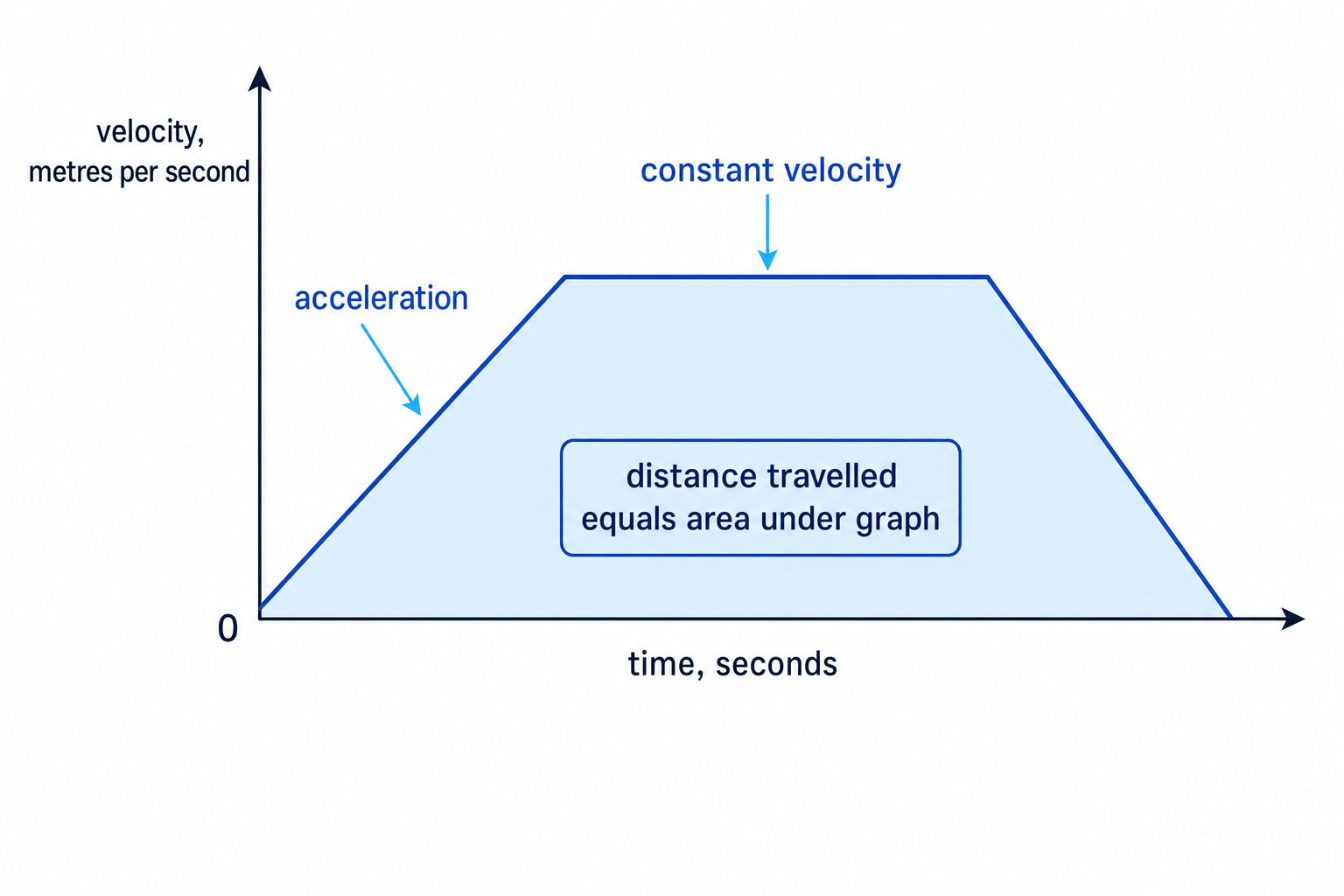
There are two very important rules:
acceleration=gradient of a velocity-time graph\text{acceleration} = \text{gradient of a velocity-time graph}acceleration=gradient of a velocity-time graph distance travelled=area under a velocity-time graph\text{distance travelled} = \text{area under a velocity-time graph}distance travelled=area under a velocity-time graphOn a velocity-time graph:
- A horizontal line means constant velocity, not necessarily stationary.
- A line sloping upwards means positive acceleration.
- A line sloping downwards means negative acceleration.
- A line on the time axis, where velocity is zero, means the object is stationary.
Example
Using gradient on a velocity-time graph
A train’s velocity increases from 0 m/s to 30 m/s in 15 s. Calculate its acceleration.
- Find the change in velocity: 30 m/s−0 m/s=30 m/s30\ \text{m/s} - 0\ \text{m/s} = 30\ \text{m/s}30 m/s−0 m/s=30 m/s.
- Use the gradient rule for a velocity-time graph: a=Δvta = \frac{\Delta v}{t}a=tΔv.
- Substitute and calculate: a=30 m/s15 s=2 m/s2a = \frac{30\ \text{m/s}}{15\ \text{s}} = 2\ \text{m/s}^2a=15 s30 m/s=2 m/s2.
Example
Finding distance from a velocity-time graph
A car accelerates from 0 m/s to 12 m/s in 4 s, then travels at 12 m/s for 6 s. Find the distance travelled.
- Split the area under the graph into a triangle for the acceleration section and a rectangle for the constant velocity section.
- Calculate the triangle area: 12×4 s×12 m/s=24 m\frac{1}{2} \times 4\ \text{s} \times 12\ \text{m/s} = 24\ \text{m}21×4 s×12 m/s=24 m.
- Calculate the rectangle area: 6 s×12 m/s=72 m6\ \text{s} \times 12\ \text{m/s} = 72\ \text{m}6 s×12 m/s=72 m, so the total distance is 24 m+72 m=96 m24\ \text{m} + 72\ \text{m} = 96\ \text{m}24 m+72 m=96 m.
Common Mistake
Below the time axis
If velocity is below the time axis, the object is moving in the opposite direction. Areas below the axis count as negative displacement, but exam questions often ask for total distance travelled, so read the wording carefully.
Choosing the right graph rule
A quick way to remember the graph skills is:
Key Idea
Graph rules for motion
- On a distance-time graph, gradient gives speed.
- On a velocity-time graph, gradient gives acceleration.
- On a velocity-time graph, area under the graph gives distance travelled or displacement.
The word “gradient” means “slope”. For a straight line, calculate it using:
gradient=change in vertical valuechange in horizontal value\text{gradient} = \frac{\text{change in vertical value}}{\text{change in horizontal value}}gradient=change in horizontal valuechange in vertical valueThe units help you check the rule:
- distance divided by time gives m/s, so a distance-time gradient is speed
- velocity divided by time gives m/s², so a velocity-time gradient is acceleration
- velocity multiplied by time gives m, so velocity-time area is distance or displacement
Exam technique
In the exam
- Check the graph axes first: distance-time and velocity-time graphs use different rules.
- For gradients, use two points on the line and calculate change in vertical value divided by change in horizontal value.
- For areas under velocity-time graphs, split the shape into rectangles and triangles, then include the correct units.
Self review
Check yourself
- What is the difference between distance and displacement?
- On a distance-time graph, what does a horizontal line mean?
- How would you find the distance travelled from a velocity-time graph?
You've reached the end
Test yourself on this topic, or move on to the next guide.
How was this guide?