Energy is conserved
Definition
Conservation of energy
Energy cannot be created or destroyed; it can only be transferred from one store to another, or transferred between objects.
- In any change, energy is transferred usefully, stored, or dissipated, but the total amount stays the same.
- Energy does not "run out" or "disappear"; it becomes stored in different ways.
- When a battery torch is switched on, energy from the chemical store of the battery is transferred electrically to the lamp, some usefully by light and some to the thermal store of the surroundings.
- A useful energy transfer is the one the device is designed to produce: light for a lamp, heating for a heater, or the kinetic store for a moving car.
Key Idea
The same transfer can be useful or wasted depending on the device: heating is useful in a kettle but wasted in a lamp.
Energy transfers in a closed system
Definition
Closed system
A closed system is a system where no energy enters and no energy leaves.
- In a closed system there is no net change to the total energy, because none enters or leaves.
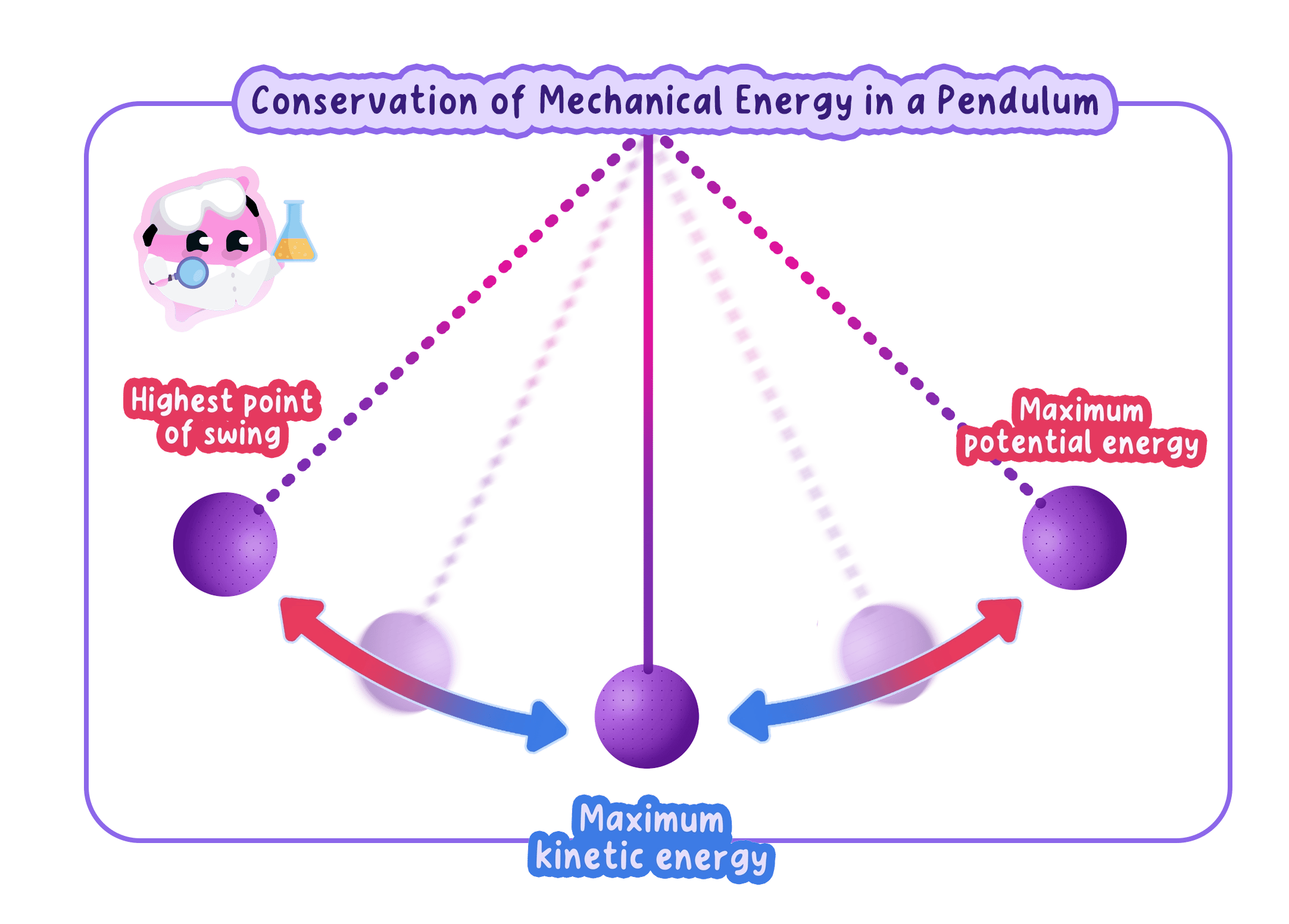
- Energy can move between stores inside the system, but the total stays constant.
- For a ball rolling down a ramp, energy moves from its gravitational potential store to its kinetic store, and friction sends some to thermal stores, yet the total in the closed system is unchanged.
- For a swinging pendulum, energy shifts between the gravitational potential store and the kinetic store each swing, while air resistance and friction gradually transfer some to the thermal store of the surroundings.
Energy is dissipated in system changes
Definition
Dissipated energy
Dissipated energy is energy that has been transferred to less useful stores, often to the thermal store of the surroundings.
- In every system change some energy is dissipated, spreading into less useful stores, and this is often called wasted energy even though it is not destroyed.
- When a phone charger is used, some energy is stored usefully in the phone battery's chemical store while some heats the charger and the surroundings.
- That dissipated energy is hard to use again because it is spread thinly through the surroundings.
- In a moving car, energy from the fuel's chemical store fills the kinetic store, but friction in the engine, friction between the tyres and road, air resistance and sound dissipate some of it.
Common Mistake
- Do not say energy is "lost" without saying what that means, because energy is never destroyed.
- When you mean "lost", say it is transferred to the surroundings or dissipated to less useful stores, usually thermal stores.
Exam technique
- Use the phrase "energy is transferred to the thermal store of the surroundings" when describing wasted energy.
- Avoid "energy is used up" or "energy disappears", because they do not show conservation of energy.
- A question often gives a device or situation and asks you to describe the energy transfers.
- Name the starting energy store, the useful store or transfer, and the wasted or dissipated store.
- State that the total energy is unchanged in a closed system.
- For an electric drill, say energy is transferred electrically from the battery or mains to the kinetic store of the rotating bit, some is dissipated to thermal stores of the drill and surroundings, some by sound, and the total is conserved.
Self review
- State the principle of conservation of energy.
- What is a closed system?
- What does it mean to say energy is dissipated?
- Why is it wrong to say energy is "used up"?
- For an electric drill, name the starting store, the useful store and where energy is wasted.
