Vectors Proof Questions
What you'll learn
- How to turn a geometry diagram into vector algebra.
- How to use ratios on a line segment to find position vectors.
- How to prove points lie on the same straight line.
- How to handle harder questions with extensions, midpoints, parallelograms and regular hexagons.
1. Vector routes: the starting point
A vector describes a movement: it has a size and a direction. In proof questions, you usually express every movement using the given vectors, such as aaa and bbb.
Vector notation
- AB⃗\vec{AB}AB means the vector from point A to point B.
- A position vector starts from the origin point O, for example OA⃗\vec{OA}OA.
- A scalar is a number multiplying a vector, such as 3 in 3a3a3a.
The most useful route fact is:
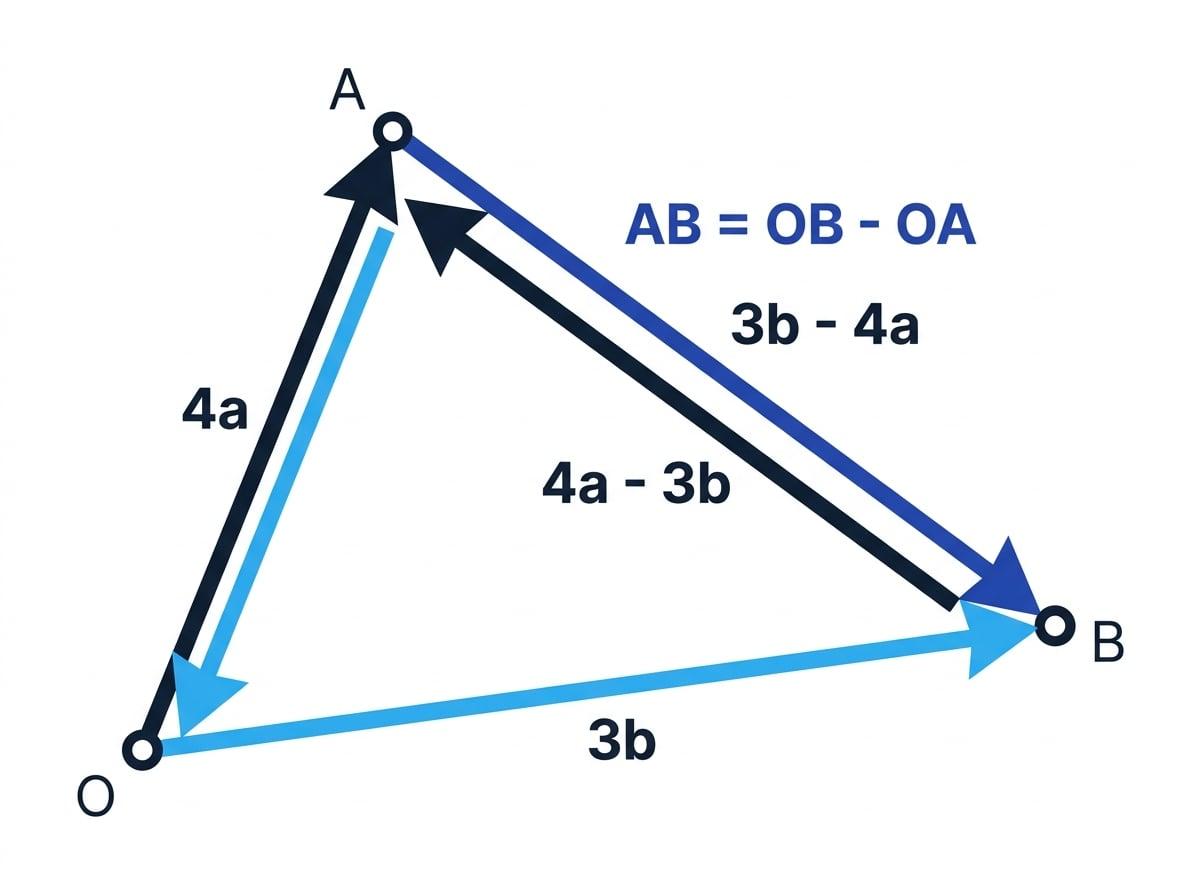
AB⃗=OB⃗−OA⃗\vec{AB}=\vec{OB}-\vec{OA}AB=OB−OAThat means: to go from A to B, go from A back to O, then from O to B.
Finding a side vector
In triangle OAB, suppose OA⃗=4a\vec{OA}=4aOA=4a and OB⃗=3b\vec{OB}=3bOB=3b. Find AB⃗\vec{AB}AB and BA⃗\vec{BA}BA.

-
To travel from A to B, subtract the position vector of A from the position vector of B.
AB⃗=3b−4a\vec{AB}=3b-4aAB=3b−4a -
The reverse vector has the opposite sign.
BA⃗=4a−3b\vec{BA}=4a-3bBA=4a−3b
Routes must join up
When you write a vector route, the end of one vector must be the start of the next. For example, AO⃗+OB⃗=AB⃗\vec{AO}+\vec{OB}=\vec{AB}AO+OB=AB.
2. Points dividing a line in a ratio
If P lies on AB and AP:PB=m:n\text{AP}:\text{PB}=m:nAP:PB=m:n, then P is mm+n\frac{m}{m+n}m+nm of the way from A to B.

So:
OP⃗=OA⃗+mm+nAB⃗\vec{OP}=\vec{OA}+\frac{m}{m+n}\vec{AB}OP=OA+m+nmABYou can also use the weighted form:
OP⃗=nm+nOA⃗+mm+nOB⃗\vec{OP}=\frac{n}{m+n}\vec{OA}+\frac{m}{m+n}\vec{OB}OP=m+nnOA+m+nmOBOpposite weights
In the weighted formula, the coefficient of OA⃗\vec{OA}OA uses the part near B, and the coefficient of OB⃗\vec{OB}OB uses the part near A.
Finding from a ratio
In triangle OAB, OA⃗=3a\vec{OA}=3aOA=3a and OB⃗=2b\vec{OB}=2bOB=2b. Point P lies on AB with AP:PB=2:1\text{AP}:\text{PB}=2:1AP:PB=2:1. Given that OP⃗=k(3a+4b)\vec{OP}=k(3a+4b)OP=k(3a+4b), find kkk.

-
Since AP is 2 out of 3 equal parts, P is 23\frac{2}{3}32 of the way from A to B.
OP⃗=OA⃗+23AB⃗\vec{OP}=\vec{OA}+\frac{2}{3}\vec{AB}OP=OA+32AB -
Substitute OA⃗=3a\vec{OA}=3aOA=3a and AB⃗=2b−3a\vec{AB}=2b-3aAB=2b−3a.
OP⃗=3a+23(2b−3a)=3a+43b−2a=a+43b\begin{aligned} \vec{OP}&=3a+\frac{2}{3}(2b-3a)\\ &=3a+\frac{4}{3}b-2a\\ &=a+\frac{4}{3}b \end{aligned}OP=3a+32(2b−3a)=3a+34b−2a=a+34b -
Factor the expression so it matches the given form.
OP⃗=13(3a+4b)\vec{OP}=\frac{1}{3}(3a+4b)OP=31(3a+4b) -
Therefore k=13k=\frac{1}{3}k=31.
Swapping the ratio
If AP:PB=2:1\text{AP}:\text{PB}=2:1AP:PB=2:1, P is 23\frac{2}{3}32 of the way from A, not 13\frac{1}{3}31 of the way from A.
3. Proving points are on the same straight line
Three points are collinear if they lie on one straight line.
Collinear points
To prove A, B and C are collinear, show that two vectors on the same line are scalar multiples of each other, such as AB⃗=λAC⃗\vec{AB}=\lambda\vec{AC}AB=λAC.

The cleanest method is:
- Find position vectors for the points.
- Choose one point as a common starting point.
- Form two vectors from that point.
- Show one is a scalar multiple of the other.
Showing three points are collinear
In triangle OAB, OA⃗=6a\vec{OA}=6aOA=6a and OB⃗=4b\vec{OB}=4bOB=4b. Point C lies on OA with OC:CA=2:1\text{OC}:\text{CA}=2:1OC:CA=2:1. M is the midpoint of AB. Point D lies on OB extended with OB:OD=1:2\text{OB}:\text{OD}=1:2OB:OD=1:2. Show that C, M and D are collinear.

-
Find the position vectors of C, M and D.
OC⃗=23(6a)=4aOM⃗=12(6a+4b)=3a+2bOD⃗=2(4b)=8b\begin{aligned} \vec{OC}&=\frac{2}{3}(6a)=4a\\ \vec{OM}&=\frac{1}{2}(6a+4b)=3a+2b\\ \vec{OD}&=2(4b)=8b \end{aligned}OCOMOD=32(6a)=4a=21(6a+4b)=3a+2b=2(4b)=8b -
Use C as the common starting point.
CM⃗=OM⃗−OC⃗=(3a+2b)−4a=−a+2b\begin{aligned} \vec{CM}&=\vec{OM}-\vec{OC}\\ &=(3a+2b)-4a\\ &=-a+2b \end{aligned}CM=OM−OC=(3a+2b)−4a=−a+2b -
Find the vector from C to D.
CD⃗=OD⃗−OC⃗=8b−4a=−4a+8b\begin{aligned} \vec{CD}&=\vec{OD}-\vec{OC}\\ &=8b-4a\\ &=-4a+8b \end{aligned}CD=OD−OC=8b−4a=−4a+8b -
Compare the two vectors.
CD⃗=4CM⃗\vec{CD}=4\vec{CM}CD=4CM -
Since CD⃗\vec{CD}CD is a scalar multiple of CM⃗\vec{CM}CM, the points C, M and D are collinear.
Parallel is not always enough
To prove points are on the same straight line, compare vectors that share a point, or clearly state that the parallel vectors pass through a common point.
4. Using shape facts
For a parallelogram, opposite sides are parallel and equal. If O is one corner and A and B are adjacent corners, the opposite corner C has:

For a regular hexagon, all sides are equal and all angles are equal. With centre O, opposite vertices have opposite position vectors.
Regular hexagon proof
PQRSTU is a regular hexagon with centre O. Suppose OP⃗=p\vec{OP}=pOP=p and OQ⃗=q\vec{OQ}=qOQ=q. N is the midpoint of QR. Y lies on PQ extended so that PQ:QY=3:2\text{PQ}:\text{QY}=3:2PQ:QY=3:2. Prove that T, N and Y are collinear.

-
Use regular hexagon facts. Since P and Q are adjacent vertices, the next vertex has position vector OR⃗=q−p\vec{OR}=q-pOR=q−p, and the opposite vertex has OT⃗=−q\vec{OT}=-qOT=−q.
-
Find the midpoint N of QR.
ON⃗=12(OQ⃗+OR⃗)=12(q+q−p)=−12p+q\begin{aligned} \vec{ON}&=\frac{1}{2}(\vec{OQ}+\vec{OR})\\ &=\frac{1}{2}(q+q-p)\\ &=-\frac{1}{2}p+q \end{aligned}ON=21(OQ+OR)=21(q+q−p)=−21p+q -
Since PQ:QY=3:2\text{PQ}:\text{QY}=3:2PQ:QY=3:2, the whole vector from P to Y is 53PQ⃗\frac{5}{3}\vec{PQ}35PQ.
OY⃗=OP⃗+53PQ⃗=p+53(q−p)=−23p+53q\begin{aligned} \vec{OY}&=\vec{OP}+\frac{5}{3}\vec{PQ}\\ &=p+\frac{5}{3}(q-p)\\ &=-\frac{2}{3}p+\frac{5}{3}q \end{aligned}OY=OP+35PQ=p+35(q−p)=−32p+35q -
Compare vectors starting from T.
TN⃗=ON⃗−OT⃗=−12p+2qTY⃗=OY⃗−OT⃗=−23p+83q\begin{aligned} \vec{TN}&=\vec{ON}-\vec{OT}\\ &=-\frac{1}{2}p+2q\\ \vec{TY}&=\vec{OY}-\vec{OT}\\ &=-\frac{2}{3}p+\frac{8}{3}q \end{aligned}TNTY=ON−OT=−21p+2q=OY−OT=−32p+38q -
Show one is a scalar multiple of the other.
TY⃗=43TN⃗\vec{TY}=\frac{4}{3}\vec{TN}TY=34TN -
Therefore T, N and Y are collinear.
5. Finding an unknown extension vector
Sometimes the question tells you that three points are collinear and asks you to find an unknown vector.
The trick is to introduce a variable, then compare coefficients of aaa and bbb.
Independent vectors
Vectors aaa and bbb are independent if they are not parallel. That means if two expressions in aaa and bbb are equal, the coefficient of aaa must match and the coefficient of bbb must match.
Finding an unknown vector
In triangle OAB, OA⃗=6a\vec{OA}=6aOA=6a and OB⃗=3b\vec{OB}=3bOB=3b. Point C lies on OA with OC:CA=5:1\text{OC}:\text{CA}=5:1OC:CA=5:1. Point D lies on AB with AD:DB=1:2\text{AD}:\text{DB}=1:2AD:DB=1:2. The line OB is extended to E. Given that C, D and E are collinear, find BE⃗\vec{BE}BE.

-
Find the position vector of C.
OC⃗=56(6a)=5a\vec{OC}=\frac{5}{6}(6a)=5aOC=65(6a)=5a -
Find the position vector of D using the ratio on AB.
OD⃗=23(6a)+13(3b)=4a+b\begin{aligned} \vec{OD}&=\frac{2}{3}(6a)+\frac{1}{3}(3b)\\ &=4a+b \end{aligned}OD=32(6a)+31(3b)=4a+b -
Let BE⃗=tb\vec{BE}=tbBE=tb, so OE⃗=(3+t)b\vec{OE}=(3+t)bOE=(3+t)b.
-
Find CD⃗\vec{CD}CD and CE⃗\vec{CE}CE.
CD⃗=(4a+b)−5a=−a+bCE⃗=(3+t)b−5a=−5a+(3+t)b\begin{aligned} \vec{CD}&=(4a+b)-5a=-a+b\\ \vec{CE}&=(3+t)b-5a=-5a+(3+t)b \end{aligned}CDCE=(4a+b)−5a=−a+b=(3+t)b−5a=−5a+(3+t)b -
Since C, D and E are collinear, write CE⃗=λCD⃗\vec{CE}=\lambda\vec{CD}CE=λCD and compare the aaa coefficients.
−5=−λ⇒λ=5-5=-\lambda \Rightarrow \lambda=5−5=−λ⇒λ=5 -
Compare the bbb coefficients: 3+t=53+t=53+t=5, so t=2t=2t=2.
-
Therefore BE⃗=2b\vec{BE}=2bBE=2b.
In the exam
- Start by writing position vectors for every important point.
- For a ratio, decide whether you are moving from the first point or using the weighted formula.
- To prove collinearity, form two vectors with the same starting point and show one is a scalar multiple of the other.
- If a point is on an extension, introduce a variable and solve by comparing coefficients.
Check yourself
- Can you find AB⃗\vec{AB}AB quickly from OA⃗\vec{OA}OA and OB⃗\vec{OB}OB?
- If AP:PB=3:2\text{AP}:\text{PB}=3:2AP:PB=3:2, what fraction of the way from A to B is P?
- When proving three points are collinear, which two vectors would you compare?