Algebraic Fractions
What you'll learn
- How algebraic fractions work like ordinary fractions.
- How to simplify them by factorising and cancelling.
- How to divide algebraic fractions safely.
- How to solve equations and ratio problems involving algebraic fractions.
1. What is an algebraic fraction?
An algebraic fraction is just a fraction where the numerator, the denominator, or both contain algebra.
The numerator is the top of a fraction. The denominator is the bottom of a fraction.
Algebraic fraction
An algebraic fraction is a fraction made from algebraic expressions, such as x+3x−2\frac{x+3}{x-2}x−2x+3 or x2+5xx2−4\frac{x^2+5x}{x^2-4}x2−4x2+5x.
The big idea is that algebraic fractions follow the same rules as number fractions: you simplify by cancelling common factors, not random terms.
Factor
A factor is something being multiplied. For example, in 3(x+2)3(x+2)3(x+2), the factors are 3 and x+2x+2x+2.
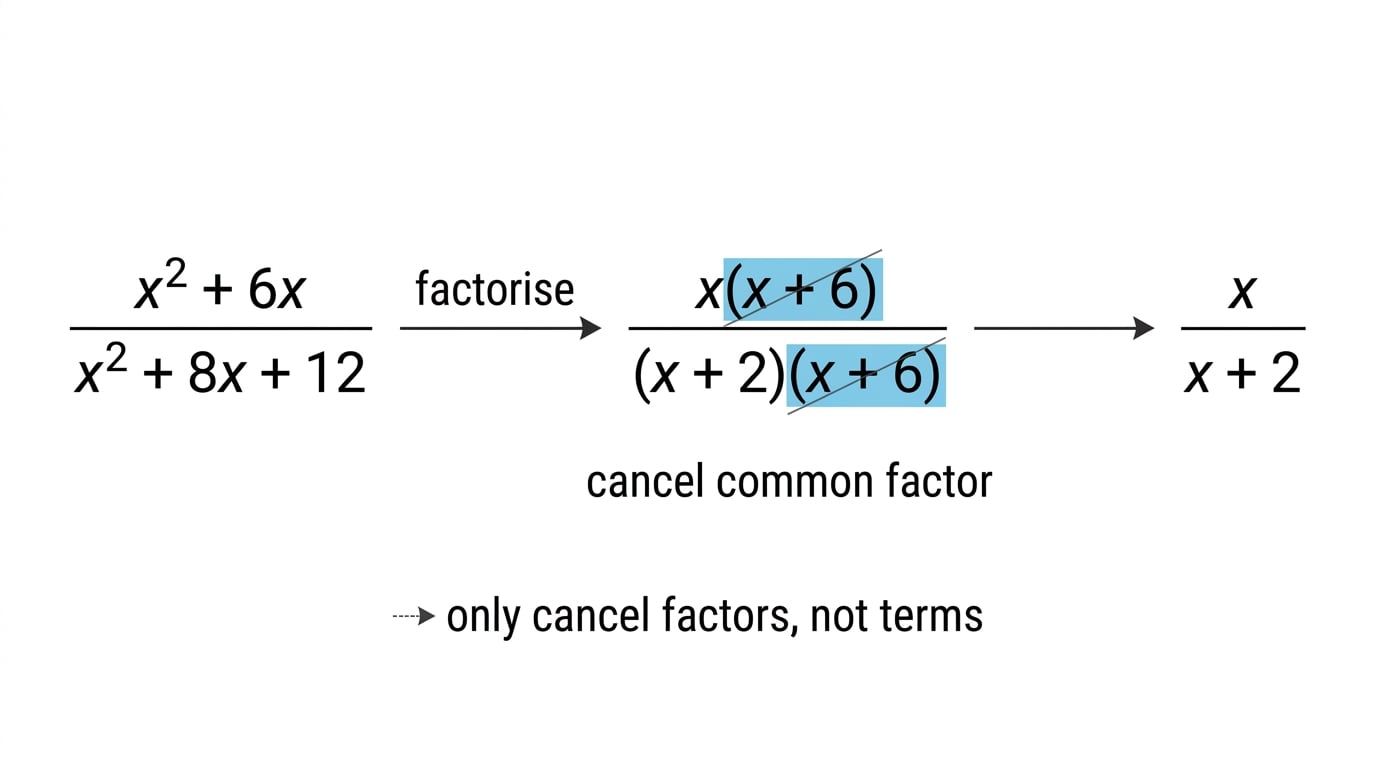
Only cancel factors
You can cancel a bracket or expression only when it is multiplying the whole numerator and the whole denominator.

Simplifying by cancelling a common factor
Simplify fully x2+6xx2+8x+12\frac{x^2+6x}{x^2+8x+12}x2+8x+12x2+6x.

-
Factorise the numerator by taking out the common factor xxx:
x2+6x=x(x+6)x^2+6x=x(x+6)x2+6x=x(x+6) -
Factorise the denominator by finding two numbers that multiply to 12 and add to 8:
x2+8x+12=(x+2)(x+6)x^2+8x+12=(x+2)(x+6)x2+8x+12=(x+2)(x+6) -
Rewrite the fraction using these factors:
x2+6xx2+8x+12=x(x+6)(x+2)(x+6)\frac{x^2+6x}{x^2+8x+12}=\frac{x(x+6)}{(x+2)(x+6)}x2+8x+12x2+6x=(x+2)(x+6)x(x+6) -
Cancel the common factor x+6x+6x+6:
xx+2\frac{x}{x+2}x+2x
Cancelling terms
Do not cancel part of a sum. In x+4x2−16\frac{x+4}{x^2-16}x2−16x+4, you cannot cancel the xxx with x2x^2x2 or the 4 with 16. Factorise first.
2. Factorising first
Factorising means rewriting an expression as a product, which means a multiplication.
You will often need these three patterns:
- Common factor: 3x2+9x=3x(x+3)3x^2+9x=3x(x+3)3x2+9x=3x(x+3)
- Quadratic factorising: x2+7x+10=(x+5)(x+2)x^2+7x+10=(x+5)(x+2)x2+7x+10=(x+5)(x+2)
- Difference of two squares: x2−25=(x−5)(x+5)x^2-25=(x-5)(x+5)x2−25=(x−5)(x+5)
Difference of two squares
A difference of two squares has the form a2−b2a^2-b^2a2−b2 and factorises to (a−b)(a+b)(a-b)(a+b)(a−b)(a+b).
Using a difference of two squares
Simplify fully 4x2+16xx2−16\frac{4x^2+16x}{x^2-16}x2−164x2+16x.

-
Factorise the numerator by taking out the common factor 4x4x4x:
4x2+16x=4x(x+4)4x^2+16x=4x(x+4)4x2+16x=4x(x+4) -
Factorise the denominator as a difference of two squares:
x2−16=(x−4)(x+4)x^2-16=(x-4)(x+4)x2−16=(x−4)(x+4) -
Rewrite the fraction:
4x2+16xx2−16=4x(x+4)(x−4)(x+4)\frac{4x^2+16x}{x^2-16}=\frac{4x(x+4)}{(x-4)(x+4)}x2−164x2+16x=(x−4)(x+4)4x(x+4) -
Cancel the common factor x+4x+4x+4:
4xx−4\frac{4x}{x-4}x−44x
Cancelled factors still mattered originally
If a factor in the denominator is cancelled, the original denominator still could not be zero. In most simplifying questions you give the simplified fraction, but remember this when solving equations.
3. Writing an algebraic fraction in a requested form
Sometimes a question asks you to write the answer in a form like ax+bx+c\frac{ax+b}{x+c}x+cax+b.
Here, aaa, bbb, and ccc are integers, meaning whole numbers, including negative numbers and zero.
The method is still the same: factorise, cancel common factors, then match the form.
Writing in the form requested
Write 2x2+11x+5x2+6x+5\frac{2x^2+11x+5}{x^2+6x+5}x2+6x+52x2+11x+5 in the form ax+bx+c\frac{ax+b}{x+c}x+cax+b.

-
Factorise the numerator:
2x2+11x+5=(2x+1)(x+5)2x^2+11x+5=(2x+1)(x+5)2x2+11x+5=(2x+1)(x+5) -
Factorise the denominator:
x2+6x+5=(x+1)(x+5)x^2+6x+5=(x+1)(x+5)x2+6x+5=(x+1)(x+5) -
Rewrite the fraction:
2x2+11x+5x2+6x+5=(2x+1)(x+5)(x+1)(x+5)\frac{2x^2+11x+5}{x^2+6x+5}=\frac{(2x+1)(x+5)}{(x+1)(x+5)}x2+6x+52x2+11x+5=(x+1)(x+5)(2x+1)(x+5) -
Cancel the common factor x+5x+5x+5:
2x+1x+1\frac{2x+1}{x+1}x+12x+1 -
Match it to ax+bx+c\frac{ax+b}{x+c}x+cax+b, so a=2a=2a=2, b=1b=1b=1, and c=1c=1c=1.
Check your factorising
After factorising, quickly expand your brackets in your head. If they do not return to the original expression, fix the factorising before cancelling.
4. Dividing algebraic fractions
To divide by a fraction, multiply by its reciprocal.
Reciprocal
The reciprocal of a fraction is the fraction turned upside down. For example, the reciprocal of x+1x−3\frac{x+1}{x-3}x−3x+1 is x−3x+1\frac{x-3}{x+1}x+1x−3.
Keep, change, flip
Keep the first fraction, change division to multiplication, and flip the second fraction.
Dividing algebraic fractions
Simplify fully 2x+4x−3÷x2+5x+6x2−3x\frac{2x+4}{x-3}\div\frac{x^2+5x+6}{x^2-3x}x−32x+4÷x2−3xx2+5x+6.

-
Factorise everything first:
2x+4=2(x+2)2x+4=2(x+2)2x+4=2(x+2) x2+5x+6=(x+2)(x+3)x^2+5x+6=(x+2)(x+3)x2+5x+6=(x+2)(x+3) x2−3x=x(x−3)x^2-3x=x(x-3)x2−3x=x(x−3) -
Rewrite the division as multiplication by the reciprocal:
2(x+2)x−3×x(x−3)(x+2)(x+3)\frac{2(x+2)}{x-3}\times\frac{x(x-3)}{(x+2)(x+3)}x−32(x+2)×(x+2)(x+3)x(x−3) -
Cancel the common factors x+2x+2x+2 and x−3x-3x−3:
2xx+3\frac{2x}{x+3}x+32x
Forgetting to flip
When dividing algebraic fractions, only the second fraction is flipped. The first fraction stays exactly where it is.
5. Solving equations with algebraic fractions
An equation is a statement that two expressions are equal. When fractions are involved, the usual aim is to remove the denominators.
A common denominator is an expression that all the denominators divide into. Multiplying every term by the common denominator clears the fractions.
Solving an algebraic fraction equation
Solve 3x+2+4x+7=1\frac{3}{x+2}+\frac{4}{x+7}=1x+23+x+74=1.

-
Exclude values that make denominators zero:
x≠−2,x≠−7x\neq -2,\quad x\neq -7x=−2,x=−7 -
Multiply every term by the common denominator (x+2)(x+7)(x+2)(x+7)(x+2)(x+7):
3(x+7)+4(x+2)=(x+2)(x+7)3(x+7)+4(x+2)=(x+2)(x+7)3(x+7)+4(x+2)=(x+2)(x+7) -
Expand both sides:
3x+21+4x+8=x2+9x+143x+21+4x+8=x^2+9x+143x+21+4x+8=x2+9x+14 -
Collect all terms on one side:
0=x2+2x−150=x^2+2x-150=x2+2x−15 -
Factorise and solve:
(x+5)(x−3)=0(x+5)(x-3)=0(x+5)(x−3)=0 x=−5orx=3x=-5\quad\text{or}\quad x=3x=−5orx=3 -
Check neither answer was excluded, so the solutions are x=−5x=-5x=−5 and x=3x=3x=3.
Multiply every term
If an equation has three terms, all three must be multiplied by the common denominator — not just the fractions on one side.
6. Ratio statements as fractions
A ratio compares two quantities. A statement like A:B=C:DA:B=C:DA:B=C:D can be rewritten as AB=CD\frac{A}{B}=\frac{C}{D}BA=DC.
Then you can cross multiply, which means multiplying each numerator by the opposite denominator.
Solving a ratio equation
Given that x+4:x+1=x+8:3x+2x+4:x+1=x+8:3x+2x+4:x+1=x+8:3x+2, find the possible values of xxx.

-
Rewrite the ratio as a fraction equation:
x+4x+1=x+83x+2\frac{x+4}{x+1}=\frac{x+8}{3x+2}x+1x+4=3x+2x+8 -
Exclude values that make denominators zero:
x≠−1,x≠−23x\neq -1,\quad x\neq -\frac{2}{3}x=−1,x=−32 -
Cross multiply:
(x+4)(3x+2)=(x+8)(x+1)(x+4)(3x+2)=(x+8)(x+1)(x+4)(3x+2)=(x+8)(x+1) -
Expand both sides:
3x2+14x+8=x2+9x+83x^2+14x+8=x^2+9x+83x2+14x+8=x2+9x+8 -
Collect terms and factorise:
2x2+5x=02x^2+5x=02x2+5x=0 x(2x+5)=0x(2x+5)=0x(2x+5)=0 -
Solve and check the excluded values:
x=0orx=−52x=0\quad\text{or}\quad x=-\frac{5}{2}x=0orx=−25
In the exam
-
Factorise every numerator and denominator before you cancel anything.
-
Cancel only common factors, especially brackets such as x+3x+3x+3.
-
When solving, write down excluded values first, then multiply every term by the common denominator.
Check yourself
-
Can you explain why x+4x2−16\frac{x+4}{x^2-16}x2−16x+4 simplifies only after factorising the denominator?
-
When dividing two algebraic fractions, which fraction do you flip?
-
In an equation like 5x−1+2x+3=1\frac{5}{x-1}+\frac{2}{x+3}=1x−15+x+32=1, what values of xxx must be excluded before solving?