x

Similar Shapes (Area and Volume)

What you'll learn

  • Recognise when 3D shapes are the same shape but different sizes.
  • Use matching lengths to find the correct scale factor.
  • Convert a length scale factor into an area or volume scale factor.
  • Work backwards from surface area, and solve frustum questions by subtracting volumes.

1. Similar shapes and scale factor

Definition

Similarity vocabulary

  • Mathematically similar shapes, also called geometrically similar shapes, have the same shape. One is a bigger or smaller copy of the other.
  • Corresponding lengths are matching measurements in the same position, such as radius with radius, height with height, or diameter with diameter.
  • The linear scale factor, usually called kkk, is the multiplier that changes a length on one shape into the matching length on another shape.
  • Surface area is the total outside area of a 3D shape.
  • Volume is the amount of 3D space inside a solid shape.

For similar shapes, every corresponding length is multiplied by the same scale factor.

Two similar cuboids show that matching lengths are all multiplied by the same linear scale factor.

If you are going from shape A to shape B:

k=length on Bmatching length on Ak=\frac{\text{length on B}}{\text{matching length on A}}k=matching length on Alength on B​

The direction matters. A to B might have a different scale factor from B to A.

Example

Finding a length scale factor

Two similar cones have base radii 6 cm and 15 cm. The smaller cone has height 10 cm. Find the height of the larger cone.

The corresponding radii give the scale factor from the smaller cone to the larger cone, which is then applied to the height.

  1. Match the radii: 6 cm on the smaller cone corresponds to 15 cm on the larger cone.

  2. Find the scale factor from smaller to larger:

    k=156=52k=\frac{15}{6}=\frac{5}{2}k=615​=25​
  3. Multiply the smaller height by the same scale factor:

    10×52=2510 \times \frac{5}{2}=2510×25​=25
  4. The height of the larger cone is 25 cm.

Tip

Label the direction

Write something like “small →\to→ large” before calculating. If you are enlarging, kkk should be bigger than 1. If you are shrinking, kkk should be less than 1.

2. Surface area: square the scale factor

Area is based on two lengths: length by length. So if all lengths are multiplied by kkk, all areas are multiplied by k2k^2k2.

Key Idea

Area scale factor

If the length scale factor is kkk, then the surface area scale factor is k2k^2k2.

Example

Similar cylinders and surface area

Two similar cylinders are labelled A and B. The height of B is 3 times the height of A. The total surface area of A is 120 cm². Find the total surface area of B.

Cylinder B is a three-times enlargement of cylinder A, so its surface area is scaled by the square of 3.

  1. Height is a length, so the length scale factor from A to B is 3.

  2. Square the length scale factor to get the area scale factor:

    32=93^2=932=9
  3. Multiply the surface area of A by 9:

    120×9=1080120 \times 9=1080120×9=1080
  4. The total surface area of B is 1080 cm².

Common Mistake

Using the length scale factor on area

If a length doubles, the surface area does not just double. It is multiplied by 4, because the area scale factor is 222^222.

3. Volume: cube the scale factor

Volume is based on three lengths: length by width by height. So if all lengths are multiplied by kkk, all volumes are multiplied by k3k^3k3.

Key Idea

Volume scale factor

If the length scale factor is kkk, then the volume scale factor is k3k^3k3.

Example

Similar cylinders and volume

Two similar cylinders have lengths 5 cm and 8 cm. The smaller cylinder has volume 250 cm³. Find the volume of the larger cylinder.

The matching cylinder lengths 5 cm and 8 cm determine the linear scale factor before cubing for volume.

  1. Use the corresponding lengths to find the scale factor from smaller to larger:

    k=85k=\frac{8}{5}k=58​
  2. Cube the scale factor to get the volume scale factor:

    (85)3=512125\left(\frac{8}{5}\right)^3=\frac{512}{125}(58​)3=125512​
  3. Multiply the smaller volume by the volume scale factor:

    250×512125=1024250 \times \frac{512}{125}=1024250×125512​=1024
  4. The volume of the larger cylinder is 1024 cm³.

If you are going from a larger shape to a smaller shape, you can either use a fractional scale factor or divide by the volume scale factor. Both methods work, as long as your direction is clear.

4. Working backwards from surface area

Sometimes you are given two surface areas, but asked for a volume. In that case, you must work in stages:

  1. Find the area scale factor.
  2. Square root it to get the length scale factor.
  3. Cube the length scale factor to get the volume scale factor.
Example

Using surface area to find volume

Two similar solid shapes X and Y have total surface areas 180 cm² and 320 cm². The volume of X is 540 cm³. Find the volume of Y.

The surface areas of similar solids are used first, then converted through the length scale factor to compare volumes.

  1. Find the area scale factor from X to Y:

    320180=169\frac{320}{180}=\frac{16}{9}180320​=916​
  2. Square root the area scale factor to get the length scale factor:

    k=169=43k=\sqrt{\frac{16}{9}}=\frac{4}{3}k=916​​=34​
  3. Cube the length scale factor to get the volume scale factor:

    (43)3=6427\left(\frac{4}{3}\right)^3=\frac{64}{27}(34​)3=2764​
  4. Multiply the volume of X by the volume scale factor:

    540×6427=1280540 \times \frac{64}{27}=1280540×2764​=1280
  5. The volume of Y is 1280 cm³.

Common Mistake

Cubing the area ratio

Do not cube the area scale factor. The area scale factor already has a square built into it, so square-root it first.

5. Frustums: subtract cone volumes

Definition

Frustum

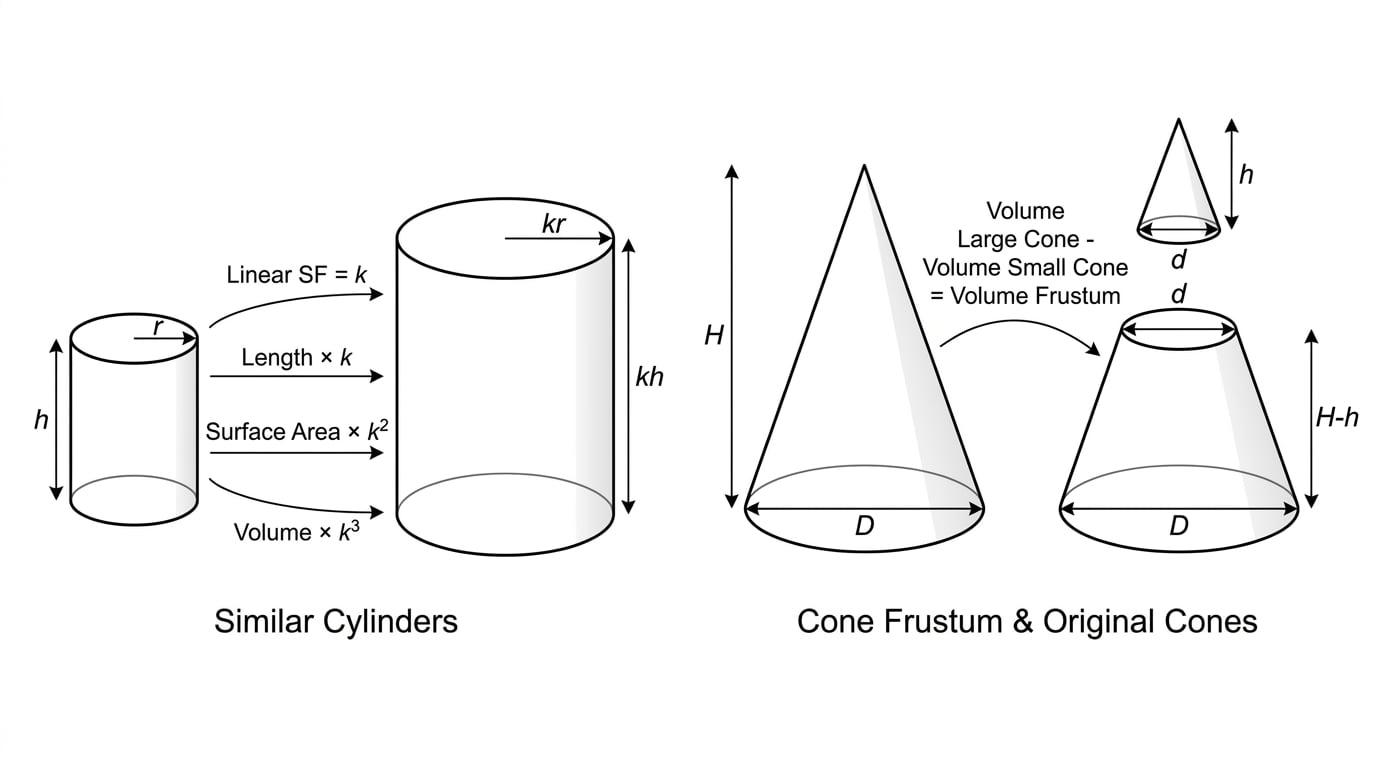
A frustum is the solid left when the top of a cone or pyramid has been cut off parallel to its base. For cone questions, the frustum volume is found by subtracting the small cone volume from the large cone volume.

A cone frustum is the lower part of a cone after a smaller similar cone is cut off parallel to the base.

For a cone:

V=13πr2hV=\frac{1}{3}\pi r^2hV=31​πr2h

Here, rrr is the radius and hhh is the height. The diameter is the full width across a circle through the centre, so the radius is half the diameter.

An answer “in terms of π\piπ” means leave π\piπ in your answer rather than using a decimal approximation.

Example

Volume of a frustum

A large cone has height 9 cm and base diameter 24 cm. A smaller similar cone at the top has height 3 cm and base diameter 8 cm. Find the volume of the frustum in terms of π\piπ.

The frustum volume is found by subtracting the small top cone from the full large cone, using radii half the given diameters.

  1. Convert the diameters into radii:

    rlarge=12rsmall=4\begin{aligned} r_{\text{large}}&=12\\ r_{\text{small}}&=4 \end{aligned}rlarge​rsmall​​=12=4​
  2. Find the volume of the large cone:

    Vlarge=13π×122×9=432πV_{\text{large}}=\frac{1}{3}\pi \times 12^2 \times 9=432\piVlarge​=31​π×122×9=432π
  3. Find the volume of the small cone:

    Vsmall=13π×42×3=16πV_{\text{small}}=\frac{1}{3}\pi \times 4^2 \times 3=16\piVsmall​=31​π×42×3=16π
  4. Subtract to get the frustum volume:

    Vfrustum=432π−16π=416πV_{\text{frustum}}=432\pi-16\pi=416\piVfrustum​=432π−16π=416π
  5. The volume of the frustum is 416π416\pi416π cm³.

Common Mistake

Using diameter instead of radius

The cone formula uses radius, not diameter. If a question gives a diameter, halve it before substituting into the formula.

Exam technique

In the exam

  1. Write the direction of your scale factor, such as A →\to→ B.
  2. Decide whether the question is about length, surface area, or volume.
  3. Use kkk for lengths, k2k^2k2 for surface areas, and k3k^3k3 for volumes.
  4. If you start with surface areas but need volume, square-root first, then cube.
  5. Check whether your answer should be bigger or smaller than the original.
Self review

Check yourself

  • If the length scale factor is 3, what are the surface area and volume scale factors?
  • Two similar solids have surface areas in the ratio 25:49. What is the length ratio?
  • Why do you subtract two cone volumes to find the volume of a frustum?

Recap questions

Test yourself with 5 quick questions on this guide. Answer them all correctly to complete it.

How was this guide?

Similar Shapes (Area and Volume) Revision Guide

  1. GCSE
  2. /Maths
  3. /Similar Shapes (Area and Volume)