Parallel and Perpendicular Lines
What you'll learn
- How to read the gradient from a straight-line equation.
- How to write equations of parallel lines.
- How to write equations of perpendicular lines.
- How to use two points, or an unknown value like kkk, to find a line’s gradient.
1. Start with y=mx+cy=mx+cy=mx+c
Most questions in this topic are about comparing gradients. So your first job is often to get the equation into the form y=mx+cy=mx+cy=mx+c.
Gradient and y-intercept
- The gradient tells you the steepness and direction of a straight line. In y=mx+cy=mx+cy=mx+c, the gradient is mmm.

- The y-intercept is where the line crosses the y-axis. In y=mx+cy=mx+cy=mx+c, the y-intercept is ccc.
“Make yyy the subject” means rearrange the equation so that yyy is on its own.
Finding the gradient
-
Start with the equation 6y=3x−126y=3x-126y=3x−12.
-
Divide every term by 6 to make yyy the subject: y=12x−2y=\frac{1}{2}x-2y=21x−2.
-
Compare it with y=mx+cy=mx+cy=mx+c.
-
The gradient is m=12m=\frac{1}{2}m=21 and the y-intercept is c=−2c=-2c=−2.
Reading the wrong coefficient
In 2x+5y=102x+5y=102x+5y=10, the coefficient of xxx is not the gradient yet. Rearrange first until yyy is on its own.
2. Parallel lines
Parallel lines
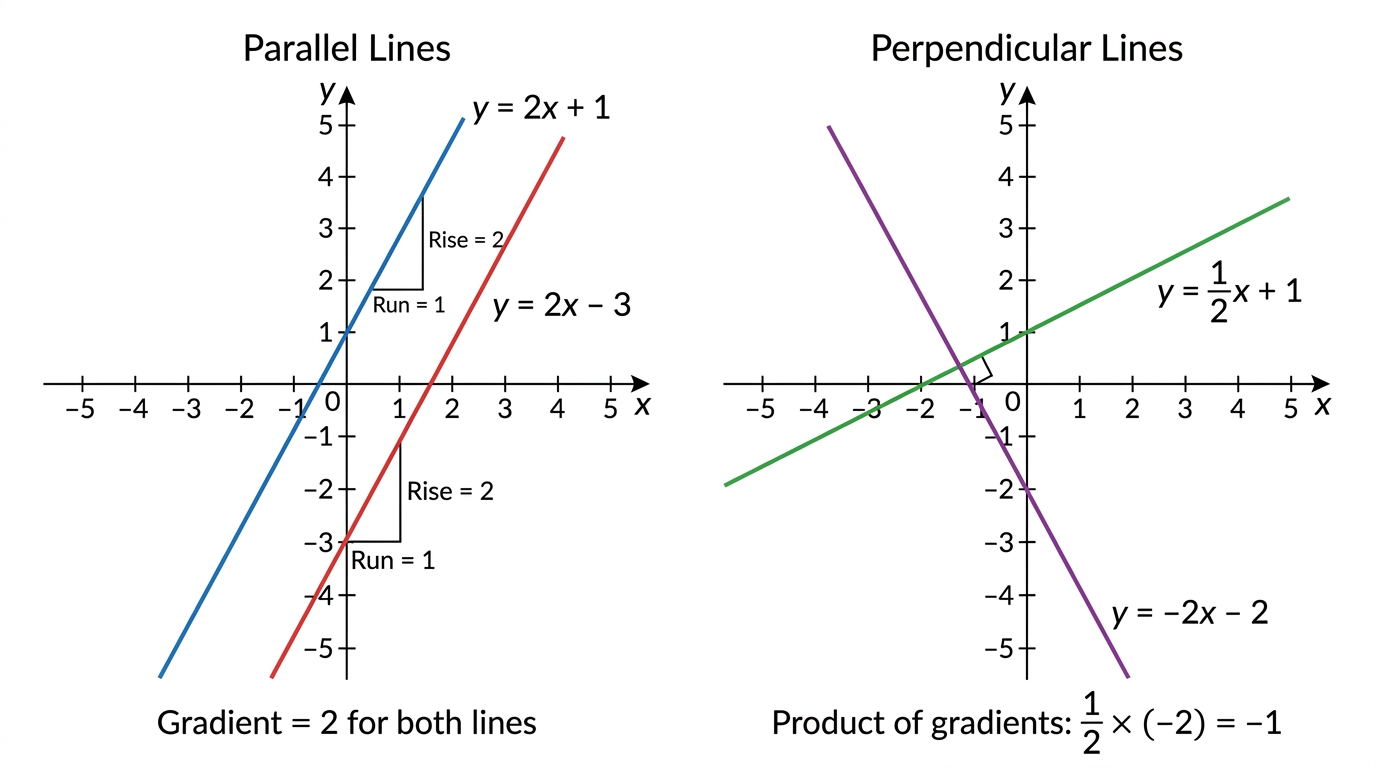
Parallel lines are straight lines that never meet. In y=mx+cy=mx+cy=mx+c form, parallel lines have the same gradient.

The y-intercept can change, but the gradient must stay the same.
Parallel line through the y-axis
-
The line y=−3x+8y=-3x+8y=−3x+8 has gradient m=−3m=-3m=−3.
-
A parallel line has the same gradient, so start with y=−3x+cy=-3x+cy=−3x+c.
-
Passing through (0, 5) means the y-intercept is 5, so c=5c=5c=5.
-
The equation is y=−3x+5y=-3x+5y=−3x+5.
When it says “a line”
If no point is given, there are many correct answers. For example, a line parallel to y=3x+1y=3x+1y=3x+1 could be y=3x−4y=3x-4y=3x−4.
3. Perpendicular lines
Perpendicular lines
Perpendicular lines meet at a right angle, 90°. For usual straight lines in y=mx+cy=mx+cy=mx+c form, their gradients are negative reciprocals, meaning you flip the fraction and change the sign. Their gradients satisfy m1m2=−1m_1m_2=-1m1m2=−1.

For example:
- m=4m=4m=4 becomes m=−14m=-\frac{1}{4}m=−41.
- m=−23m=-\frac{2}{3}m=−32 becomes m=32m=\frac{3}{2}m=23.
Perpendicular line through the y-axis
-
The line y=14x−2y=\frac{1}{4}x-2y=41x−2 has gradient m=14m=\frac{1}{4}m=41.
-
A perpendicular line has gradient m=−4m=-4m=−4.
-
Passing through (0, -6) means the y-intercept is -6, so c=−6c=-6c=−6.
-
The equation is y=−4x−6y=-4x-6y=−4x−6.
Only doing half the reciprocal rule
For perpendicular gradients, you must do both parts: flip the fraction and change the sign.
Horizontal and vertical lines
The negative-reciprocal rule assumes both lines can be written as y=mx+cy=mx+cy=mx+c. A horizontal line like y=4y=4y=4 is perpendicular to a vertical line like x=−1x=-1x=−1.

4. If the equation is not already in y=mx+cy=mx+cy=mx+c
Sometimes the given line is written in a different form, such as 3x+6y=123x+6y=123x+6y=12. Always rearrange first, then use the parallel or perpendicular rule.
Rearrange first, then use the rule
-
Rearrange 3x+6y=123x+6y=123x+6y=12 by subtracting 3x3x3x: 6y=−3x+126y=-3x+126y=−3x+12.
-
Divide by 6: y=−12x+2y=-\frac{1}{2}x+2y=−21x+2.
-
The given line has gradient m=−12m=-\frac{1}{2}m=−21.
-
A perpendicular line has gradient m=2m=2m=2.
-
Passing through (0, 7) gives c=7c=7c=7.
-
The equation is y=2x+7y=2x+7y=2x+7.
5. Using two points to find a gradient
If a line is described using two points, calculate its gradient first.
Gradient between two points
For points (x1,y1)(x_1,y_1)(x1,y1) and (x2,y2)(x_2,y_2)(x2,y2), the gradient is m=y2−y1x2−x1m=\frac{y_2-y_1}{x_2-x_1}m=x2−x1y2−y1: change in yyy divided by change in xxx.

Once you know the gradient, use y=mx+cy=mx+cy=mx+c. To substitute a point means to replace xxx and yyy with that point’s coordinates.
Parallel line from two points
- Line A passes through (1, 2) and (5, 14), so its gradient is m=14−25−1=3m=\frac{14-2}{5-1}=3m=5−114−2=3.

-
A parallel line also has gradient m=3m=3m=3.
-
Start with y=3x+cy=3x+cy=3x+c.
-
Use the point (2, 3): 3=3(2)+c3=3(2)+c3=3(2)+c.
-
Solve to get c=−3c=-3c=−3.
-
The equation is y=3x−3y=3x-3y=3x−3.
Perpendicular line from two points
- Line A passes through (0, 4) and (6, 7), so its gradient is m=7−46−0=12m=\frac{7-4}{6-0}=\frac{1}{2}m=6−07−4=21.

-
A perpendicular line has gradient m=−2m=-2m=−2.
-
Start with y=−2x+cy=-2x+cy=−2x+c.
-
Use the point (1, 5): 5=−2(1)+c5=-2(1)+c5=−2(1)+c.
-
Solve to get c=7c=7c=7.
-
The equation is y=−2x+7y=-2x+7y=−2x+7.
Gradient fraction upside down
Gradient is change in yyy over change in xxx. Keep the order of the two points consistent in the numerator and denominator.
6. Showing lines are parallel or perpendicular
When a question says “show that”, you need evidence. Calculate both gradients and then make a clear statement.
Showing two lines are parallel
-
Line A passes through (1, 2) and (3, 8), so mA=8−23−1=3m_A=\frac{8-2}{3-1}=3mA=3−18−2=3.
-
Line B passes through (-2, 1) and (0, 7), so mB=7−10−(−2)=3m_B=\frac{7-1}{0-(-2)}=3mB=0−(−2)7−1=3.
-
The gradients are equal, so the two lines are parallel.
For perpendicular lines, show that the gradients multiply to -1.
7. Finding an unknown value like kkk
If a coordinate contains kkk, write the gradient using kkk, then set it equal to the gradient you need.
Finding using perpendicular gradients
-
Line A passes through (-1, 2) and (3, 4), so mA=4−23−(−1)=12m_A=\frac{4-2}{3-(-1)}=\frac{1}{2}mA=3−(−1)4−2=21.
-
A perpendicular line must have gradient m=−2m=-2m=−2.
-
Line B passes through (2, 5) and (kkk, -1), so its gradient is mB=−1−5k−2=−6k−2m_B=\frac{-1-5}{k-2}=\frac{-6}{k-2}mB=k−2−1−5=k−2−6.

-
Set this equal to -2: −6k−2=−2\frac{-6}{k-2}=-2k−2−6=−2.
-
Solve: −6=−2(k−2)-6=-2(k-2)−6=−2(k−2), so −6=−2k+4-6=-2k+4−6=−2k+4, giving k=5k=5k=5.
In the exam
-
Rearrange into y=mx+cy=mx+cy=mx+c before deciding on the gradient.
-
For parallel lines, keep the same gradient; for perpendicular lines, flip the fraction and change the sign.
-
If points are given, calculate m=change in ychange in xm=\frac{\text{change in }y}{\text{change in }x}m=change in xchange in y carefully, then state your conclusion clearly.
Check yourself
-
What gradient would a line perpendicular to y=35x−2y=\frac{3}{5}x-2y=53x−2 have?
-
Can you rearrange 2x+3y=92x+3y=92x+3y=9 into y=mx+cy=mx+cy=mx+c and identify the gradient?
-
If two lines have gradients m=4m=4m=4 and m=−14m=-\frac{1}{4}m=−41, what is their relationship?