What you'll learn
- How to evaluate powers like 7−17^{-1}7−1 and (35)−1\left(\frac{3}{5}\right)^{-1}(53)−1.
- How powers like 12112121^{\frac{1}{2}}12121 and 21613216^{\frac{1}{3}}21631 link to square and cube calculations.
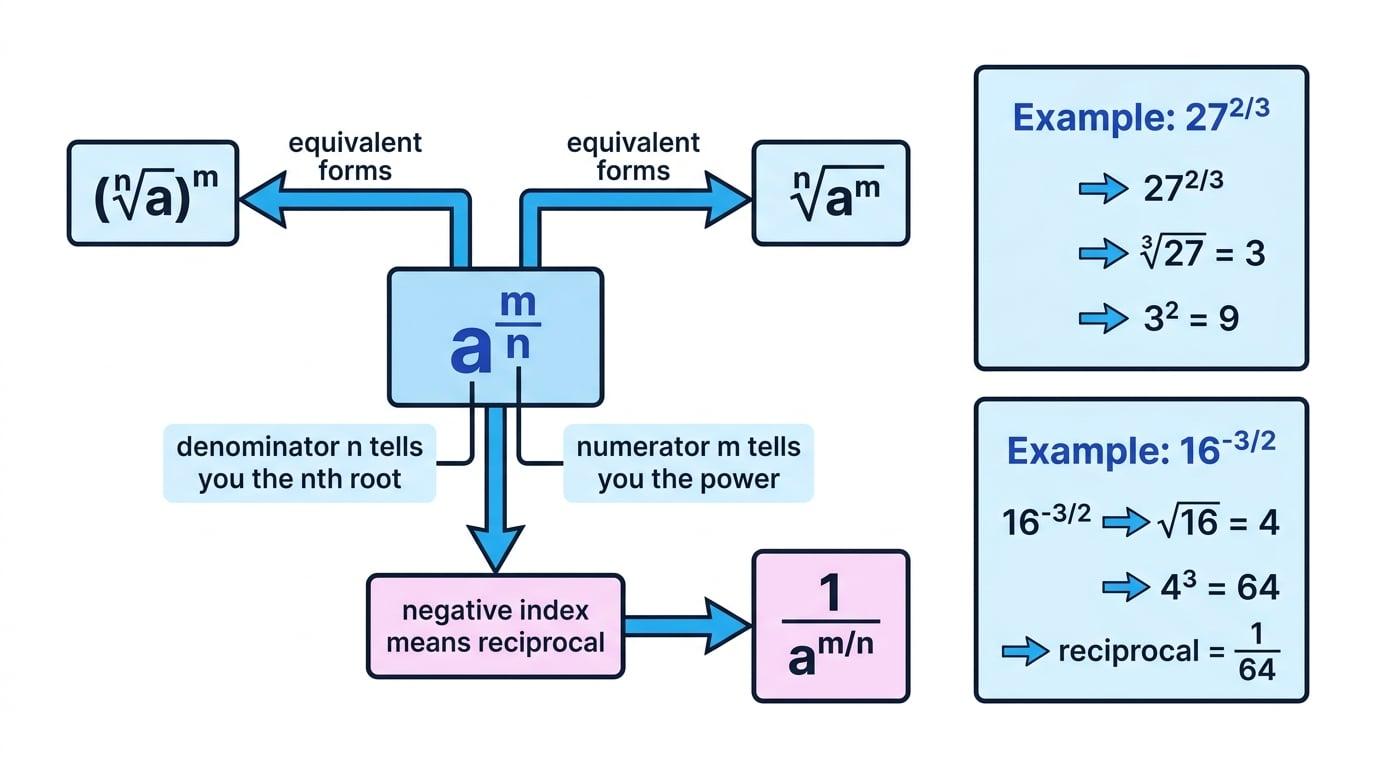
- How to handle powers such as 272327^{\frac{2}{3}}2732 and 16−3216^{-\frac{3}{2}}16−23.
- How to rewrite expressions using rules for powers.
1. Starting point: bases and indices
A power is a compact way of writing repeated multiplication.
For example, 242^424 means 2 multiplied by itself 4 times.
Base and index
- In ana^nan, the base is aaa: the number or expression being powered.
- The index is nnn: the small number telling you the power. The plural of index is indices.
The key index laws you need are:

These work directly when the base is the same.
Rewriting powers with the same base
Suppose x=2px=2^px=2p and y=2qy=2^qy=2q. Express 2p+q2^{p+q}2p+q and 2q−22^{q-2}2q−2 in terms of xxx and/or yyy.
-
Split 2p+q2^{p+q}2p+q using the multiplying law.
2p+q=2p⋅2q2^{p+q}=2^p\cdot 2^q2p+q=2p⋅2q -
Substitute x=2px=2^px=2p and y=2qy=2^qy=2q.
2p+q=xy2^{p+q}=xy2p+q=xy -
Split 2q−22^{q-2}2q−2 using the dividing law.
2q−2=2q22=y42^{q-2}=\frac{2^q}{2^2}=\frac{y}{4}2q−2=222q=4y
2. Negative indices mean reciprocals
Reciprocal
The reciprocal of a non-zero number is 1 divided by that number. In symbols, a−1=1aa^{-1}=\frac{1}{a}a−1=a1 for a≠0a\neq0a=0.
So a negative index does not mean “make the answer negative”. It means “put it over 1”.
The general rule is:
a−n=1ana^{-n}=\frac{1}{a^n}a−n=an1Finding values with a negative index
Find the value of 6−16^{-1}6−1 and (37)−1\left(\frac{3}{7}\right)^{-1}(73)−1.

-
A power of -1 means “find the reciprocal”.
6−1=166^{-1}=\frac{1}{6}6−1=61 -
For a fraction, the reciprocal is found by flipping the numerator and denominator.
(37)−1=73\left(\frac{3}{7}\right)^{-1}=\frac{7}{3}(73)−1=37
Negative index does not mean negative answer
Do not turn 6−16^{-1}6−1 into -6. The correct value is 16\frac{1}{6}61.
Zero is different
Negative index rules need a non-zero base. For example, 0−10^{-1}0−1 would mean 10\frac{1}{0}01, which is undefined.
3. Fractional indices as roots
Root
A root is the opposite of a power. a\sqrt{a}a is the number whose square is aaa, and a3\sqrt[3]{a}3a is the number whose cube is aaa.
The most common fractional indices are:
a12=a,a13=a3a^{\frac{1}{2}}=\sqrt{a}, \qquad a^{\frac{1}{3}}=\sqrt[3]{a}a21=a,a31=3aSo the denominator of the fraction tells you the type of root.
Evaluating powers of one half and one third
Find the value of 14412144^{\frac{1}{2}}14421 and 21613216^{\frac{1}{3}}21631.

-
A power of 12\frac{1}{2}21 means square root.
14412=144=12144^{\frac{1}{2}}=\sqrt{144}=1214421=144=12 -
A power of 13\frac{1}{3}31 means cube root.
21613=2163=6216^{\frac{1}{3}}=\sqrt[3]{216}=621631=3216=6
Square roots in GCSE questions
When you are asked to “find the value” of something like 491249^{\frac{1}{2}}4921, use the positive square root, so the answer is 7.
4. General fractional indices
Fractional index
A fractional index is a power written as a fraction. For positive aaa, the rule is amn=(an)ma^{\frac{m}{n}}=\left(\sqrt[n]{a}\right)^manm=(na)m.
The denominator tells you the root. The numerator tells you the power.
Root first is usually easier
For amna^{\frac{m}{n}}anm, take the nnnth root first, then raise the result to the power mmm.

Evaluating a fractional index
Find the value of 272327^{\frac{2}{3}}2732.

-
The denominator is 3, so take the cube root first.
273=3\sqrt[3]{27}=3327=3 -
The numerator is 2, so square the result.
2723=(273)2=32=927^{\frac{2}{3}}=\left(\sqrt[3]{27}\right)^2=3^2=92732=(327)2=32=9
5. Negative fractional indices
A negative fractional index combines both ideas:
- the fraction means root and power
- the negative sign means reciprocal
Order to use
For a−mna^{-\frac{m}{n}}a−nm, do the positive fractional power first, then take the reciprocal.
Evaluating a negative fractional index
Find the value of 16−3216^{-\frac{3}{2}}16−23.

-
Ignore the negative sign at first and work out 163216^{\frac{3}{2}}1623.
1632=(16)316^{\frac{3}{2}}=\left(\sqrt{16}\right)^31623=(16)3 -
Take the square root, then cube.
(16)3=43=64\left(\sqrt{16}\right)^3=4^3=64(16)3=43=64 -
The negative index means take the reciprocal.
16−32=16416^{-\frac{3}{2}}=\frac{1}{64}16−23=641
6. Fractions inside brackets
When the base is a fraction in brackets, the whole fraction is being powered.
Negative fractional index with a fraction
Find the value of (2764)−23\left(\frac{27}{64}\right)^{-\frac{2}{3}}(6427)−32.

-
First work out the positive fractional power.
(2764)23=(27643)2\left(\frac{27}{64}\right)^{\frac{2}{3}}=\left(\sqrt[3]{\frac{27}{64}}\right)^2(6427)32=(36427)2 -
Cube root the numerator and denominator.
27643=34\sqrt[3]{\frac{27}{64}}=\frac{3}{4}36427=43 -
Square the result.
(34)2=916\left(\frac{3}{4}\right)^2=\frac{9}{16}(43)2=169 -
Use the negative index to take the reciprocal.
(2764)−23=169\left(\frac{27}{64}\right)^{-\frac{2}{3}}=\frac{16}{9}(6427)−32=916
Missing the brackets
In (2764)−23\left(\frac{27}{64}\right)^{-\frac{2}{3}}(6427)−32, the whole fraction is the base. Keep the brackets in your working so you do not only power part of the fraction.
7. Brackets with variables
If a power is outside brackets, it applies to everything being multiplied inside the brackets.
For example, (ab)n=anbn(ab)^n=a^n b^n(ab)n=anbn.
Fractional index with a variable
Find the value of (27x6)23(27x^6)^{\frac{2}{3}}(27x6)32.
-
The denominator is 3, so take the cube root first.
27x63=3x2\sqrt[3]{27x^6}=3x^2327x6=3x2 -
The numerator is 2, so square the result.
(27x6)23=(3x2)2=9x4(27x^6)^{\frac{2}{3}}=(3x^2)^2=9x^4(27x6)32=(3x2)2=9x4
8. Roots with powers of 10
Sometimes it is easier to split a root into smaller parts, especially with powers of 10.
Using roots with powers of 10
Find the value of 81⋅1084\sqrt[4]{81\cdot10^8}481⋅108.
-
Split the fourth root into two useful parts.
81⋅1084=814⋅1084\sqrt[4]{81\cdot10^8}=\sqrt[4]{81}\cdot\sqrt[4]{10^8}481⋅108=481⋅4108 -
Work out each fourth root.
814=3,1084=102\sqrt[4]{81}=3, \qquad \sqrt[4]{10^8}=10^2481=3,4108=102 -
Multiply the results.
3⋅102=3003\cdot10^2=3003⋅102=300
9. Finding an unknown index
To find a missing index, try to write both sides using the same base. Then compare the indices.
Solving for an unknown index
Given that 9n=279^n=279n=27, find nnn.

-
Rewrite both numbers as powers of 3.
9=32,27=339=3^2, \qquad 27=3^39=32,27=33 -
Substitute these into the equation.
(32)n=33(3^2)^n=3^3(32)n=33 -
Use the power law.
32n=333^{2n}=3^332n=33 -
Match the indices and solve.
2n=3⇒n=322n=3 \Rightarrow n=\frac{3}{2}2n=3⇒n=23
Writing a root as a power
Given that 28=2n2\sqrt{8}=2^n28=2n, find nnn.
-
Write 8 as a power of 2.
8=23\sqrt{8}=\sqrt{2^3}8=23 -
Change the square root into a power of 12\frac{1}{2}21.
23=(23)12=232\sqrt{2^3}=(2^3)^{\frac{1}{2}}=2^{\frac{3}{2}}23=(23)21=223 -
Multiply powers with the same base by adding indices.
28=21⋅232=2522\sqrt{8}=2^1\cdot2^{\frac{3}{2}}=2^{\frac{5}{2}}28=21⋅223=225 -
Match with 2n2^n2n.
n=52n=\frac{5}{2}n=25
In the exam
-
Look at the sign of the index first: a negative index means reciprocal.
-
For a fractional index, use “denominator = root, numerator = power”.
-
If an unknown index is involved, rewrite numbers using the same base before comparing indices.
Check yourself
-
Can you explain why 5−15^{-1}5−1 is not -5?
-
Can you work out 64−2364^{-\frac{2}{3}}64−32 by doing the cube root first?
-
If x=3px=3^px=3p, can you express 3p+23^{p+2}3p+2 in terms of xxx?