Solving Quadratics
Teach Genie
Review Solving Quadratics by teaching Genie
Teach it back in your own words, spot gaps, and remember it better.

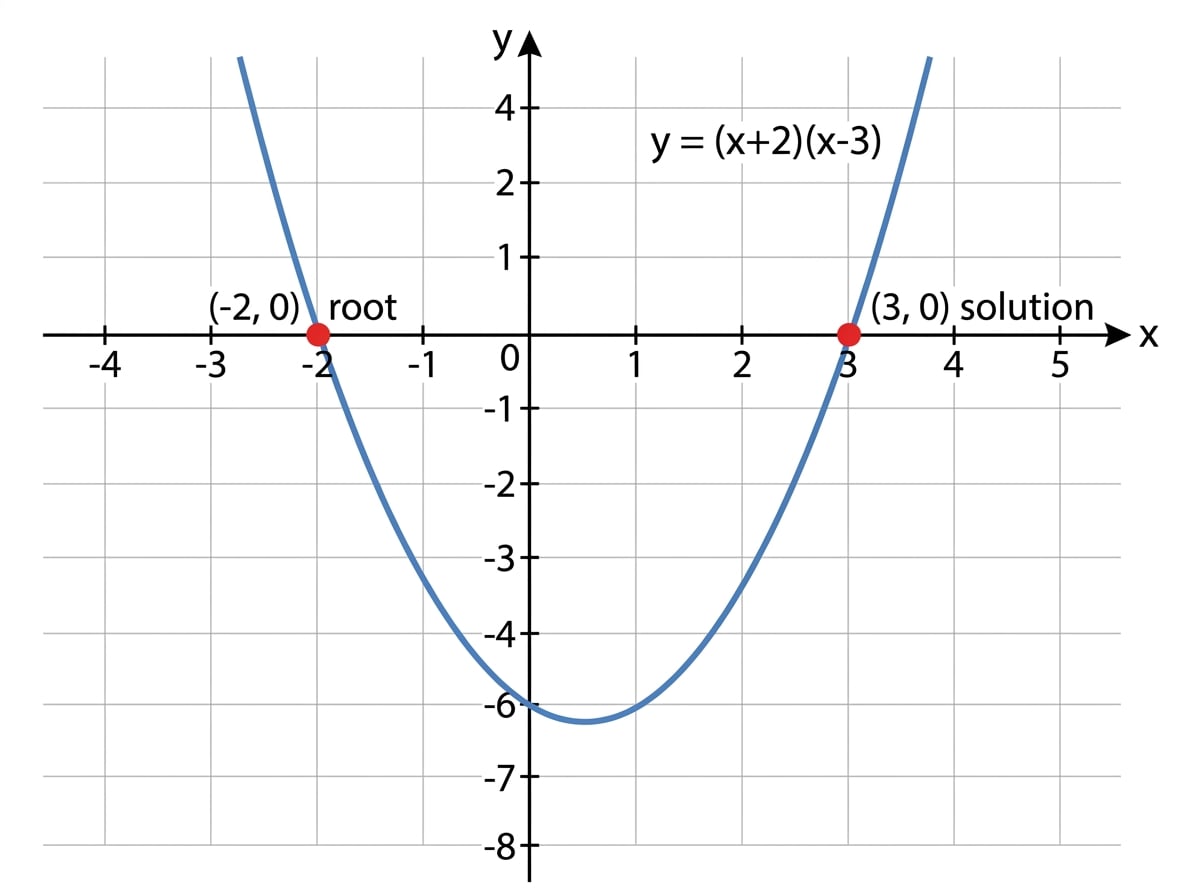
A quadratic equation has a squared term as its highest power, such as x2−x−6=0x^2-x-6=0x2−x−6=0. The graph above is of y=(x+2)(x−3)=x2−x−6y=(x+2)(x-3)=x^2-x-6y=(x+2)(x−3)=x2−x−6, so its roots are x=−2x=-2x=−2 and x=3x=3x=3. In this lesson, we focus on equations of the form x2+bx+c=0x^2+bx+c=0x2+bx+c=0, where the coefficient of x2x^2x2 is 1.
When we solve a quadratic, we are finding the values of the variable that make the equation true. On a graph, these values are the roots, where the curve crosses the x-axis.
A common GCSE method is factorising, which rewrites the quadratic as a product of two brackets. Then the zero product rule lets us solve each bracket.
Question 1
3 marksFactorise a2+3a−28a^2 + 3a - 28a2+3a−28
What is the highest power of the variable in a quadratic expression?
Solving Quadratics Revision Guide
Revision notes for WJEC GCSE Maths Solving Quadratics: explanations and worked examples.