Standard Form
What you'll learn
- Recognise what standard form looks like.
- Convert very large and very small numbers into and out of standard form.
- Multiply, divide, add, subtract, and compare numbers involving powers of 10.
- Use standard form in worded questions, including distance, mass, and formula problems.
Ordinary numbers and powers of 10
Before standard form, you need to be confident with place value and powers of 10.
Ordinary number and power of 10
- An ordinary number is a number written in the usual way, like 42000 or 0.0036.
- A power of 10 is a number such as 10310^3103 or 10−210^{-2}10−2.
- The small raised number is called the exponent or index. It tells you how many places the decimal point moves.
A positive exponent makes the number bigger. A negative exponent makes the number smaller.
Decimal movement
Multiplying by 10n10^n10n moves the decimal point right if nnn is positive, and left if nnn is negative.
Using powers of 10
- For 7.41×1037.41 \times 10^37.41×10³, the exponent is positive 3, so move the decimal point 3 places to the right.

-
This gives 7410.
-
For 7.41×10−27.41 \times 10^{-2}7.41×10⁻², the exponent is negative 2, so move the decimal point 2 places to the left.

- This gives 0.0741.
What counts as standard form?
Standard form
A number is in standard form when it is written as a×10na \times 10^na×10n, where 1≤a<101 \le a < 101≤a<10 and nnn is an integer, meaning a whole number. The front number aaa is called the coefficient.

So the coefficient must be at least 1 and less than 10.
For example, 4.6×1084.6 \times 10^84.6×10⁸ is in standard form, but 46×10746 \times 10^746×107 is not.
Fixing a number that is nearly standard form
- Write 0.48×1050.48 \times 10^50.48×10⁵ in standard form.

-
The coefficient 0.48 is too small, because it is less than 1.
-
Rewrite 0.48 as 4.8×10−14.8 \times 10^{-1}4.8×10⁻¹.
-
Combine the powers of 10: 10−1×105=10410^{-1} \times 10^5 = 10^410−1×105=104.
-
So 0.48×105=4.8×1040.48 \times 10^5 = 4.8 \times 10^40.48×105=4.8×10⁴.
Forgetting the front-number rule
12.3×10412.3 \times 10^412.3×10⁴ is not finished because 12.3 is not less than 10. Rewrite it as 1.23×1051.23 \times 10^51.23×10⁵.
Converting from standard form to ordinary numbers
To turn standard form into an ordinary number, move the decimal point.
- Positive exponent: move right.
- Negative exponent: move left.
- Add zeros if you need extra place holders.
Standard form to ordinary numbers
- Write 8.17×1048.17 \times 10^48.17×10⁴ as an ordinary number.

-
The exponent is positive 4, so move the decimal point 4 places right: 8.17→817008.17 \to 817008.17→81700.
-
So 8.17×104=817008.17 \times 10^4 = 817008.17×104=81700.
-
Write 5.09×10−35.09 \times 10^{-3}5.09×10⁻³ as an ordinary number.
-
The exponent is negative 3, so move the decimal point 3 places left: 5.09→0.005095.09 \to 0.005095.09→0.00509.
-
So 5.09×10−3=0.005095.09 \times 10^{-3} = 0.005095.09×10−3=0.00509.
Count places, not zeros
When converting, count the number of decimal-place moves. Do not just count how many zeros appear.
Converting ordinary numbers to standard form
To convert an ordinary number into standard form:
- Put the decimal point after the first non-zero digit.
- Count how many places the decimal point moved.
- Use a positive exponent for large numbers.
- Use a negative exponent for small decimals between 0 and 1.
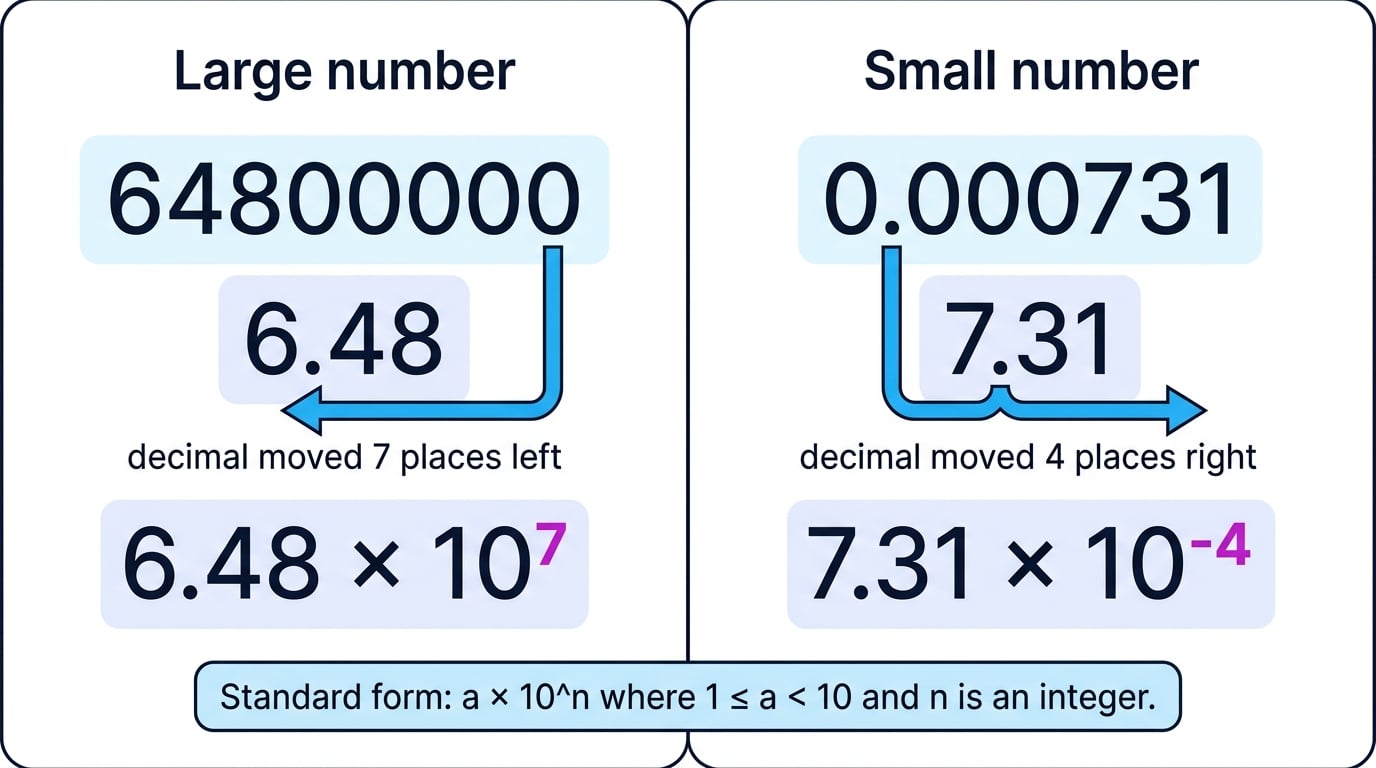
Large ordinary number to standard form
- Write 64 800 000 in standard form.

-
The first non-zero digit is 6, so the coefficient will be 6.48.
-
The decimal point has moved 7 places left from 64800000 to 6.48.
-
Because the original number was large, the exponent is positive.
-
So 64 800 000 is 6.48×1076.48 \times 10^76.48×10⁷.
Small decimal to standard form
- Write 0.000731 in standard form.

-
The first non-zero digit is 7, so the coefficient will be 7.31.
-
The decimal point has moved 4 places right to make 7.31.
-
Because the original number was small, the exponent is negative.
-
So 0.000731 is 7.31×10−47.31 \times 10^{-4}7.31×10⁻⁴.
Wrong sign on the exponent
Large ordinary numbers have positive exponents. Small decimals between 0 and 1 have negative exponents.
Multiplying and dividing in standard form
When multiplying:
- Multiply the coefficients.
- Add the exponents.
When dividing:
- Divide the coefficients.
- Subtract the exponents.
Multiplying two standard form numbers
- Work out (7×10⁵)(3×10⁻³)\left(7 \times 10^5\right)\left(3 \times 10^{-3}\right)(7×10⁵)(3×10⁻³).

-
Multiply the coefficients: 7 multiplied by 3 is 21.
-
Add the exponents: 5 + (-3) = 2, giving 21×10221 \times 10^221×102.
-
The coefficient 21 is too big for standard form.
-
Rewrite 21×10221 \times 10^221×102 as 2.1×1032.1 \times 10^32.1×10³.
Dividing two standard form numbers
-
Work out (8.4×10⁻⁵)÷(2.1×10⁻⁷)\left(8.4 \times 10^{-5}\right)\div\left(2.1 \times 10^{-7}\right)(8.4×10⁻⁵)÷(2.1×10⁻⁷).
-
Divide the coefficients: 8.4 divided by 2.1 is 4.
-
Subtract the exponents: -5 - (-7) = 2.
-
So the answer is 4×1024 \times 10^24×102.
Subtracting a negative exponent
Be careful with two minus signs. For example, -5 - (-7) means -5 + 7, which gives 2.
Fractions involving decimals
Sometimes it is easier to convert decimals into standard form first, especially when the numbers are very small.
A fraction with small decimals
-
Work out 0.06×0.0040.0008\frac{0.06 \times 0.004}{0.0008}0.00080.06×0.004 in standard form.
-
Convert each decimal: 0.06=6×10−20.06 = 6 \times 10^{-2}0.06=6×10⁻², 0.004=4×10−30.004 = 4 \times 10^{-3}0.004=4×10⁻³, and 0.0008=8×10−40.0008 = 8 \times 10^{-4}0.0008=8×10⁻⁴.
-
Rewrite the calculation:
(6×10⁻²)(4×10⁻³)8×10⁻⁴\frac{\left(6 \times 10^{-2}\right)\left(4 \times 10^{-3}\right)}{8 \times 10^{-4}}8×10⁻⁴(6×10⁻²)(4×10⁻³) -
Multiply the top: 6 multiplied by 4 is 24, and -2 + (-3) = -5, so the top is 24×10−524 \times 10^{-5}24×10−5.
-
Divide by the bottom: 24 divided by 8 is 3, and -5 - (-4) = -1.
-
The answer is 3×10⁻¹³ \times 10^{-1}3×10⁻¹.
Adding, subtracting, and ordering
For addition and subtraction, do not just add or subtract the exponents. Either convert to ordinary numbers, or rewrite the numbers using the same power of 10.
For Grade 5 questions, converting to ordinary numbers is often the safest method.
Finding a difference
-
A large moon has diameter 6.0×1046.0 \times 10^46.0×10⁴ km. A smaller moon has diameter 7.5×1037.5 \times 10^37.5×10³ km.
-
Convert both to ordinary numbers: 6.0×104=600006.0 \times 10^4 = 600006.0×104=60000 and 7.5×103=75007.5 \times 10^3 = 75007.5×103=7500.
-
Subtract: 60000 - 7500 = 52500.
-
Convert 52500 into standard form.
-
The difference is 5.25×1045.25 \times 10^45.25×10⁴ km.
Ordering numbers
-
Convert each number to an ordinary number:
- 4.8×102=4804.8 \times 10^2 = 4804.8×102=480
- 0.048×102=4.80.048 \times 10^2 = 4.80.048×102=4.8
- 4800×10−4=0.484800 \times 10^{-4} = 0.484800×10−4=0.48
- 48 stays as 48
-
Order the ordinary numbers from smallest to largest: 0.48, 4.8, 48, 480.
-
So the original numbers in order are 4800×10−44800 \times 10^{-4}4800×10−4, 0.048×1020.048 \times 10^20.048×10², 48, 4.8×1024.8 \times 10^24.8×10².
Adding the powers
For addition or subtraction, do not add the exponents. 2×10⁵+3×105=5×1052 \times 10^5 + 3 \times 10^5 = 5 \times 10^52×105+3×105=5×10⁵, but different powers need careful converting first.
Worded problems and formula questions
In worded questions, first decide the operation.
- “Total” usually means add.
- “Difference” means subtract.
- “Times larger” means divide.
- “12 objects each weighing...” means multiply.
- Time is distance divided by speed.
A distance and speed question
-
A signal travels 84 million km at a speed of 2.8×1052.8 \times 10^52.8×10⁵ km/s.
-
Write 84 million in standard form: 8.4×1078.4 \times 10^78.4×10⁷ km.
-
Time is distance divided by speed.
-
Calculate:
8.4×1072.8×105=3×10²\frac{8.4 \times 10^7}{2.8 \times 10^5}=3 \times 10^22.8×1058.4×107=3×10² -
The time is 3×10²³ \times 10^23×102 seconds.
Using a sphere formula
-
A sphere has radius 2.0×1032.0 \times 10^32.0×10³ metres. Use V=43πr3V=\frac{4}{3}\pi r^3V=34πr3.
-
Cube the radius:
(2.0×10³)3=8.0×10⁹\left(2.0 \times 10^3\right)^3=8.0 \times 10^9(2.0×10³)3=8.0×10⁹ -
Multiply by 43π\frac{4}{3}\pi34π: using a calculator, V≈3.351×10¹⁰V \approx 3.351 \times 10^{10}V≈3.351×10¹⁰.
-
Rounded to 1 decimal place in standard form, the volume is 3.4×10103.4 \times 10^{10}3.4×10¹⁰ cubic metres.
Calculator display
Some calculators show 1.2E51.2\text{E}51.2E5 to mean 1.2×1051.2 \times 10^51.2×10⁵. Always rewrite it clearly in standard form in your answer.
In the exam
-
Check the coefficient: it must be at least 1 and less than 10.
-
For multiplication and division, handle the coefficients and exponents separately, then adjust the final answer into standard form.
-
In worded questions, identify the operation before calculating: total, difference, times larger, or distance divided by speed.
Check yourself
-
Is 0.72×1050.72 \times 10^50.72×10⁵ in standard form? If not, what should it become?
-
When you divide 10−310^{-3}10−3 by 10−710^{-7}10−7, what happens to the exponents?
-
How would you write 56 million in standard form?