Pythagoras
Teach Genie
Review Pythagoras by teaching Genie
Teach it back in your own words, spot gaps, and remember it better.

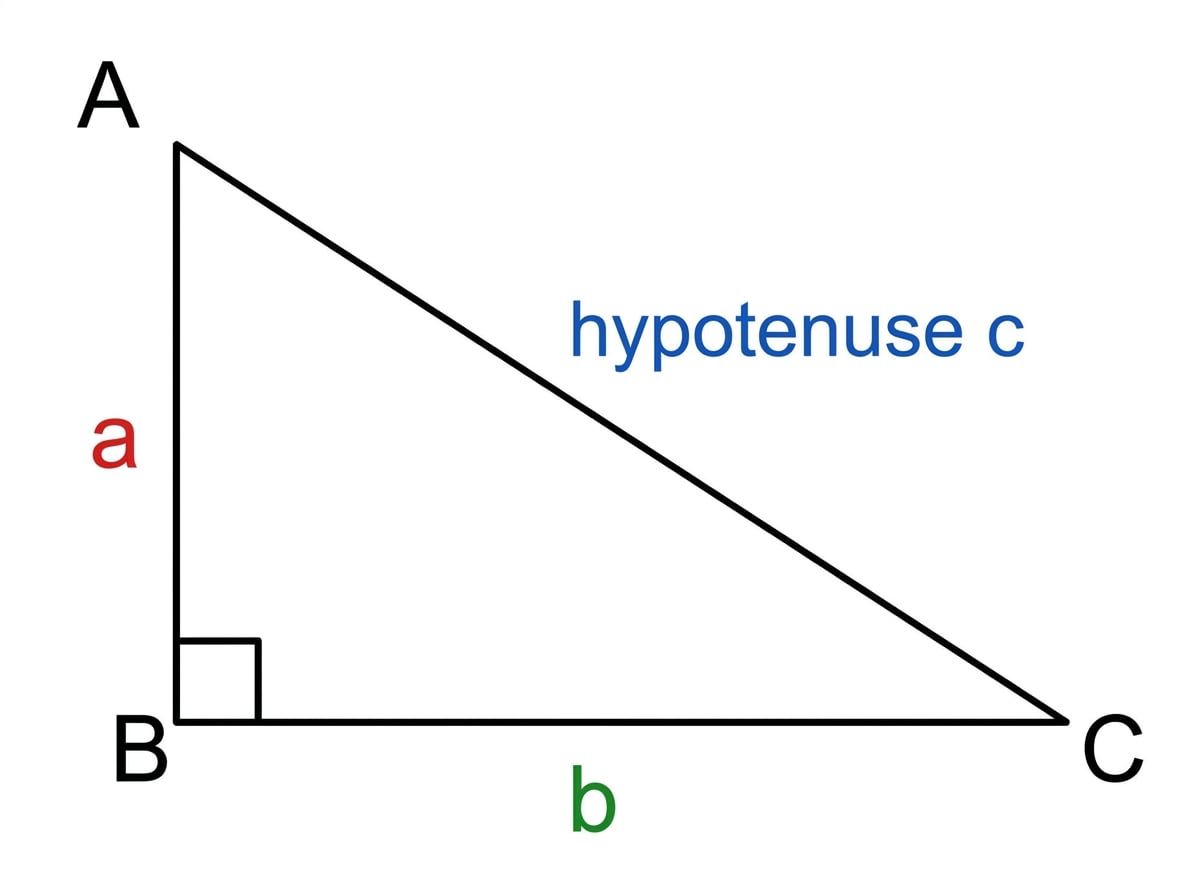
Pythagoras' theorem only works in a right-angled triangle. Find the 90∘90^\circ90∘ angle first. The side opposite the right angle is the hypotenuse, which is always the longest side.
If the two shorter sides are aaa and bbb, and the hypotenuse is ccc, then
a2+b2=c2 a^2 + b^2 = c^2 a2+b2=c2This means the squares of the two shorter sides add to the square of the longest side.
Before you calculate, label the right angle and the hypotenuse. Also make sure every side length is in the same unit before you substitute into the formula.
Question 1
3 marksA right-angled triangle ABC ABC\,ABC is shown. The right angle is at vertex BBB. The horizontal side AB AB\,AB is 4.8 cm. The vertical side BC BC\,BC is 3.6 cm.
Calculate the length of ACACAC.
What specific type of triangle is required to use Pythagoras' theorem?
Pythagoras Revision Guide
Revision notes for WJEC GCSE Maths Pythagoras: explanations and worked examples.