Bearings
What you'll learn
- What a bearing is and why it is always written with three figures.
- How to read a bearing from a diagram.
- How to draw a bearing using a protractor.
- How to find a reverse bearing, such as going back from B to A.
The basics you need first
A compass direction tells you which way something is facing. The main compass directions are North, East, South and West.
A North line is a line drawn upwards from a point and usually labelled N. It is the starting line for every bearing.
Clockwise means the direction the hands of a clock move: round to the right, then down, then left.
What is a bearing?
A bearing is a special angle used to describe direction.
Bearing
A bearing is an angle measured from North, going clockwise, and written using three figures, such as 067° or 125°.

The three bearing rules
- Start measuring from North.
- Measure clockwise.
- Write the answer using three figures.
Reading a bearing from a diagram
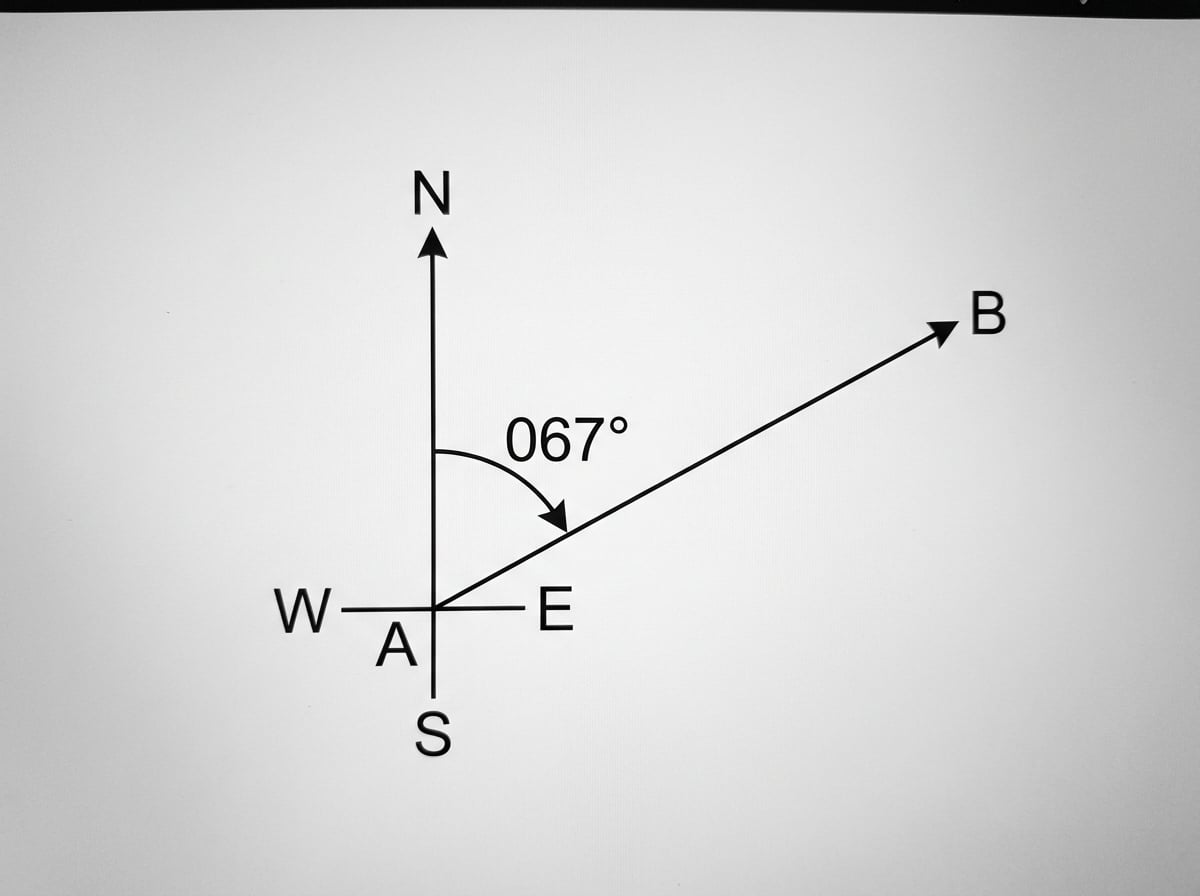
When a question says “the bearing of B from A”, you start at A. The word from tells you where the angle begins.
Reading a bearing from a diagram
Imagine point A has a North line drawn upwards. The line from A to B is to the right of North, and the clockwise angle from North to AB is 67°.

-
Start at A, because the bearing is of B from A.
-
Look at the North line drawn at A.
-
Turn clockwise from North until you are pointing along the line AB.
-
The angle is 67°, so write it as a three-figure bearing: 067°.
Mixing up from and to
In “the bearing of B from A”, you measure at A, not at B. If you measure at the wrong point, you usually find the opposite direction.
Three-figure bearings
A three-figure bearing always has three digits.
So:
- 7° becomes 007°
- 42° becomes 042°
- 115° stays 115°
You add zeros at the front if the angle has fewer than three digits.
Leading zeros matter
If your bearing is less than 100°, check whether you need a zero at the front. For example, 58° must be written as 058°.
Writing a small angle as a bearing
At point P, the clockwise angle from North to point Q is 34°. Write the bearing of Q from P.

-
The angle has been measured from North.
-
It has been measured clockwise.
-
The angle is 34°, which has only two digits.
-
Add a zero at the front, so the bearing of Q from P is 034°.
Drawing a bearing
To draw a bearing, you usually need a ruler and a protractor. A protractor is the tool used to measure and draw angles.
The key idea is: draw the North line first, then measure clockwise from it.
Drawing a bearing
Draw point Q so that it is 5 cm from P on a bearing of 120°.

-
Draw and label point P.
-
Draw a vertical North line upwards from P and label it N.
-
Place the centre of your protractor on P.
-
Line up 0° on the protractor with the North line.
-
Measure 120° clockwise and make a small mark.
-
Draw a straight line from P through the mark.
-
Measure 5 cm along this line and label the point Q.
Check the direction
A bearing of 120° should point down and to the right, because it is more than 90° but less than 180°.
When the angle is on the other side of North
Sometimes a diagram shows a small angle going anticlockwise from North. Anticlockwise means the opposite direction to the hands of a clock.
That small angle is not the bearing. Bearings must go clockwise, so you need to go all the way round from North.
Finding a bearing using 360°
At point C, the line to D is 35° anticlockwise from North. Find the bearing of D from C.

-
Start at C, because the bearing is of D from C.
-
The 35° angle goes anticlockwise, so it is not the bearing.
-
A full turn around a point is 360°. Subtract the small angle from a full turn:
360∘−35∘=325∘360^\circ - 35^\circ = 325^\circ360∘−35∘=325∘ -
The bearing of D from C is 325°.
Using the small anticlockwise angle
If the diagram shows 35° to the left of North, the bearing is not 035°. You must measure clockwise, so the answer is 325°.
Reverse bearings
A reverse bearing is the bearing for travelling back the other way.
For example, if you know the bearing of B from A, the reverse bearing is the bearing of A from B.
Reverse bearing
A reverse bearing points in the opposite direction. Opposite directions differ by 180°.

To find a reverse bearing:
- If the bearing is less than 180°, add 180°.
- If the bearing is more than 180°, subtract 180°.
Finding the bearing back again
A walker travels from village V to tower T on a bearing of 072°. Find the bearing of V from T.

-
The new bearing starts at T, because you are finding the bearing of V from T.
-
This is the opposite direction to the original journey.
-
Add 180° because 072° is less than 180°:
072∘+180∘=252∘072^\circ + 180^\circ = 252^\circ072∘+180∘=252∘ -
The bearing of V from T is 252°.
Reverse bearing when the angle is large
A ship travels from A to B on a bearing of 230°. Find the bearing of A from B.

-
You are now looking back from B to A.
-
Opposite directions differ by 180°.
-
Subtract 180° because 230° is more than 180°:
230∘−180∘=050∘230^\circ - 180^\circ = 050^\circ230∘−180∘=050∘ -
Write the answer with three figures: 050°.
In the exam
-
Read the wording carefully: the point after from is where you measure the angle.
-
Check the three bearing rules before writing your answer: North, clockwise, three figures.
-
If you have found a small anticlockwise angle, use 360° minus that angle; if you need the reverse direction, add or subtract 180°.
Check yourself
-
Why is 35° written as 035° when it is a bearing?
-
If a bearing is measured at point A, which phrase tells you that in the question?
-
What calculation helps when the marked angle is anticlockwise from North?