Compound Interest and Depreciation
Teach Genie
Review Compound Interest and Depreciation by teaching Genie
Teach it back in your own words, spot gaps, and remember it better.

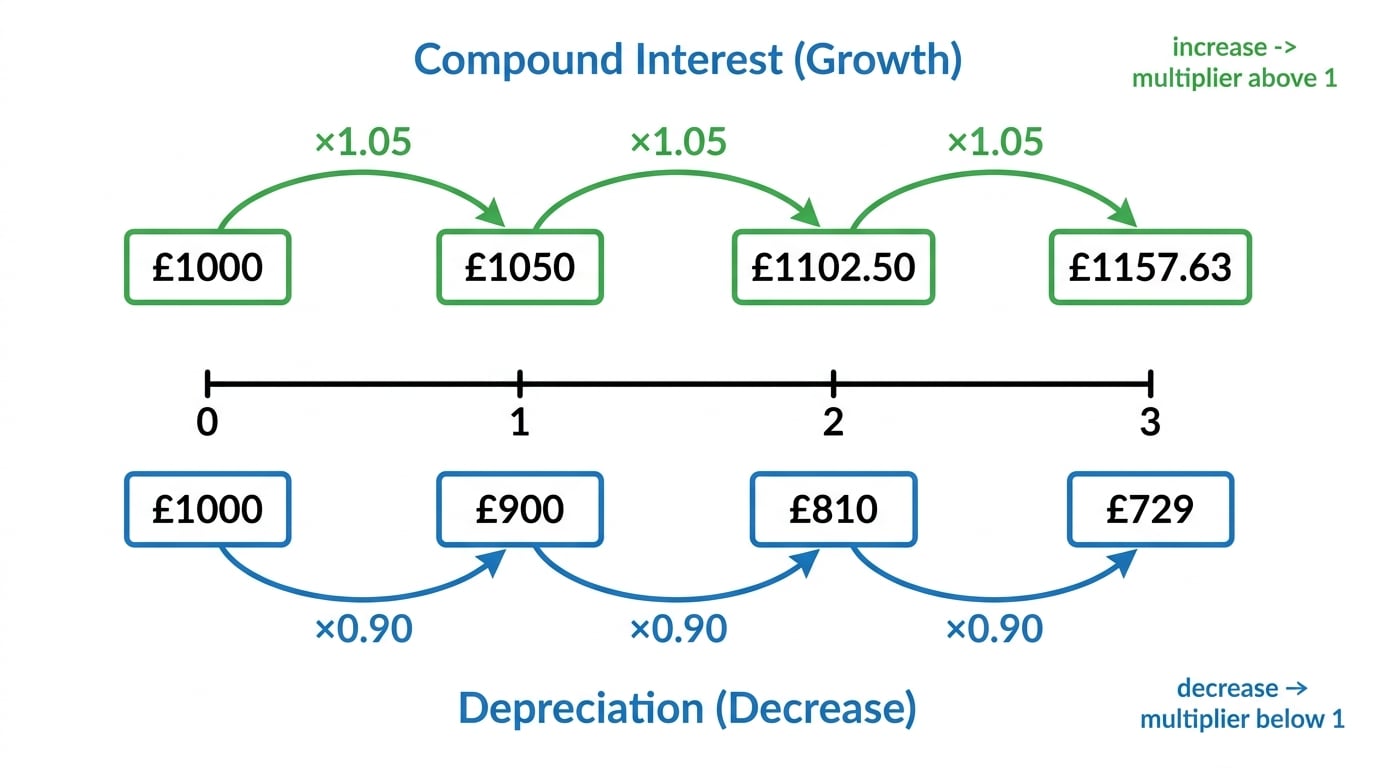
The starting amount is 100% of itself, so an increase uses a multiplier bigger than 1 and a decrease uses a multiplier smaller than 1. For example, a 6% increase uses 1.061.061.06, while a 6% decrease uses 0.940.940.94.
To build a multiplier, rewrite the new percentage as a decimal. So 8% increase means 108%=1.08108\% = 1.08108%=1.08, and 25% decrease means 75%=0.7575\% = 0.7575%=0.75. Compound interest and depreciation both use these multipliers again and again over time.
Question 1
2 marksAnnie invests £8000 for 4 years in a savings account. She gets 2.5% per annum compound interest.
How much money does Annie have at the end of 4 years.
In percentage calculations, what is the multiplier for a 6% increase?
Compound Interest and Depreciation Revision Guide
Revision notes for WJEC GCSE Maths Compound Interest and Depreciation: explanations and worked examples.