Exchange Rates
What you'll learn
- What an exchange rate tells you.
- When to multiply and when to divide.
- How to change money back into pounds and round to the nearest penny.
- How to compare prices in different countries.
Currencies and exchange rates
A currency is the type of money used in a country or area. For example, the UK uses pounds (£), many European countries use euros (€), and Japan uses yen (¥).
Exchange rate
An exchange rate tells you how much one currency is worth in another currency. For example, £1 = €1.16 means 1 pound is worth 1.16 euros.

The key question is always:
- What currency do you have?
- What currency do you want?
Follow the direction
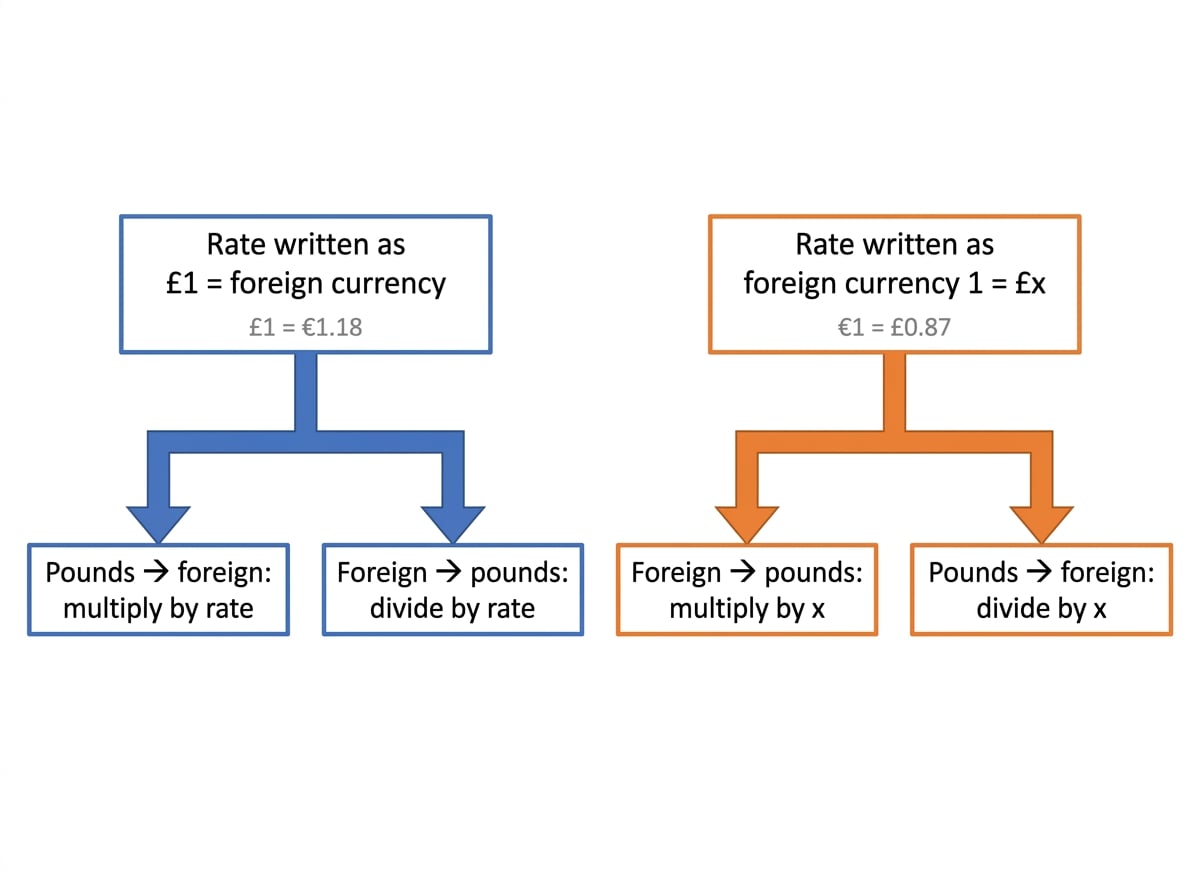
If the exchange rate says £1 = €1.20, then changing from pounds to euros means multiply by 1.20. Changing from euros back to pounds means divide by 1.20.

Changing pounds into another currency
When the rate starts with £1, and you are changing pounds into the other currency, you multiply.
This is because every £1 gives you a certain number of euros, lira, yen, rupees, and so on.
Changing pounds into euros
A traveller changes £265 into euros. The exchange rate is £1 = €1.18.

-
The rate says that each £1 gives €1.18.
-
Multiply the number of pounds by 1.18:
265×1.18=312.70265 \times 1.18 = 312.70265×1.18=312.70 -
The traveller receives €312.70.
Changing another currency back into pounds
If the exchange rate is written as £1 = €1.18, then 1 pound is worth 1.18 euros.
So if you already have euros and want pounds, you need to work backwards. That means you divide by 1.18.
Nearest penny
Money in pounds is usually written to two decimal places, such as £14.50. “Nearest penny” means round to two decimal places.
Changing euros into pounds
A tourist has €80 left. The exchange rate is now £1 = €1.18. Work out how many pounds they receive, to the nearest penny.

-
The rate says £1 gives €1.18, but we are changing euros into pounds.
-
Divide the euros by 1.18:
80÷1.18=67.796…80 \div 1.18 = 67.796\ldots80÷1.18=67.796… -
Round to the nearest penny: £67.80.
Multiplying every time
Do not automatically multiply. If the rate is £1 = €1.18 and you are changing euros into pounds, you divide by 1.18.
When the rate is written the other way round
Sometimes the exchange rate does not start with £1.
For example, €1 = £0.87 means 1 euro is worth £0.87.
So if you have euros and want pounds, you multiply by 0.87.
A cafe bill in euros
A meal costs €32. The exchange rate is €1 = £0.87. Work out the cost in pounds.

-
The rate already tells us the value of 1 euro in pounds.
-
Multiply the number of euros by 0.87:
32×0.87=27.8432 \times 0.87 = 27.8432×0.87=27.84 -
The meal costs £27.84.
Multi-step questions: find the total first
Some questions have an extra step before the exchange rate. For example, a hotel might cost a certain amount per night.
The word per means “for each”. So £40 per night means £40 for each night.
Hotel cost in yen
A hotel costs ¥9000 per night for 5 nights. The exchange rate is £1 = ¥150. Work out the total cost in pounds.

-
First find the total cost in yen:
9000×5=450009000 \times 5 = 450009000×5=45000 -
The rate is £1 = ¥150, so change yen into pounds by dividing by 150:
45000÷150=30045000 \div 150 = 30045000÷150=300 -
The hotel costs £300.
Comparing prices in different countries
To compare two prices, they must be in the same currency.
Usually, it is easiest to convert the foreign price into pounds, then compare it with the UK price.
Difference
The difference between two prices is found by subtracting the smaller price from the larger price.
Comparing the cost of trainers
A pair of trainers costs 3200 rupees in India. The same pair costs £45 in the UK. The exchange rate is £1 = 80 rupees. Work out which is cheaper and the difference in pounds.

-
Convert the Indian price into pounds by dividing by 80:
3200÷80=403200 \div 80 = 403200÷80=40 -
So the trainers cost £40 in India.
-
Compare £40 with £45. The trainers are cheaper in India.
-
Find the difference:
45−40=545 - 40 = 545−40=5 -
The trainers are £5 cheaper in India.
Choosing the better exchange rate
Sometimes two places offer exchange rates written in different directions.
If someone wants to change pounds into euros, compare how many euros they get for £1.
Choosing where to exchange money
In City A, the exchange rate is £1 = €1.12. In City B, the exchange rate is €1 = £0.88. A traveller wants to change pounds into euros. Which city gives more euros?

-
City A is already in the right direction: £1 gives €1.12.
-
City B says €1 = £0.88, so find how many euros you get for £1 by dividing 1 by 0.88:
1÷0.88=1.136…1 \div 0.88 = 1.136\ldots1÷0.88=1.136… -
City B gives about €1.14 for each £1.
-
€1.14 is more than €1.12, so City B gives more euros.
Greatest number of notes
Some questions ask for the greatest number of notes of a certain value, such as 200 000 dong notes.
You cannot have part of a note, so the answer must be a whole number.
Whole notes
For “greatest number of notes” questions, round down. Do not round to the nearest whole number.
Getting the greatest number of notes
A traveller changes £600 into dong. The exchange rate is £1 = 25 000 dong. They want as many 200 000 dong notes as possible.
-
First change £600 into dong:
600×25000=15000000600 \times 25000 = 15000000600×25000=15000000 -
Divide by the value of each note:
15000000÷200000=7515000000 \div 200000 = 7515000000÷200000=75 -
The traveller can get 75 notes.
In the exam
-
Read the exchange rate carefully and underline the currency you start with.
-
If you are going from £1 to the other currency, multiply. If you are coming back to pounds, usually divide.
-
For comparison questions, convert both prices into the same currency before deciding which is cheaper.
Check yourself
-
If £1 = €1.25, would you multiply or divide to change £80 into euros?
-
If £1 = €1.25, would you multiply or divide to change €80 into pounds?
-
Why must both prices be in the same currency before you compare them?