Percentages
What you'll learn
- What percentages mean and how they link to 100.
- How to find 10%, 50%, 1%, and build other percentages.
- How to solve money problems involving increases, reductions, deposits and offers.
- How to find simple interest over several years.
What is a percentage?
A percentage is a way of describing part of an amount by comparing it to 100.
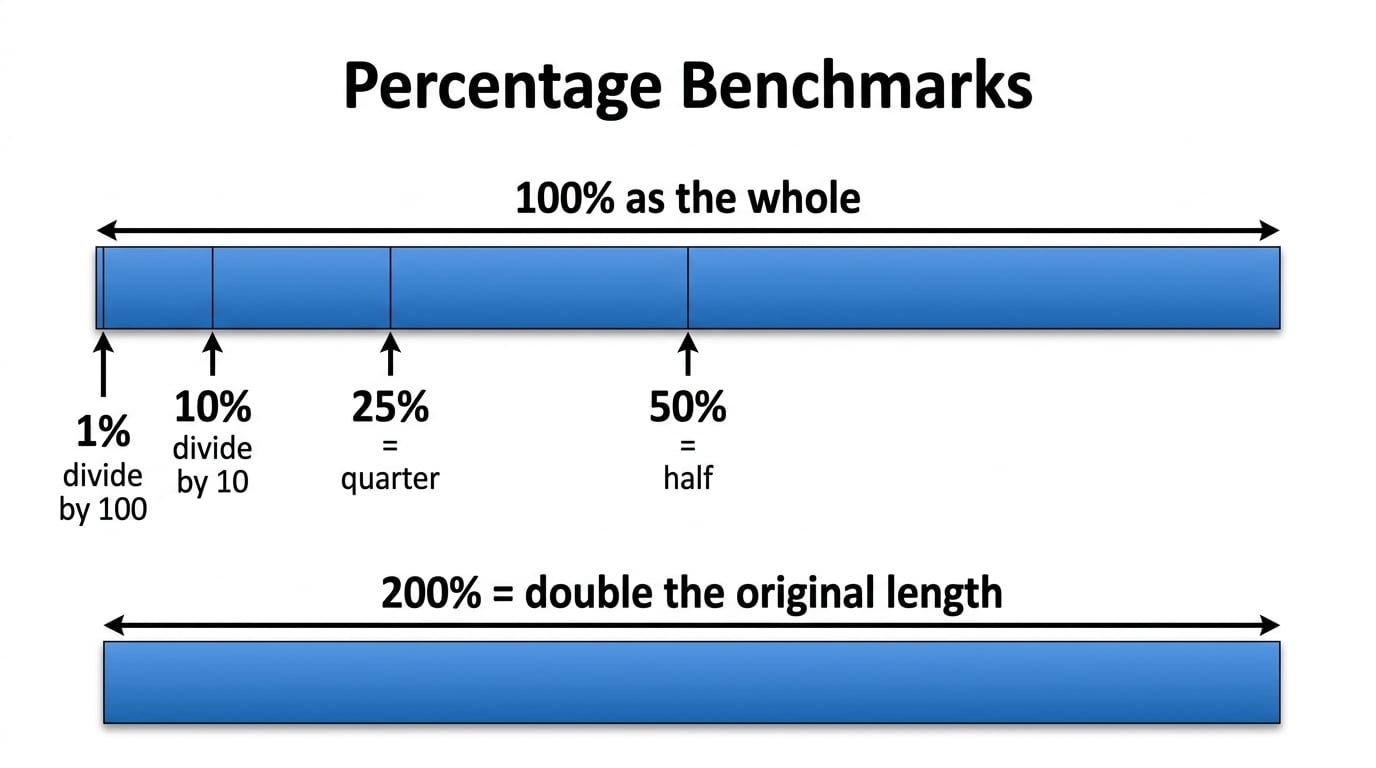
The whole means the full amount you are starting with. The whole is always 100%.

Percentage
- A percentage means “out of 100”.
- 100% means the whole amount.
- 50% means half of the amount.
- 25% means a quarter of the amount.
- 1% means one hundredth of the amount.
Finding easy percentages
10%, 50% and 1%
These are the most useful starting points:

- To find 10%, divide by 10.
- To find 50%, halve the amount.
- To find 1%, divide by 100.
Finding 10% and 50%
- Find 10% of £86 by dividing 86 by 10.

$$
86 \div 10 = 8.6
$$
2. So 10% of £86 is £8.60.
-
Find 50% of 1280 grams by halving 1280.
1280÷2=6401280 \div 2 = 6401280÷2=640 -
So 50% of 1280 grams is 640 grams.
Finding 1%
-
Find 1% of 350 litres by dividing 350 by 100.
350÷100=3.5350 \div 100 = 3.5350÷100=3.5 -
So 1% of 350 litres is 3.5 litres.
Quick check
If you find 10% of an amount, your answer should be smaller than the original. If it is bigger, check your division.
Building other percentages
For percentages like 34%, split them into easy parts.
For example:
- 30% means three lots of 10%.
- 4% means four lots of 1%.
- Then add the parts together.
Main method
Break the percentage into easy chunks, find each chunk, then add them.
Finding 34% of 2500
- Find 10% of 2500.

$$
2500 \div 10 = 250
$$
2. Find 30%.
$$
3 \times 250 = 750
$$
3. Find 1% of 2500.
$$
2500 \div 100 = 25
$$
4. Find 4%.
$$
4 \times 25 = 100
$$
5. Add 30% and 4%.
$$
750 + 100 = 850
$$
6. So 34% of 2500 is 850.
Forgetting to divide by 100
34% does not mean multiply by 34 only. A percentage is out of 100, so you must use percentage chunks or divide by 100.
Percentages greater than 100%
Sometimes a percentage is more than 100%. This means the answer will be bigger than the original amount.
For example, 200% means double the amount.
Finding 215% of 80
- Split 215% into 200%, 10% and 5%.

-
Find 200% of 80.
2×80=1602 \times 80 = 1602×80=160 -
Find 10% of 80.
80÷10=880 \div 10 = 880÷10=8 -
Find 5% by halving 10%.
8÷2=48 \div 2 = 48÷2=4 -
Add the parts.
160+8+4=172160 + 8 + 4 = 172160+8+4=172 -
So 215% of 80 is 172.
Comparing percentage amounts
If a question asks which is greater, work out both values first. Do not guess from the percentages alone.
Comparing two percentage amounts
-
Work out 25% of 96. Since 25% is a quarter, divide by 4.
96÷4=2496 \div 4 = 2496÷4=24 -
Work out 28% of 85 by splitting it into 20% and 8%.
10%=8.520%=171%=0.858%=6.828%=23.8\begin{aligned} 10\% &= 8.5\\ 20\% &= 17\\ 1\% &= 0.85\\ 8\% &= 6.8\\ 28\% &= 23.8 \end{aligned}10%20%1%8%28%=8.5=17=0.85=6.8=23.8 -
Compare the answers: 24 is greater than 23.8.
-
So 25% of 96 is greater.
Percentage story problems
Finding a difference
A difference means how much bigger one amount is than another. To find it, subtract the smaller amount from the larger amount.
Comparing two bonuses
-
Maya gets a bonus of 25% of £180. Since 25% is a quarter, divide by 4.
180÷4=45180 \div 4 = 45180÷4=45 -
Maya gets £45. Liam gets £50.
-
Find the difference.
50−45=550 - 45 = 550−45=5 -
Liam gets £5 more.
Working backwards from a percentage
Sometimes you are given part of the total and need to find the whole amount.
If 40% are children, then the remaining 60% are adults because the whole is 100%.
Finding the total number of people
- At an event, there are 54 adults. 40% of the people are children, so 60% are adults.

-
If 60% is 54, find 10% by dividing by 6.
54÷6=954 \div 6 = 954÷6=9 -
Find 100% by multiplying 10% by 10.
9×10=909 \times 10 = 909×10=90 -
So there are 90 people altogether.
Using the wrong whole
Do not find 40% of 54 here, because 54 is not the total. It is the number of adults, which represents 60%.
Increases, reductions and deposits
An increase means add on the percentage amount.
A reduction or decrease means take off the percentage amount.
A deposit is money paid at the start. The rest is paid later.
Increasing and reducing money amounts
- A wage of £32,000 increases by 3%. First find 1%.

$$
32000 \div 100 = 320
$$
2. Find 3%.
$$
3 \times 320 = 960
$$
3. Add the increase.
$$
32000 + 960 = 32960
$$
4. So the new wage is £32,960.
-
A coat costs £45 and is reduced by 20%. Find 10%.
45÷10=4.545 \div 10 = 4.545÷10=4.5 -
Find 20%, then subtract it from the original price.
45−9=3645 - 9 = 3645−9=36 -
So the sale price is £36.
Deposit and monthly payments
- A tablet costs £260. The deposit is 15%. Find 10%, 5%, then 15%.

$$
\begin{aligned}
10\% &= 26\\
5\% &= 13\\
15\% &= 39
\end{aligned}
$$
2. Subtract the deposit from the total cost.
$$
260 - 39 = 221
$$
3. The rest is paid in monthly payments of £17.
$$
221 \div 17 = 13
$$
4. So 13 monthly payments are needed.
Special offers and best buys
For shop offers, always work out the total cost for the exact number of items you need.
Choosing the cheaper shop
-
Shop A sells 6 cans at 50p each with 10% off. The total before discount is 300p, and 10% of 300p is 30p.
300−30=270300 - 30 = 270300−30=270 -
Shop B sells cans at 72p each with “buy 2 get 1 free”. For 6 cans, you pay for 4 cans.
4×72=2884 \times 72 = 2884×72=288 -
Shop A costs 270p and Shop B costs 288p.
-
So Shop A is cheaper.
Simple interest
Interest is extra money earned on savings or investments. The rate is the percentage used, often each year.
Simple interest
Simple interest means the interest is worked out from the original amount each year. It does not change from year to year.
Finding simple interest
-
£600 is invested for 4 years at 1.5% simple interest per year. First find 1% of £600.
600÷100=6600 \div 100 = 6600÷100=6 -
Find 0.5% by halving 1%.
6÷2=36 \div 2 = 36÷2=3 -
So 1.5% per year is £9.
6+3=96 + 3 = 96+3=9 -
Multiply by 4 years.
9×4=369 \times 4 = 369×4=36 -
The total interest is £36.
Simple interest only
This method works when the question says simple interest. Compound interest is different because the amount changes each year.
In the exam
- Underline the number that represents 100%.
- Break awkward percentages into 10%, 5%, 1% and 50% chunks.
- For increases, add the percentage amount; for reductions, subtract it.
- In comparison questions, work out both amounts before deciding.
- Include units, and write money answers clearly using pounds and pence.
Check yourself
- How could you find 17% of 300 without a calculator?
- If a price is reduced by 15%, do you add or subtract the 15%?
- If 30% of people are children, what percentage are not children?