Estimating
What you'll learn
- Round numbers to make calculations easier.
- Estimate answers to fractions, roots, powers, money and area problems.
- Decide whether an estimate is an underestimate or an overestimate.
- Use estimates to check if a calculator answer is sensible.
1. Estimates and rounding
Key words
- An estimate is an answer that is close to the exact answer, but not exact.
- An approximation is a rounded or simplified value used instead of the exact value.
- Rounding means changing a number to a nearby, easier number.
- A significant figure is a digit that tells you the size of a number. The first significant figure is the first non-zero digit.
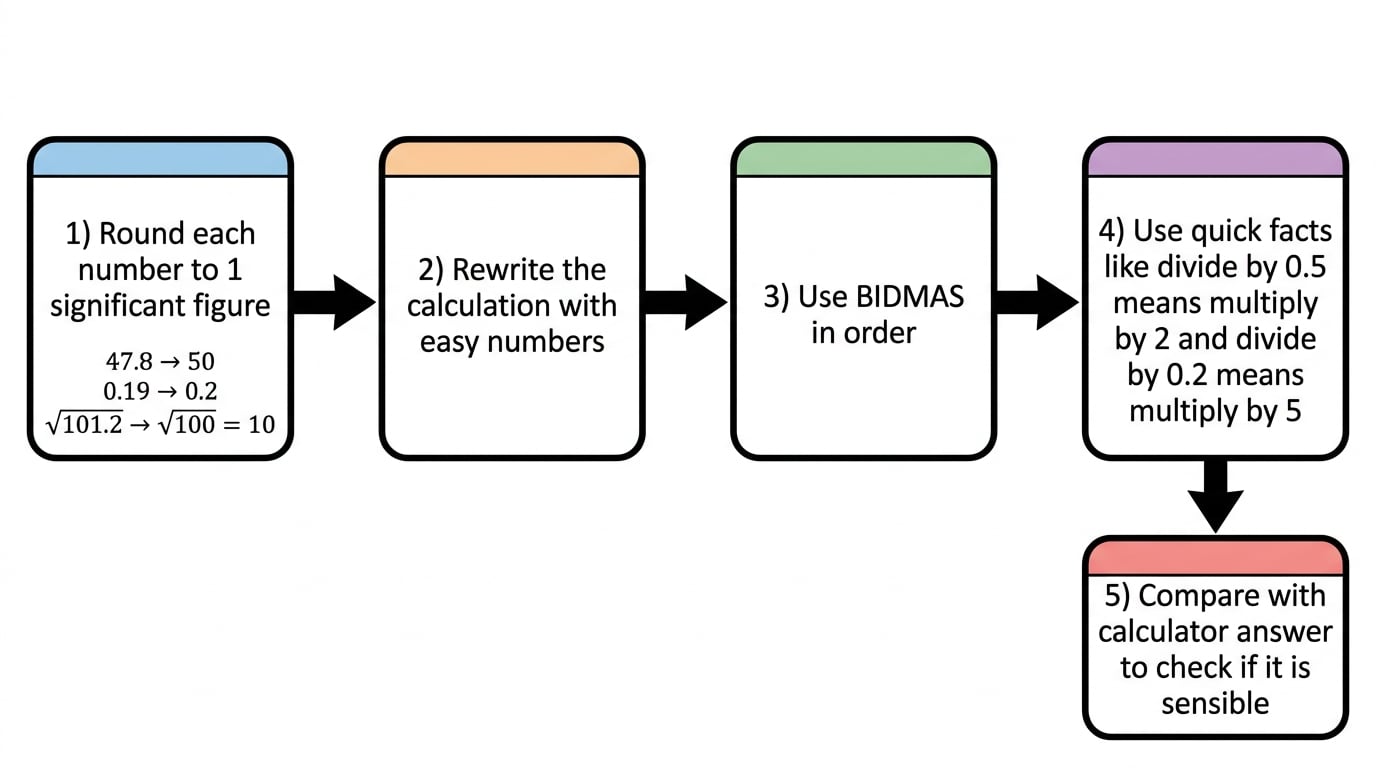
For GCSE estimating, you usually round each number to 1 significant figure unless another easy approximation is clearly better.
For example, 47.6 rounds to 50, and 0.184 rounds to 0.2.
Rounding to 1 significant figure
Round 47.6, 0.52, 12.4 and 0.184 to 1 significant figure.

-
For 47.6, the first significant digit is 4 and the next digit is 7, so it rounds up to 50.
-
For 0.52, ignore the zero before the decimal point. The first significant digit is 5, so it becomes 0.5.
-
For 12.4, the first significant digit is 1 and the next digit is 2, so it becomes 10.
-
For 0.184, the first significant digit is 1 and the next digit is 8, so it rounds up to 0.2.
Rounding small decimals to zero
0.52 to 1 significant figure is 0.5, not 0. The zero before the decimal point is only a placeholder.
2. Estimating calculations
Round first, then calculate
Do not work out the exact answer first. Round the numbers, write the easier calculation, then work it out.
Use BIDMAS, the order of operations: Brackets, Indices, Division and Multiplication, Addition and Subtraction.
Estimating a fraction calculation
Estimate the value of 47.8×61.612.1\frac{47.8 \times 61.6}{12.1}12.147.8×61.6.

-
Round each number to 1 significant figure: 47.8 becomes 50, 61.6 becomes 60, and 12.1 becomes 10.
-
Replace the original calculation with the rounded calculation:
50×6010\frac{50 \times 60}{10}1050×60 -
Multiply the numbers on the top:
50×60=300050 \times 60 = 300050×60=3000 -
Divide by the number on the bottom:
3000÷10=3003000 \div 10 = 3003000÷10=300
When the top contains addition
Estimate the value of 18.7+62.40.19\frac{18.7 + 62.4}{0.19}0.1918.7+62.4.
-
Round the numbers: 18.7 becomes 20, 62.4 becomes 60, and 0.19 becomes 0.2.
-
Add the rounded numbers on the top:
20+60=8020 + 60 = 8020+60=80 -
Divide by 0.2. Dividing by 0.2 is the same as multiplying by 5:
80÷0.2=40080 \div 0.2 = 40080÷0.2=400
Useful decimal divisions
Dividing by 0.5 doubles the number. Dividing by 0.2 multiplies by 5. Dividing by 0.1 multiplies by 10.
3. Square roots, powers and calculator checks
A square root, written like 100\sqrt{100}100, asks “what number squares to make this?” Since 10 squared is 100, 100=10\sqrt{100}=10100=10.
A power is a repeated multiplication, such as 424^242, which means 4 times 4.
When estimating with square roots, round to a perfect square. A perfect square is a number like 25, 49, 64 or 100.
Estimating with a square root
Estimate the value of 22.4+101.20.48\frac{22.4 + \sqrt{101.2}}{0.48}0.4822.4+101.2.

-
Round 22.4 to 20, 101.2 to 100, and 0.48 to 0.5.
-
Use the easy square root:
100=10\sqrt{100}=10100=10 -
Substitute the rounded values:
20+100.5\frac{20 + 10}{0.5}0.520+10 -
Add the top, then divide by 0.5:
30÷0.5=6030 \div 0.5 = 6030÷0.5=60
Choosing the sensible calculator answer
A calculation is 426.514.8+3.92\frac{426.5}{14.8 + 3.9^2}14.8+3.92426.5. One calculator answer is 1.4 and another is 14. Use an estimate to decide which is sensible.

-
Round 426.5 to 400, 14.8 to 10, and 3.9 to 4.
-
Estimate the power:
42=164^2 = 1642=16 -
Estimate the denominator:
10+16=2610 + 16 = 2610+16=26 -
Use 26 as about 30, then estimate:
40030≈13\frac{400}{30} \approx 1330400≈13 -
The sensible calculator answer is 14, because it is close to 13.
4. Underestimates and overestimates
Underestimate and overestimate
An underestimate is too small. An overestimate is too large.
For positive multiplication, if all the numbers are rounded down, the answer is an underestimate. If all the numbers are rounded up, the answer is an overestimate.
Division can flip the direction
In a fraction, making the denominator smaller makes the whole answer bigger. For under/over questions, always explain what you rounded and how that affects the result.
Estimating weekly pay
Maya is paid £8.32 per hour and works 41 hours in a week. Estimate her weekly pay and say whether it is an underestimate or an overestimate.

-
Round £8.32 to £8 and 41 hours to 40 hours.
-
Multiply the rounded values:
8×40=3208 \times 40 = 3208×40=320 -
The estimate is £320.
-
£8.32 was rounded down and 41 was rounded down, so the estimate is an underestimate.
A rate tells you how much happens per unit, such as pence per minute, miles per week, or one event every few seconds.
Estimating a yearly total from seconds
A machine records one event every 58 seconds. Estimate how many events happen in one year.

-
Use easy estimates: 1 year is about 400 days, 1 day is about 20 hours, and 58 seconds is about 60 seconds.
-
Estimate the number of seconds in a year, then divide by 60 seconds per event:
400×20×60×6060\frac{400 \times 20 \times 60 \times 60}{60}60400×20×60×60 -
Cancel one factor of 60:
400×20×60400 \times 20 \times 60400×20×60 -
Calculate the estimate:
400×20×60=480000400 \times 20 \times 60 = 480000400×20×60=480000
5. Estimating area
Area is the amount of flat space inside a shape. It is measured in square units, such as m².
Useful formulas:
- Rectangle area = length times width.
- Square area = side times side.
- Circle area uses A=πr2A=\pi r^2A=πr2, and for estimating you can use π≈3\pi \approx 3π≈3.
Estimating the area of a circle
A circular flower bed has radius 11.6 m. Estimate its area and say whether the estimate is too small or too large.

-
Round the radius 11.6 m to 10 m, and use π≈3\pi \approx 3π≈3.
-
Substitute into the area formula:
A≈3×10²A \approx 3 \times 10^2A≈3×10² -
Work out the square and multiply:
3×100=3003 \times 100 = 3003×100=300 -
The estimate is 300 m². Since the radius and π\piπ were both rounded down, this is an underestimate.
Estimating a rectangle with a square cut out
A shape is made from a rectangle measuring 5.26 m by 3.18 m, with a square of side 1.94 m removed. Estimate the remaining area.

-
Round the rectangle to 5 m by 3 m, and the square side to 2 m.
-
Estimate the large rectangle area:
5×3=155 \times 3 = 155×3=15 -
Estimate the square cut-out area:
22=42^2 = 422=4 -
Subtract the cut-out area:
15−4=1115 - 4 = 1115−4=11 -
The estimate is 11 m². The rectangle area was rounded down and the cut-out area was rounded up, so the remaining area is an underestimate.
In the exam
-
Round each number before you start calculating.
-
Show the rounded calculation clearly, even if you can do it mentally.
-
Keep units in your final answer, especially for money, distance and area.
-
For underestimates and overestimates, say which numbers were rounded up or down.
-
Use your estimate to spot calculator errors, especially answers that are 10 times too big or too small.
Check yourself
- Can you round 0.073 and 684 to 1 significant figure?
- If you divide by 0.2, what quick multiplication could you do instead?
- In a positive multiplication, what happens if both numbers are rounded down?