Area and Circumference of Circles
What you'll learn
- Name important parts of a circle, like radius, diameter, tangent and sector.
- Use formulas for circumference and area.
- Give answers rounded or in terms of π\piπ.
- Solve simple questions about semi-circles, shaded regions and costs.
1. Circle vocabulary
Before using formulas, make sure you know the circle words. These often appear in short 1-mark questions.
Key circle words
-
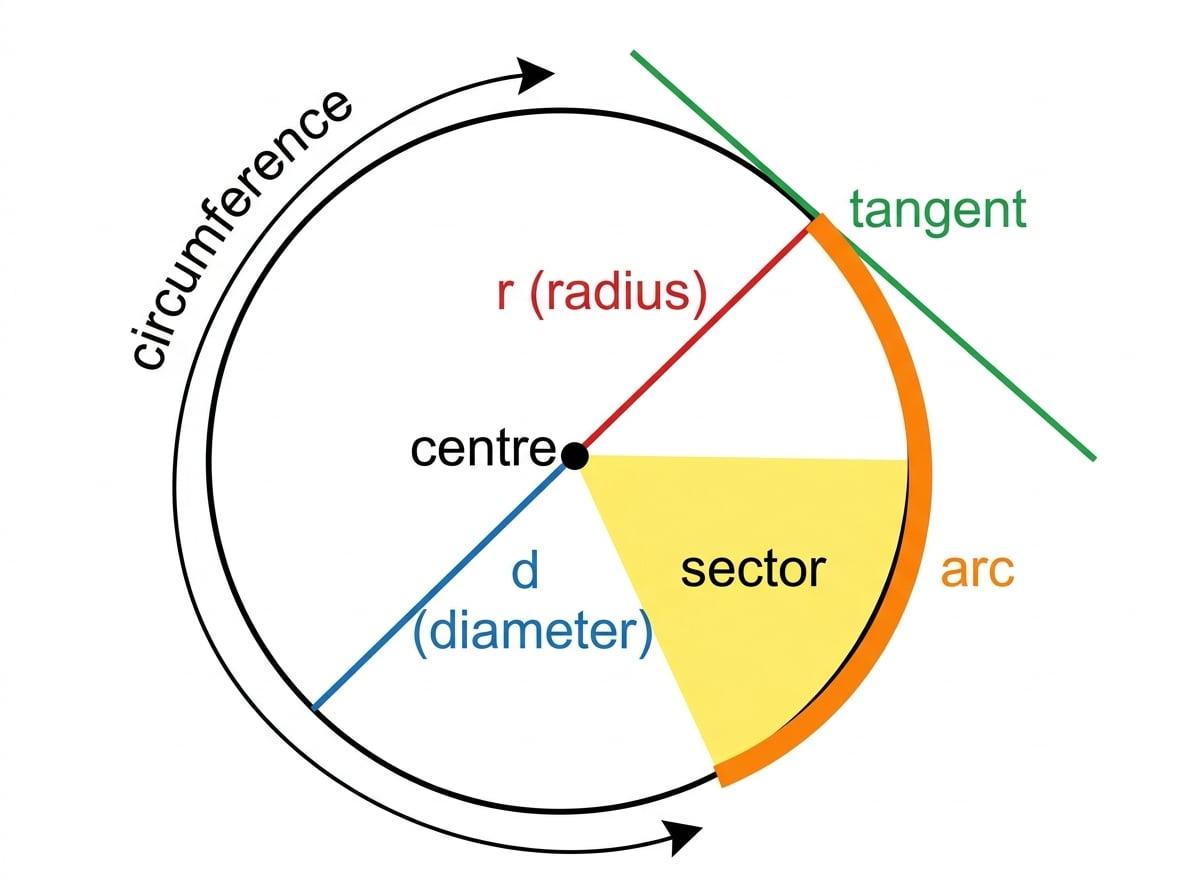
The centre is the point in the middle of a circle.
-
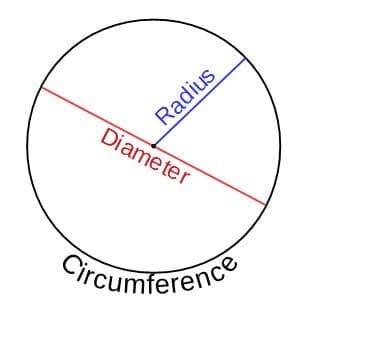
A radius is a straight line from the centre to the edge of the circle.
-
A diameter is a straight line from one side of the circle to the other, passing through the centre.
-
The circumference is the distance all the way around the circle.
-
A tangent is a straight line that touches a circle at exactly one point.
-
An arc is part of the circumference.
-
A sector is a slice of a circle, made from two radii and an arc.
-
A semi-circle is half of a circle.

Radius and diameter
The diameter is twice the radius: d=2rd = 2rd=2r. The radius is half the diameter: r=d2r = \frac{d}{2}r=2d.
Naming parts of a circle
-
If a line goes from the centre to the edge, it is a radius.
-
If a line goes from edge to edge through the centre, it is a diameter.
-
If a line just touches the circle once and does not cut through it, it is a tangent.
-
If a shaded part looks like a pizza slice, it is a sector.
2. Circumference: distance around the edge
Circumference is the perimeter of a circle. You use it when a question says things like “around the edge”, “around the field” or “around the circle”.
Circumference formulas
Use C=πdC = \pi dC=πd if you know the diameter. Use C=2πrC = 2\pi rC=2πr if you know the radius.
Finding circumference from the radius
A circular badge has radius 7.3 cm. Work out its circumference to 2 decimal places.

-
The question gives the radius, so use the radius formula.
C=2πrC = 2\pi rC=2πr -
Substitute r=7.3r = 7.3r=7.3.
C=2×π×7.3=14.6πC = 2 \times \pi \times 7.3 = 14.6\piC=2×π×7.3=14.6π -
Use your calculator.
C≈45.8672C \approx 45.8672C≈45.8672 -
Round to 2 decimal places: 45.87 cm.
Cost around a circular field
A circular field has diameter 30 m. Fencing costs £14.50 per metre. Find the total cost.

-
“Around the field” means circumference.
-
The diameter is given, so use C=πdC = \pi dC=πd.
C=30π≈94.2478C = 30\pi \approx 94.2478C=30π≈94.2478 -
Multiply the length by the cost per metre.
94.2478×14.50≈1366.5994.2478 \times 14.50 \approx 1366.5994.2478×14.50≈1366.59 -
The total cost is £1366.59.
Use the pi button
Use the π\piπ button on your calculator for decimal answers. Only use 3.14 if the question specifically tells you to.
3. Area: space inside the circle
Area means the amount of space inside a shape. Circle area is measured in square units, such as cm² or m².
Area formula
Use A=πr2A = \pi r^2A=πr2. This formula needs the radius, not the diameter.
Finding area from the diameter
A circle has diameter 11 m. Work out its area correct to 1 decimal place.

-
Halve the diameter to find the radius.
r=112=5.5r = \frac{11}{2} = 5.5r=211=5.5 -
Use the area formula.
A=πr2A = \pi r^2A=πr2 -
Substitute r=5.5r = 5.5r=5.5.
A=π×5.52=30.25πA = \pi \times 5.5^2 = 30.25\piA=π×5.52=30.25π -
Use your calculator.
A≈95.0332A \approx 95.0332A≈95.0332 -
Round to 1 decimal place: 95.0 m².
Using the diameter as the radius
If the diameter is given, halve it before using A=πr2A = \pi r^2A=πr2. Forgetting this makes the area much too large.
4. Answers in terms of pi
Sometimes the question says “give your answer in terms of π\piπ”. This means leave π\piπ in your answer and do not turn it into a decimal.
Leaving answers in terms of pi
- A circle has diameter 16 mm. Its circumference is:

$$
C = \pi d = 16\pi
$$
2. So the circumference is 16π mm.
- A circle has radius 9 cm. Its area is:

$$
A = \pi r^2 = \pi \times 9^2 = 81\pi
$$
4. So the area is 81π cm².
5. Semi-circles and sectors
For part-circles, first think: “What fraction of the full circle do I have?”
- A semi-circle is one half.
- A quarter circle is one quarter.
- Three quarters of a circle is three quarters of the full circle.
Perimeter of part-circles
For curved edges, take the correct fraction of the circumference. For perimeter, remember to add any straight outside edges too.
Perimeter of a semi-circle from its area
A semi-circle has area 40 m². Find its perimeter to 1 decimal place.

-
A semi-circle is half a circle, so the full circle area would be 80 m².
-
Use the circle area formula to find the radius.
πr2=80\pi r^2 = 80πr2=80 -
Divide by π\piπ and square root.
r=80π≈5.05r = \sqrt{\frac{80}{\pi}} \approx 5.05r=π80≈5.05 -
The curved edge of a semi-circle is half the circumference.
π×5.05≈15.86\pi \times 5.05 \approx 15.86π×5.05≈15.86 -
The diameter is two radii, so it is about 10.10 m.
-
Perimeter equals curved edge plus diameter: about 26.0 m.
Forgetting the straight edge
A semi-circle perimeter is not just half the circumference. You must also add the diameter.
6. Shaded and compound areas
A compound shape is made from two or more simple shapes joined together. For shaded regions, you often need to subtract one area from another.
Add or subtract areas
For joined shapes, add the areas. For cut-out or shaded-gap shapes, subtract the smaller area from the larger area.
Area of a shaded ring
A shaded ring is made from a large circle with diameter 18 cm and a smaller circle of radius 7 cm cut out. Find the shaded area to 1 decimal place.

-
Find the large radius by halving the diameter.
r=182=9r = \frac{18}{2} = 9r=218=9 -
Find both circle areas.
Alarge=π×92=81πAsmall=π×72=49π\begin{aligned} A_{\text{large}} &= \pi \times 9^2 = 81\pi \\ A_{\text{small}} &= \pi \times 7^2 = 49\pi \end{aligned}AlargeAsmall=π×92=81π=π×72=49π -
Subtract the smaller area from the larger area.
Ashaded=81π−49π=32πA_{\text{shaded}} = 81\pi - 49\pi = 32\piAshaded=81π−49π=32π -
Convert to a decimal and round: 100.5 cm².
Boxes, tiles and bags
If you need a whole number of boxes, divide the total area by the coverage per box, then round up.
In the exam
-
Label the radius and diameter on the diagram before choosing a formula.
-
Decide whether you need a length around the edge or an area inside.
-
Keep extra calculator digits until the final rounding, and include the correct units.
Check yourself
-
What formula would you use if the diameter is given and you need the circumference?
-
Why must you halve the diameter before using the area formula?
-
For a semi-circle perimeter, which straight edge must be added to the curved edge?