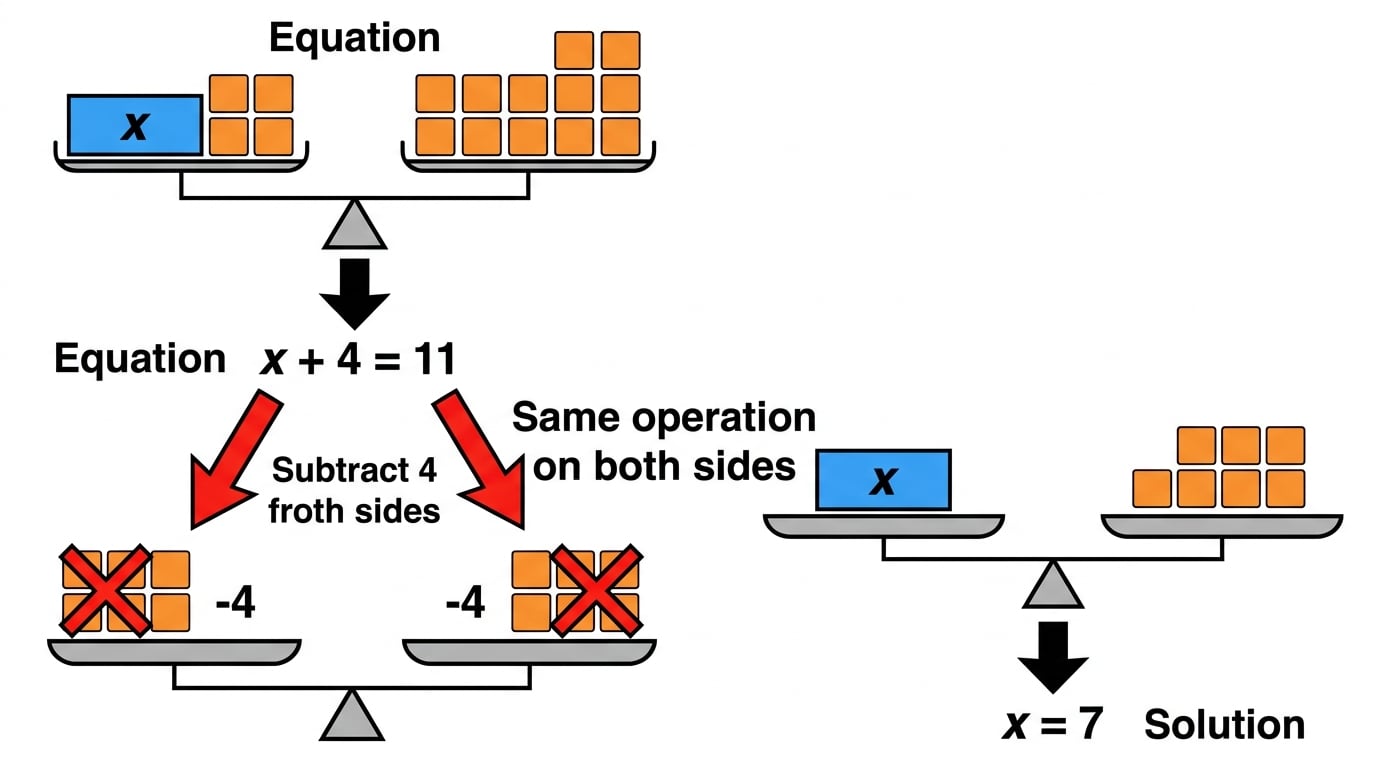
When we solve equations we are finding an unknown number
We can use inverse operations to solve an equation:**
The opposite of adding is subtracting
The opposite of multiplying is dividing.**
Example 1
Solve: 3a + 4 = 19
This equation says 3 times a plus 4 is equal to 19
We need to find out what number a is, to do that we need to get a by itself
The first step is to get rid of the 4
The opposite of adding 4 is subtracting 4
To keep both sides of the equation equal we need to subtract 4 from both sides of the equation
We now have:
3a + 4 - 4 = 19 - 4
This simplifies to:
3a = 15
We now have 3 times a is equal to 15
a is multiplied by 3. The opposite of multiplication is division.
We need to divide both sides by 3
This gives us:
3a⁄3 = 15⁄3
This can be simplified to:
a = 5
Example 2
Solve: 43 = 5b - 7
This time we need to get b by itself
The first step is to get rid of the 7
The opposite of subtracting 7 is adding 7
We need to add 7 to both sides of the equation
We now have:
43 + 7 = 5b - 7 + 7
This simplifies to:
50 = 5b
To get b by itself we need to get rid of the 5
At the moment b is multiplied by 5, the opposite of multiplying by 5 is dividing by 5
We need to divide both sides by 5
This gives us:
50⁄5 = 5b⁄5
This can be simplified to:
10 = b
We can rewrite this with b first:
b = 10
Example 3
Solve: c⁄4 + 2 = 8
This time we need to get c by itself
We start by getting rid of the 2
The opposite of adding 2 is subtracting 2
We need to subtract 2 from both sides of the equation
We now have:
c⁄4 + 2 - 2 = 8 - 2
This simplifies to:
c⁄4 = 6
To get c by itself we need to get rid of the 4
At the moment c is divided by 4, the opposite of dividing by 4 is multiplying by 4
We need to multiply both sides by 4
This gives us:
4c⁄4 = 6 × 4
This can be simplified to:
c = 24
Example 4
Solve: d - 9⁄2 = 7
We need to get d by itself
This time the whole left side is divided by 2, the first step is to multiply both sides by 2
This gives us:
2(d - 9)⁄2 = 7 × 2
Which simplifies to:
d - 9 = 14
To get d by itself we need to add 9 to both sides
This gives:
d - 9 + 9 = 14 + 9
Which simplifies to:
d = 23
Try these:
When the unknown (what we are working out) appears on both sides of the equation, the first step is to get them on the same side
It is easiest to do this when we get rid of the smallest unknown, the one with the smallest number in front of it (coefficient)
Example 6
Solve: 7a - 3 = 4a + 9
In this questions we need to find out what a is.
There is an a term on both sides of the equation.
On the left side of the equation we have 7a
On the right side we have 4a
4a is smaller than 7a so we will get rid of 4a
To get rid of 4a will will subtract 4a from both sides of the equation
This gives us:
7a - 3 - 4a = 4a + 9 - 4a
Which simplifies to: 3a - 3 = 9
We now continue to solve the equation: the next step is to add 3 to both sides
3a - 3 + 3 = 9 + 3
This simplifies to:
3a = 12
We now divide both sides by 3 to get a by itself:
3a⁄3 = 12⁄3
This can be simplified to:
a = 4
Example 7
Solve: 2b - 9 = 4 - 6b
This time we have a b term on both sides of the equation
We have 2b on the left and negative 6b on the right side. The smaller b term is negative 6b.
This time we will start by adding 6b to both sides of the equation
2b - 9 + 6b = 4 - 6b + 6b
This simplifies to:
8b - 9 = 4
We now add 9 to both sides:
8b - 9 + 9 = 4 + 9
This simplifies to:
8b = 13
We finally divide both sides by 8:
8b⁄8 = 13⁄8
We leave our answer as a fraction:
b = 13⁄8
Example 8
Solve: c - 9 = 3c - 2
This time we have a c term on both sides of the equation.
Where we have a 'c' term this means we have 1c.
We have 1c on the left and 3c on the right side. The smaller c term is 1c.
We will start by subtracting c from both sides of the equation.
c - 9 - c = 3c - 2 - c
This simplifies to:
-9 = 2c - 2
We now add 2 to both sides:
-9 + 2 = 2c - 2 + 2
This simplifies to:
-7 = 2c
We finally divide both sides by 2:
-7⁄2 = 2c⁄2
We leave our answer as a fraction:
c = -7⁄2
Try these: