What you'll learn
- Understand a unit: the label on a measurement, such as cm, kg or litres.
- Use metric facts for length (distance), mass (how heavy something is) and capacity (liquid amount).
- Decide when to multiply or divide by 10, 100 or 1000.
- Check whether your answer should get bigger or smaller.
Metric units: what changes?
A measurement has two parts: a number and a unit. For example, in 30 cm, the number is 30 and the unit is cm.
Metric conversion
The metric system is a measurement system using units like metres, grams and litres. A conversion changes from one unit to another without changing the real amount.
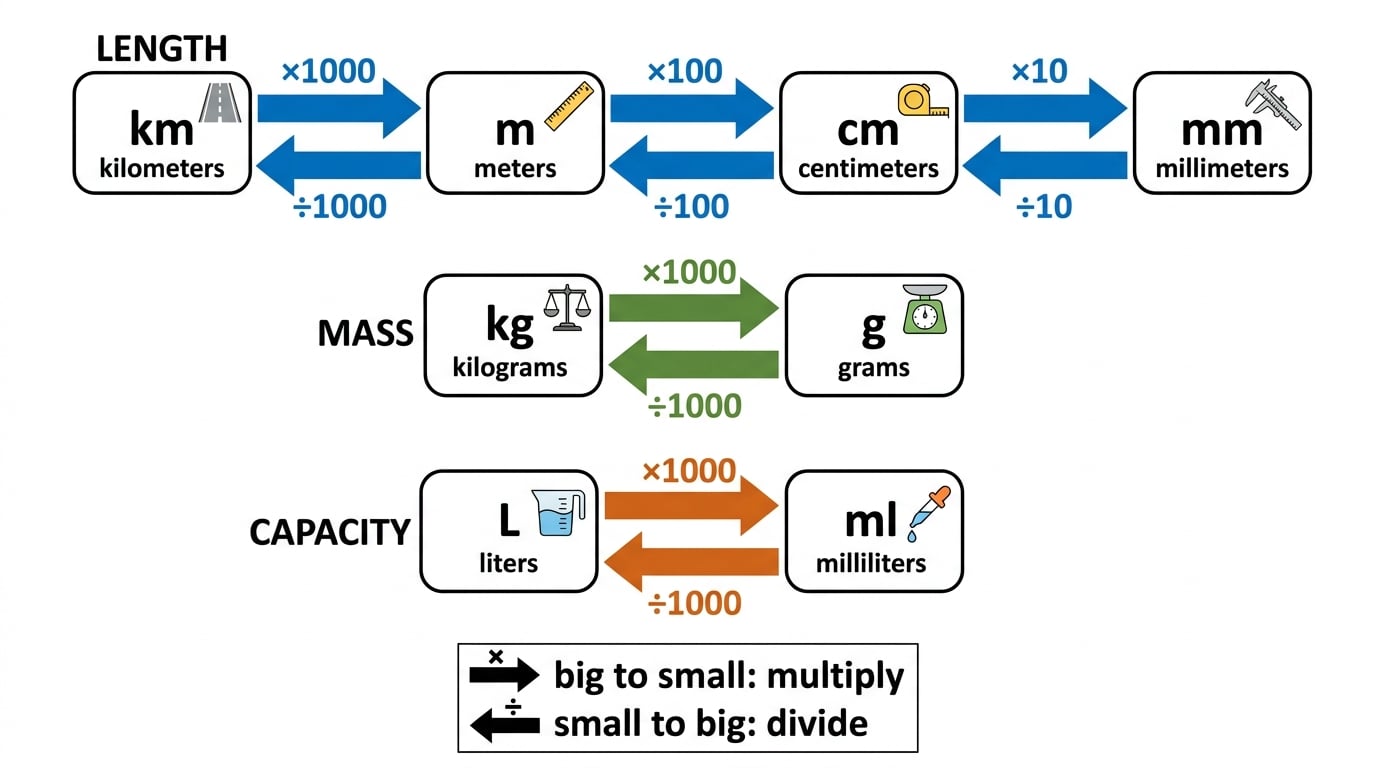
Key facts to remember
Learn these facts:


- 1 kilometre = 1000 metres
- 1 metre = 100 centimetres
- 1 centimetre = 10 millimetres
- 1 kilogram = 1000 grams
- 1 litre = 1000 millilitres
The short unit names are:
- kilometres = km
- metres = m
- centimetres = cm
- millimetres = mm
- kilograms = kg
- grams = g
- millilitres = ml
Change 6 metres to centimetres

-
You are changing from metres to centimetres.
-
Use the fact 1 metre = 100 centimetres.
-
There are 6 lots of 100, so calculate:
6×100=6006 \times 100 = 6006×100=600 -
Answer: 600 cm.
Big unit to smaller unit: multiply
A bigger unit covers more. For example, 1 km is much longer than 1 m.
If you change to a smaller unit, you need more of them, so the number gets bigger.

Big to small means multiply
Changing from a bigger unit to a smaller unit makes the number bigger, so multiply by the conversion number.
Change 2.7 kilometres to metres

-
Kilometres are bigger than metres.
-
Use the fact 1 km = 1000 m.
-
Because you are going from big to small, multiply by 1000:
2.7×1000=27002.7 \times 1000 = 27002.7×1000=2700 -
Answer: 2700 m.
Change 0.72 kilograms to grams

-
Kilograms are bigger than grams.
-
Use the fact 1 kg = 1000 g.
-
Multiply by 1000:
0.72×1000=7200.72 \times 1000 = 7200.72×1000=720 -
Answer: 720 g.
Smaller unit to big unit: divide
If you change to a bigger unit, you need fewer of them, so the number gets smaller.

For example, 3000 g is only 3 kg, because kilograms are larger units.
Change 4300 grams to kilograms

-
Grams are smaller than kilograms.
-
Use the fact 1000 g = 1 kg.
-
Because you are going from small to big, divide by 1000:
4300÷1000=4.34300 \div 1000 = 4.34300÷1000=4.3 -
Answer: 4.3 kg.
Multiplying every time
Do not automatically multiply just because you see 1000. First ask: “Am I changing to a bigger unit or a smaller unit?”
Length conversions
Length means distance or how long something is.
For length, there are three common links:

- km to m uses 1000
- m to cm uses 100
- cm to mm uses 10
Metres and centimetres
Change 8.4 metres to centimetres
-
Metres are bigger than centimetres.
-
Use the fact 1 metre = 100 centimetres.
-
Going from big to small means multiply:
8.4×100=8408.4 \times 100 = 8408.4×100=840 -
Answer: 840 cm.
Change 950 centimetres to metres

-
Centimetres are smaller than metres.
-
Use the fact 100 cm = 1 m.
-
Going from small to big means divide:
950÷100=9.5950 \div 100 = 9.5950÷100=9.5 -
Answer: 9.5 m.
Centimetres and millimetres
Change 37 centimetres to millimetres

-
Centimetres are bigger than millimetres.
-
Use the fact 1 cm = 10 mm.
-
Going from big to small means multiply:
37×10=37037 \times 10 = 37037×10=370 -
Answer: 370 mm.
Quick size check
If the unit gets smaller, your number should get bigger. If the unit gets bigger, your number should get smaller.
Capacity conversions: litres and millilitres
Capacity means how much liquid something can hold.

The key fact is:
- 1 litre = 1000 millilitres
Change 3.6 litres to millilitres

-
Litres are bigger than millilitres.
-
Use the fact 1 litre = 1000 ml.
-
Going from big to small means multiply:
3.6×1000=36003.6 \times 1000 = 36003.6×1000=3600 -
Answer: 3600 ml.
Change 680 millilitres to litres
-
Millilitres are smaller than litres.
-
Use the fact 1000 ml = 1 litre.
-
Going from small to big means divide:
680÷1000=0.68680 \div 1000 = 0.68680÷1000=0.68 -
Answer: 0.68 litres.
Decimals are normal
A decimal is a number with a decimal point, such as 1.5 or 0.42.
Decimals work in exactly the same way. You still multiply or divide by the conversion number.
Change 0.95 kilometres to metres
-
Kilometres are bigger than metres.
-
Use the fact 1 km = 1000 m.
-
Multiply by 1000:
0.95×1000=9500.95 \times 1000 = 9500.95×1000=950 -
Answer: 950 m.
In the exam
-
Underline the starting unit and the unit you are changing to.
-
Write the correct fact, such as 1 m = 100 cm or 1 kg = 1000 g.
-
Decide whether the number should get bigger or smaller before you calculate.
Check yourself
-
Should the number get bigger or smaller when changing kilograms to grams?
-
Which fact links centimetres and millimetres?
-
What would you do to change millilitres into litres?
