Coordinates
What you'll learn
- How to read and plot points on a coordinate grid.
- How to use negative coordinates correctly.
- How to find the midpoint of a line segment.
- How to draw simple lines such as x=−1x=-1x=−1 and y=6y=6y=6.
The coordinate grid
A coordinate grid has two number lines crossing each other. You use it to describe exact positions of points.

Coordinate grid
-
The x-axis is the horizontal line going left and right.
-
The y-axis is the vertical line going up and down.
-
The origin is the point where the axes meet. It is at (0,0)(0,0)(0,0).

- A coordinate pair tells you a point’s position and is written as (x,y)(x,y)(x,y).
Across first, then up or down
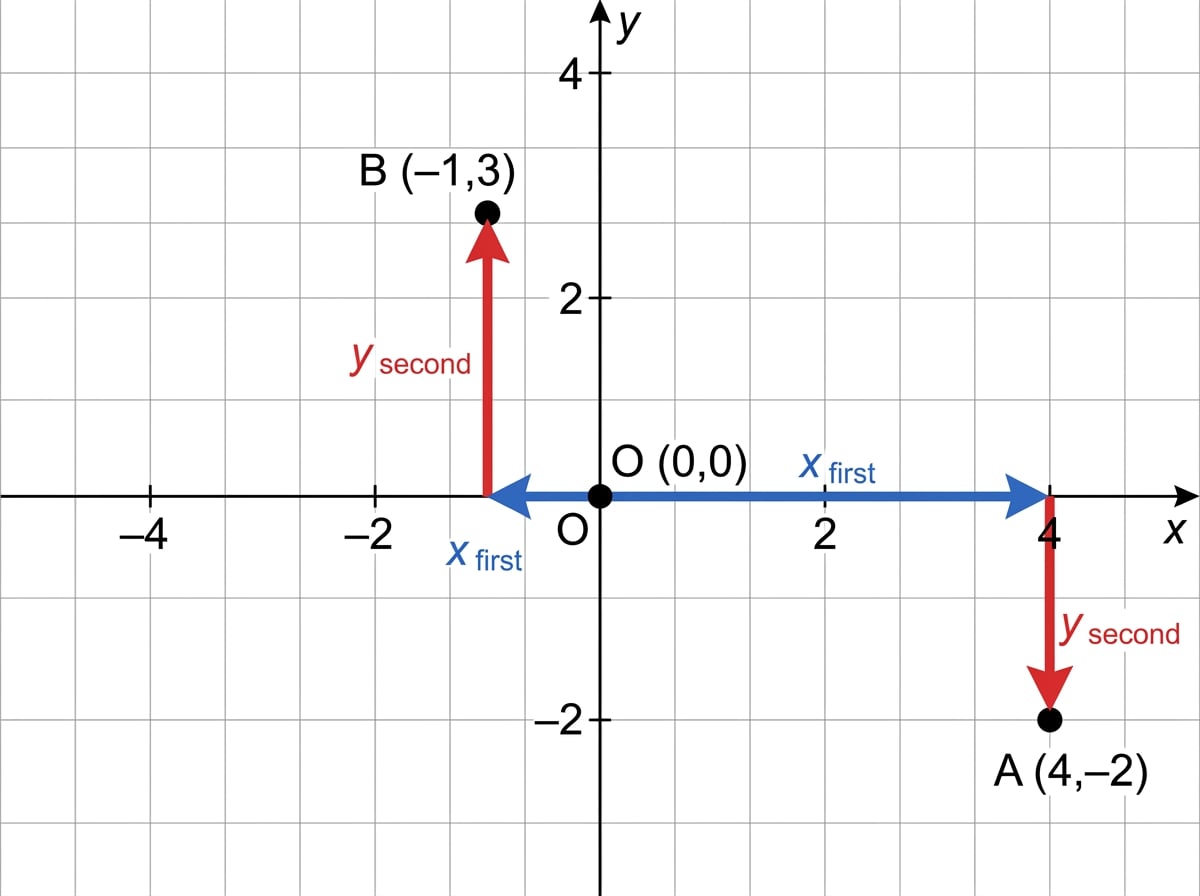
Coordinates are always read in this order: x first, then y.
Reading coordinates
To read a point from a grid, start at the origin.
- The first number tells you how far left or right the point is.
- The second number tells you how far up or down the point is.
- Positive x means right.
- Negative x means left.
- Positive y means up.
- Negative y means down.
Writing down the coordinates of a marked point

-
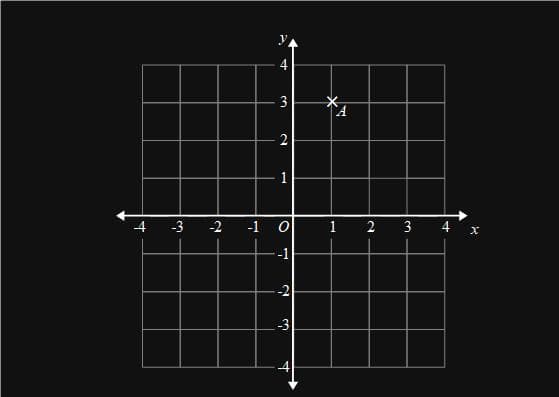
Suppose point A is 4 squares to the right of the origin.
-
That means the x-coordinate is 4.
-
Point A is also 2 squares below the x-axis.
-
That means the y-coordinate is -2.
-
So the coordinates of point A are (4,−2)(4,-2)(4,−2).

Swapping the coordinates
A very common mistake is writing the y-coordinate first. Remember: coordinates are always written as across, then up/down.
Plotting a point
To plot a point means to put it in the correct place on the grid.
Always start at the origin, then count across first, then up or down.
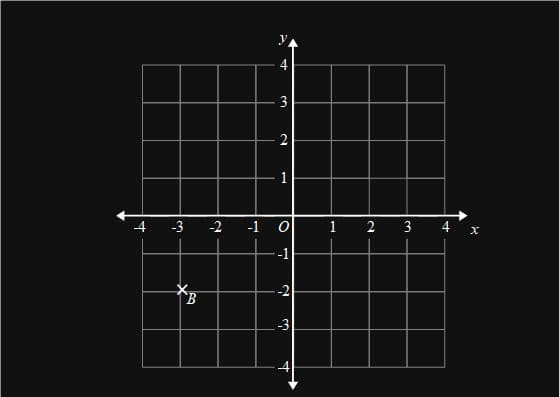
Plotting point B at

-
Start at the origin, (0,0)(0,0)(0,0).
-
The x-coordinate is -1, so move 1 square left.
-
The y-coordinate is 3, so move 3 squares up.
-
Put a cross at that position.
-
Label the point B.

Negative directions
Negative x goes left. Negative y goes down. If both are negative, you move left and down.
Midpoints
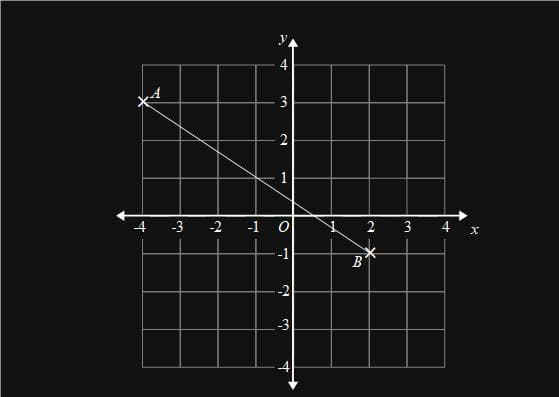
Sometimes you are given two points joined by a line segment. A line segment is a straight line between two endpoints.
Midpoint
The midpoint is the point exactly halfway between two endpoints.
To find a midpoint, you find the middle of the x-coordinates and the middle of the y-coordinates.
Another way to say this is: add the two x-coordinates and divide by 2, then add the two y-coordinates and divide by 2.
Midpoint rule
Find the average of the x-coordinates and the average of the y-coordinates.
Finding the midpoint of B and C

-
Let B be at (−3,3)(-3,3)(−3,3) and C be at (3,0)(3,0)(3,0).
-
Find the middle of the x-coordinates. The x-coordinates are -3 and 3.
-
Add them and divide by 2:
(−3+3)÷2=0(-3+3)\div 2=0(−3+3)÷2=0 -
Find the middle of the y-coordinates. The y-coordinates are 3 and 0.
-
Add them and divide by 2:
(3+0)÷2=1.5(3+0)\div 2=1.5(3+0)÷2=1.5 -
So the midpoint is (0,1.5)(0,1.5)(0,1.5).

Only finding one coordinate
A midpoint needs two coordinates. Make sure you find both the x-value and the y-value.
Drawing lines like x=−1x=-1x=−1 and y=6y=6y=6
An equation is a mathematical statement with an equals sign.
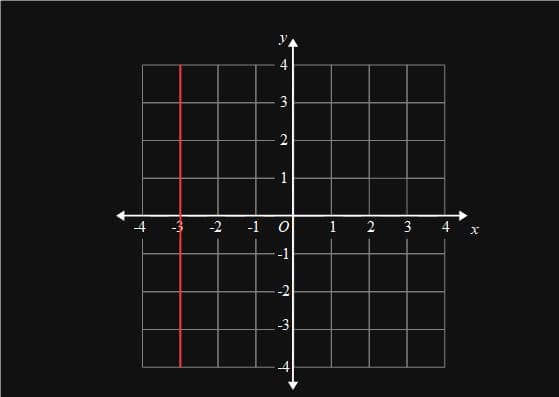
For example, x=−1x=-1x=−1 tells you that every point on the line has an x-coordinate of -1.
Equation of a line
An equation of a line tells you which points are on that line.
Lines where x is fixed
A line such as x=3x=3x=3 is vertical. Every point on the line has x-coordinate 3.

Drawing the line
-
Find -2 on the x-axis.
-
Draw a straight vertical line through -2.
-
The line goes up and down through the grid.
-
Check with a point on the line, such as (−2,4)(-2,4)(−2,4). Its x-coordinate is -2.

Lines where y is fixed
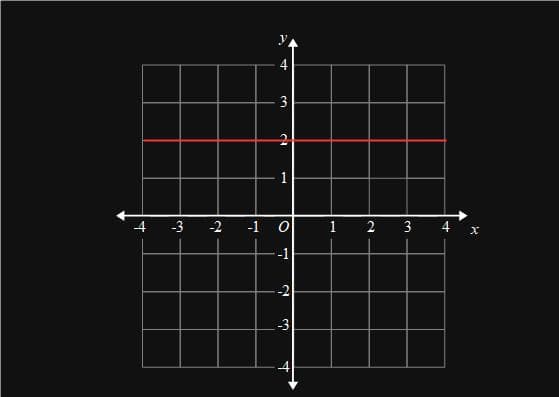
A line such as y=6y=6y=6 is horizontal. Every point on the line has y-coordinate 6.

Drawing the line
-
Find 4 on the y-axis.
-
Draw a straight horizontal line through 4.
-
The line goes left and right through the grid.
-
Check with a point on the line, such as (1,4)(1,4)(1,4). Its y-coordinate is 4.

Remember vertical and horizontal
Lines written as x=numberx=\text{number}x=number are vertical. Lines written as y=numbery=\text{number}y=number are horizontal.
Completing a square on a grid
A square is a shape with 4 equal sides and 4 right angles.
If you are given three corners of a square, you can find the missing corner by matching the movement from one side.
For a square called ABCD, the letters usually go around the shape in order.
Finding the missing corner D
-
Suppose A is at (−1,3)(-1,3)(−1,3), B is at (3,2)(3,2)(3,2), and C is at (2,−2)(2,-2)(2,−2).
-
Look at the move from B to C.
-
From B to C, you move 1 square left and 4 squares down.
-
To find D, repeat that same move from A.
-
From A, move 1 square left and 4 squares down.
-
So D is at (−2,−1)(-2,-1)(−2,−1).

Use the matching side
In a square ABCD, the side AD matches the side BC. So the movement from B to C is repeated from A to D.
In the exam
-
Always read coordinates in the order x first, then y.
-
When plotting, start at the origin and count carefully.
-
For a midpoint, average the x-coordinates and average the y-coordinates separately.
-
For x=numberx=\text{number}x=number draw a vertical line; for y=numbery=\text{number}y=number draw a horizontal line.
Check yourself
-
Can you plot the point (−3,2)(-3,2)(−3,2) on a grid?
-
What is the midpoint of (4,−2)(4,-2)(4,−2) and (4,6)(4,6)(4,6)?
-
Is the line x=2x=2x=2 horizontal or vertical?