Skip to content
MathsGenie logo
Open app

Course home

  1. GCSE
  2. Maths WJEC
  3. Revision guides

BIDMAS

What you'll learn

  • What the letters in BIDMAS mean.
  • Which part of a calculation to do first.
  • How brackets and powers can change an answer.
  • How to place brackets to make a statement correct.

The basic idea

Sometimes a calculation has more than one operation, such as adding, multiplying, or subtracting. BIDMAS tells you the order to do them in.

Definition

Expression and operation

An expression is a calculation, such as 6 + 3 × 2. An operation is something you do to numbers, like add, subtract, multiply, divide, or square.

If there is only one operation

If a calculation only has one operation, just work it out normally.

Example

One operation

Work out:

15−815 - 815−8
  1. There is only one operation: subtraction.

  2. Subtract 8 from 15.

    15−8=715 - 8 = 715−8=7
  3. The answer is 7.

What BIDMAS stands for

BIDMAS is a memory word:

A priority ladder showing the BIDMAS order, with division/multiplication tied and addition/subtraction tied.

  • Brackets
  • Indices
  • Division and Multiplication
  • Addition and Subtraction
Key Idea

The BIDMAS order

Do brackets first, then indices, then multiplication or division, then addition or subtraction.

BIDMAS priority order from first to last, showing the equal-priority pairs.

Multiplication before addition

Example

Multiplication before addition

Work out:

3+6×4![Themultiplicationpartof3+6×4ishighlightedtoshowitmustbedonebeforetheaddition.](https://assets.mathsgenie.co.uk/notes/diagrams/fe720786−56ce−4c15−895d−9a4e8c7373e1.png)3 + 6 \times 4 ![The multiplication part of 3 + 6 × 4 is highlighted to show it must be done before the addition.](https://assets.mathsgenie.co.uk/notes/diagrams/fe720786-56ce-4c15-895d-9a4e8c7373e1.png)3+6×4![Themultiplicationpartof3+6×4ishighlightedtoshowitmustbedonebeforetheaddition.](https://assets.mathsgenie.co.uk/notes/diagrams/fe720786−56ce−4c15−895d−9a4e8c7373e1.png)
  1. There are two operations: addition and multiplication.

  2. Multiplication comes before addition, so work out 6 multiplied by 4 first.

The multiplication part of 3 + 6 × 4 is identified as the first step before adding 3.

6×4=246 \times 4 = 246×4=24
  1. Now add 3.

    3+24=273 + 24 = 273+24=27
  2. The answer is 27.

Common Mistake

Going left to right too soon

A common mistake is to do 3 + 6 first just because it is on the left. BIDMAS says multiplication must be done before addition.

Brackets come first

Definition

Brackets

Brackets show a part of the calculation that must be done first. They look like this: ( ).

Anything inside brackets gets worked out before the rest of the calculation.

The bracketed part of (9 − 4) × 3 is shown as the first part to calculate before multiplying by 3.

Example

Brackets first

Work out:

(9−4)×3![Thebracketsaround9−4showtheparttocalculatefirstbeforemultiplyingby3.](https://assets.mathsgenie.co.uk/notes/diagrams/37f59220−d272−4096−bae3−f62d59c6014c.png)(9 - 4) \times 3 ![The brackets around 9 − 4 show the part to calculate first before multiplying by 3.](https://assets.mathsgenie.co.uk/notes/diagrams/37f59220-d272-4096-bae3-f62d59c6014c.png)(9−4)×3![Thebracketsaround9−4showtheparttocalculatefirstbeforemultiplyingby3.](https://assets.mathsgenie.co.uk/notes/diagrams/37f59220−d272−4096−bae3−f62d59c6014c.png)
  1. The brackets tell you to work out 9 minus 4 first.

    9−4=59 - 4 = 59−4=5
  2. Replace the bracket part with 5.

    5×35 \times 35×3
  3. Multiply.

    5×3=155 \times 3 = 155×3=15
  4. The answer is 15.

Tip

Spot the brackets

When you see brackets, circle or underline the part inside them. That reminds you to do that part first.

Indices come next

Definition

Index

An index tells you how many times to multiply a number by itself. For example, 424^242 means 4 multiplied by 4. We say “4 squared”.

An index is shown as a small number telling how many equal factors to multiply.

Indices are done after brackets, but before multiplication, division, addition, and subtraction.

Example

Squaring before adding

Work out:

7+42![Theindexappliesonlytothe4,so42iscalculatedbeforeadding7.](https://assets.mathsgenie.co.uk/notes/diagrams/f25edfd7−90d5−4759−bac0−bbc77407c0d4.png)7 + 4^2 ![The index applies only to the 4, so 4² is calculated before adding 7.](https://assets.mathsgenie.co.uk/notes/diagrams/f25edfd7-90d5-4759-bac0-bbc77407c0d4.png)7+42![Theindexappliesonlytothe4,so42iscalculatedbeforeadding7.](https://assets.mathsgenie.co.uk/notes/diagrams/f25edfd7−90d5−4759−bac0−bbc77407c0d4.png)
  1. The index is on 4, so work out 4 squared first.

    42=4×4=164^2 = 4 \times 4 = 1642=4×4=16
  2. Now add 7.

    7+16=237 + 16 = 237+16=23
  3. The answer is 23.

Brackets before indices

If the brackets are squared, work out inside the brackets first, then square the answer.

For (6 + 2)², the bracket calculation happens before the squaring.

Example

Brackets then square

Work out:

(6+2)2![Forasquaredbracket,thecalculationinsidethebracketsisdonefirst,thentheresultissquared.](https://assets.mathsgenie.co.uk/notes/diagrams/c545b490−6dfe−4f80−b251−e09d5c6ea00d.png)(6 + 2)^2 ![For a squared bracket, the calculation inside the brackets is done first, then the result is squared.](https://assets.mathsgenie.co.uk/notes/diagrams/c545b490-6dfe-4f80-b251-e09d5c6ea00d.png)(6+2)2![Forasquaredbracket,thecalculationinsidethebracketsisdonefirst,thentheresultissquared.](https://assets.mathsgenie.co.uk/notes/diagrams/c545b490−6dfe−4f80−b251−e09d5c6ea00d.png)
  1. Work out the brackets first.

    6+2=86 + 2 = 86+2=8
  2. Now square 8.

    82=8×8=648^2 = 8 \times 8 = 6482=8×8=64
  3. The answer is 64.

Multiplication and division before addition and subtraction

Multiplication and division have higher priority than addition and subtraction.

Example

Division before addition

Work out:

5+18÷35 + 18 \div 35+18÷3
  1. Division comes before addition, so work out 18 divided by 3 first.

    18÷3=618 \div 3 = 618÷3=6
  2. Now add 5.

    5+6=115 + 6 = 115+6=11
  3. The answer is 11.

When multiplication and division both appear

Multiplication and division are equal priority. Do them from left to right.

Multiplication and division are tied in priority, so the operations are tackled from left to right.

Example

Multiplication and division left to right

Work out:

4+8×3÷6![Multiplicationanddivisionhaveequalpriority,sothe×and÷stepsaretakenfromlefttorightbeforeadding4.](https://assets.mathsgenie.co.uk/notes/diagrams/28908beb−5b83−47df−8be3−60ddade92e16.png)4 + 8 \times 3 \div 6 ![Multiplication and division have equal priority, so the × and ÷ steps are taken from left to right before adding 4.](https://assets.mathsgenie.co.uk/notes/diagrams/28908beb-5b83-47df-8be3-60ddade92e16.png)4+8×3÷6![Multiplicationanddivisionhaveequalpriority,sothe×and÷stepsaretakenfromlefttorightbeforeadding4.](https://assets.mathsgenie.co.uk/notes/diagrams/28908beb−5b83−47df−8be3−60ddade92e16.png)
  1. Multiplication and division come before addition.

  2. Work from left to right: first do 8 multiplied by 3.

    8×3=248 \times 3 = 248×3=24
  3. Now divide by 6.

    24÷6=424 \div 6 = 424÷6=4
  4. Now add 4.

    4+4=84 + 4 = 84+4=8
  5. The answer is 8.

Common Mistake

Division is not always before multiplication

The D and M in BIDMAS are a tie. If both appear, work from left to right.

Addition and subtraction are also left to right

Addition and subtraction have equal priority too. Once the brackets, indices, multiplication, and division are finished, work left to right.

Addition and subtraction are tied in priority, so 10 − 6 + 3 is worked from left to right.

Example

Subtraction and addition left to right

Work out:

10−6+3![Additionandsubtractionhaveequalpriority,sothisexpressionisworkedfromlefttoright.](https://assets.mathsgenie.co.uk/notes/diagrams/e2728e13−02e0−4dd7−986d−1c6b000967c4.png)10 - 6 + 3 ![Addition and subtraction have equal priority, so this expression is worked from left to right.](https://assets.mathsgenie.co.uk/notes/diagrams/e2728e13-02e0-4dd7-986d-1c6b000967c4.png)10−6+3![Additionandsubtractionhaveequalpriority,sothisexpressionisworkedfromlefttoright.](https://assets.mathsgenie.co.uk/notes/diagrams/e2728e13−02e0−4dd7−986d−1c6b000967c4.png)
  1. Addition and subtraction are equal priority, so start on the left.

  2. First do 10 minus 6.

    10−6=410 - 6 = 410−6=4
  3. Now add 3.

    4+3=74 + 3 = 74+3=7
  4. The answer is 7.

Putting BIDMAS together

Now you can handle calculations with several operations.

Example

Full BIDMAS calculation

Work out:

5+4×235 + 4 \times 2^35+4×23
  1. There are no brackets, so look for indices.

  2. Work out 2 cubed.

    23=2×2×2=82^3 = 2 \times 2 \times 2 = 823=2×2×2=8
  3. Now do the multiplication.

    4×8=324 \times 8 = 324×8=32
  4. Now do the addition.

    5+32=375 + 32 = 375+32=37
  5. The answer is 37.

Adding brackets to make a statement correct

Sometimes you are asked to put brackets into a calculation so the answer becomes correct. Brackets change the order, so they can change the answer.

Adding brackets around 4 + 2 changes the first operation and makes the target statement possible.

Example

Choosing where to put brackets

Add brackets to make this statement correct:

5×4+2=30![Puttingbracketsaround4+2forcestheadditiontohappenfirst,makingthetargetstatementpossible.](https://assets.mathsgenie.co.uk/notes/diagrams/da951685−164a−4459−8d7c−30bc881a573a.png)5 \times 4 + 2 = 30 ![Putting brackets around 4 + 2 forces the addition to happen first, making the target statement possible.](https://assets.mathsgenie.co.uk/notes/diagrams/da951685-164a-4459-8d7c-30bc881a573a.png)5×4+2=30![Puttingbracketsaround4+2forcestheadditiontohappenfirst,makingthetargetstatementpossible.](https://assets.mathsgenie.co.uk/notes/diagrams/da951685−164a−4459−8d7c−30bc881a573a.png)
  1. Without brackets, multiplication happens first.

    5×4+2=225 \times 4 + 2 = 225×4+2=22
  2. To make 30, try grouping 4 plus 2.

    4+2=64 + 2 = 64+2=6
  3. Now multiply by 5.

    5×6=305 \times 6 = 305×6=30
  4. So the correct statement is:

    5×(4+2)=305 \times (4 + 2) = 305×(4+2)=30
Example

Using two pairs of brackets

Add brackets to make this statement correct:

3+2×4+5=453 + 2 \times 4 + 5 = 453+2×4+5=45
  1. Notice that 45 can be made by 5 multiplied by 9.

  2. Put brackets around 3 plus 2 to make 5.

    3+2=53 + 2 = 53+2=5
  3. Put brackets around 4 plus 5 to make 9.

    4+5=94 + 5 = 94+5=9
  4. Multiply the two bracket answers.

    5×9=455 \times 9 = 455×9=45
  5. So the correct statement is:

    (3+2)×(4+5)=45(3 + 2) \times (4 + 5) = 45(3+2)×(4+5)=45
Tip

Bracket questions

Try the calculation without brackets first. If the answer is too small or too big, use brackets to force an addition or subtraction to happen earlier.

Exam technique

In the exam

  1. Write BIDMAS at the side if you need a reminder.
  2. Work out one part at a time, replacing it with the answer.
  3. For bracket questions, check your final statement actually gives the target answer.
Self review

Check yourself

  • In BIDMAS, what should you do before multiplying?
  • Why is 6 + 2 × 5 not the same as (6 + 2) × 5?
  • If multiplication and division are both in a calculation, what direction do you work in?
Recap questions

1 of 5

Work out 4+3×54 + 3 \times 54+3×5.

How was this guide?

Teach Genie

Review BIDMAS by teaching Genie

Teach it back in your own words, spot gaps, and remember it better.

Start teaching
Genie and Baby Genie

Lesson

Recap your knowledge with an interactive lesson

7 minute activity

Start lesson

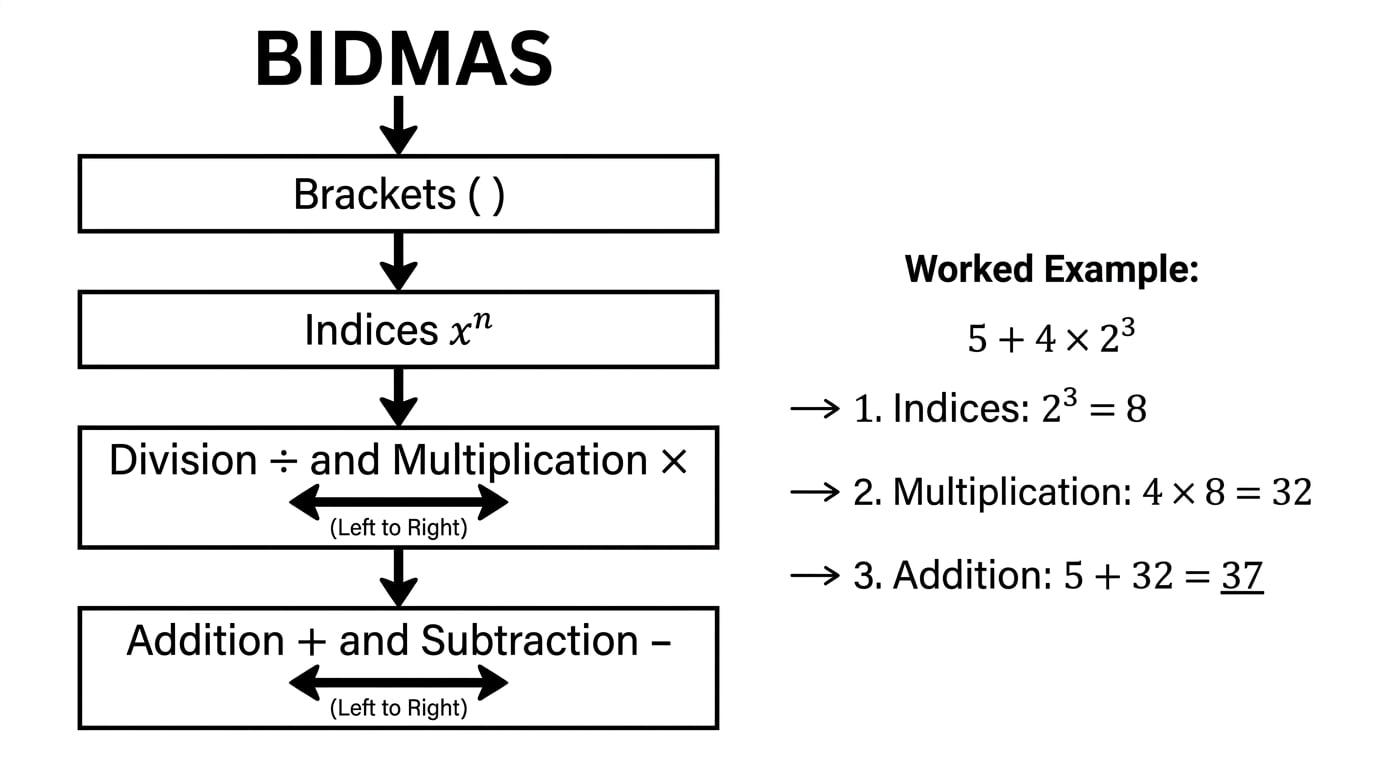
Flowchart showing BIDMAS order from Brackets to Indices to Division and Multiplication to Addition and Subtraction, with example 5 plus 4 times 2 cubed worked to 37

BIDMAS tells you the order for working through an expression with more than one operation. It helps everyone get the same answer instead of just going from left to right too early.

The letters stand for Brackets, Indices, Division and Multiplication, Addition and Subtraction. If an expression has only one operation, you can just do that operation normally.

Division and multiplication are a tie, and addition and subtraction are a tie. Inside each tied pair, work from left to right.

Flashcards

Remember key concepts with flashcards

27 flashcards

Practice flashcards

What does the B in BIDMAS stand for?

BIDMAS Revision Guide

  1. GCSE
  2. /Maths
  3. /BIDMAS