Skip to content
MathsGenie logo
Open app

Course home

  1. GCSE
  2. Maths WJEC
  3. Revision guides

Addition and Subtraction

What you'll learn

  • How to line up numbers using place value.
  • How to add using carrying.
  • How to subtract using exchanging.
  • How to handle decimals, money, and longer calculations with both + and -.

Place value: putting numbers in the right columns

Before you add or subtract, the most important skill is lining up the numbers correctly.

Definition

Digits and place value

  • A digit is one symbol used to make a number, such as 0, 1, 2, up to 9.
  • Place value means the value of a digit depends on where it is in the number: ones, tens, hundreds, thousands, tenths, hundredths, and so on.

For whole numbers, line up:

A place value grid showing how whole numbers are lined up in matching columns before adding or subtracting.

  • ones under ones
  • tens under tens
  • hundreds under hundreds

This helps you add or subtract one column at a time.

Key Idea

Line up the columns

Addition and subtraction are much easier when each place value is directly underneath the matching place value.

Adding whole numbers

Definition

Addition

Addition means combining amounts to find a total. The answer to an addition is sometimes called the sum.

When a column adds to 10 or more, you need to carry into the next column.

Definition

Carrying

Carrying means moving extra value into the next place value column. For example, 14 ones is the same as 4 ones and 1 ten.

Example

Adding whole numbers

Work out 346 + 78.

Column addition for 346 + 78 showing the carried tens and hundreds.

Column addition for 346 + 78 with digits lined up by place value and carried 1s shown above the next columns.

  1. Line up the numbers by place value. The 78 has no hundreds digit, so it goes under the tens and ones.

  2. Add the ones: 6 + 8 = 14. Write down 4 in the ones column and carry 1 ten.

  3. Add the tens: 4 + 7 + 1 carried = 12. Write down 2 in the tens column and carry 1 hundred.

  4. Add the hundreds: 3 + 1 carried = 4.

  5. The answer is 424.

Common Mistake

Forgetting the carried number

A very common error is to carry 1, then forget to add it in the next column. Put the carried number small above the next column so you can see it.

Subtracting whole numbers

Definition

Subtraction

Subtraction means taking one amount away from another. The answer to a subtraction is called the difference.

Sometimes the top digit is too small to subtract from. Then you use exchanging, also called borrowing.

Definition

Exchanging

Exchanging means taking 1 from the next column and changing it into 10 in the column you are working in.

For example, if you cannot do 2 - 7 in the ones column, exchange 1 ten for 10 ones.

Exchanging one ten for ten ones makes enough ones to subtract from.

Exchanging turns one ten into ten ones so there are enough ones to subtract from.

Example

Subtracting with exchanging

Work out 2470 - 638.

Column subtraction for 2470 − 638 showing the exchanges needed in the ones and hundreds columns.

Column subtraction for 2470 − 638 showing the exchanges from tens to ones and thousands to hundreds.

  1. Line up the numbers by place value: ones under ones, tens under tens, hundreds under hundreds.

  2. Start with the ones: 0 - 8 is not possible using whole numbers, so exchange 1 ten from the tens column. The 7 tens becomes 6 tens, and the ones become 10 ones.

  3. Now subtract the ones: 10 - 8 = 2.

  4. Subtract the tens: 6 - 3 = 3.

  5. Subtract the hundreds: 4 - 6 is not possible, so exchange 1 thousand. The 2 thousands becomes 1 thousand, and the hundreds become 14 hundreds.

  6. Now subtract the hundreds: 14 - 6 = 8.

  7. Subtract the thousands: 1 - 0 = 1.

  8. The answer is 1832.

Tip

Check subtraction quickly

Your answer should usually be smaller than the number you started with. You can also add your answer to the number you subtracted to check you get back to the starting number.

Adding and subtracting decimals

Definition

Decimal point

The decimal point is the dot in a number that separates whole numbers from parts of a whole, such as tenths and hundredths.

With decimals, the key rule is: line up the decimal points.

A decimal place value grid showing decimal points aligned so each digit is in the correct column.

You can add zeros to the end of a decimal if it helps. For example, 7.5 is the same value as 7.50.

Example

Adding decimals

Work out 47.36 + 5.89.

Decimal addition for 47.36 + 5.89 with decimal points aligned and carrying through the columns.

  1. Line up the decimal points. This also lines up the ones, tenths, and hundredths.

  2. Add the hundredths: 6 + 9 = 15. Write down 5 and carry 1 tenth.

  3. Add the tenths: 3 + 8 + 1 carried = 12. Write down 2 and carry 1 one.

  4. Add the ones: 7 + 5 + 1 carried = 13. Write down 3 and carry 1 ten.

  5. Add the tens: 4 + 1 carried = 5.

  6. The answer is 53.25.

Example

Subtracting a decimal from a whole number

Work out 75 - 28.6.

Decimal subtraction for 75 − 28.6 showing 75 written as 75.0 and the exchanges needed.

  1. Write 75 as 75.0 so both numbers have one decimal place.

  2. Line up the decimal points.

  3. Subtract the tenths: 0 - 6 is not possible, so exchange 1 one. The 5 ones becomes 4 ones, and the tenths become 10 tenths.

  4. Now subtract the tenths: 10 - 6 = 4.

  5. Subtract the ones: 4 - 8 is not possible, so exchange 1 ten. The 7 tens becomes 6 tens, and the ones become 14 ones.

  6. Now subtract the ones: 14 - 8 = 6.

  7. Subtract the tens: 6 - 2 = 4.

  8. The answer is 46.4.

Common Mistake

Not lining up decimal points

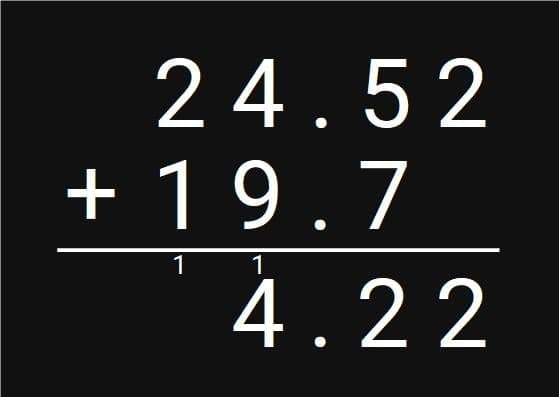
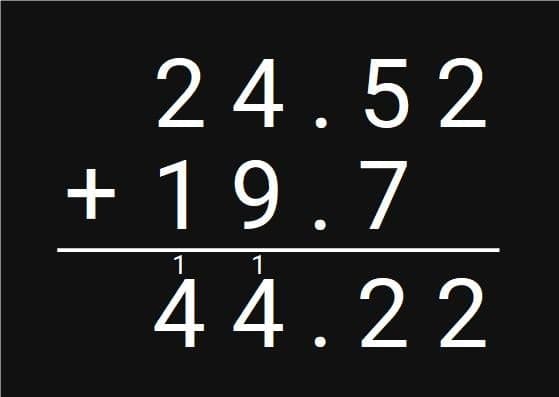
Do not line up numbers by their right-hand ends when decimals are involved. Line up the decimal points first, then fill missing spaces with zeros if needed.

A side-by-side comparison showing the wrong and right way to align decimal numbers.

Decimal points must be aligned; lining up the right-hand ends puts digits in the wrong place value columns.

Money calculations

Money works like decimals because pounds and pence use two decimal places.

For example:

  • £6.50 means 6 pounds and 50 pence.
  • £6.05 means 6 pounds and 5 pence.
Example

Subtracting money

Work out £25 - £9.38.

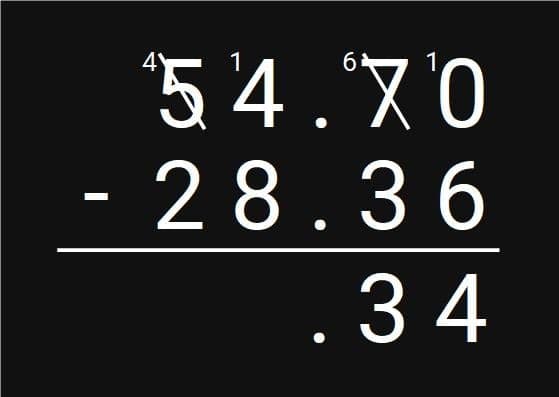
Money subtraction for £25.00 − £9.38 showing pounds and pence aligned to two decimal places.

Money subtraction for £25.00 − £9.38 showing how zeros are added and exchanged across pounds and pence.

  1. Write £25 as £25.00 because money is usually written to two decimal places.

  2. Line up the decimal points: £25.00 minus £9.38.

  3. Subtract the hundredths: 0 - 8 is not possible, so exchange from the tenths column. But the tenths is also 0, so exchange from the ones column first.

  4. After exchanging, subtract the hundredths: 10 - 8 = 2.

  5. Subtract the tenths: 9 - 3 = 6.

  6. Subtract the ones: 4 - 9 is not possible, so exchange 1 ten. The 2 tens becomes 1 ten, and the ones become 14 ones.

  7. Subtract the ones: 14 - 9 = 5.

  8. Subtract the tens: 1 - 0 = 1.

  9. The answer is £15.62.

Tip

Money answers

Always give money answers with two decimal places, even if the last digit is 0, such as £3.40.

More than two numbers

Some questions mix addition and subtraction, like a running total.

If there are only + and - signs, work from left to right. You can use column methods for each part.

Example

A mixed addition and subtraction

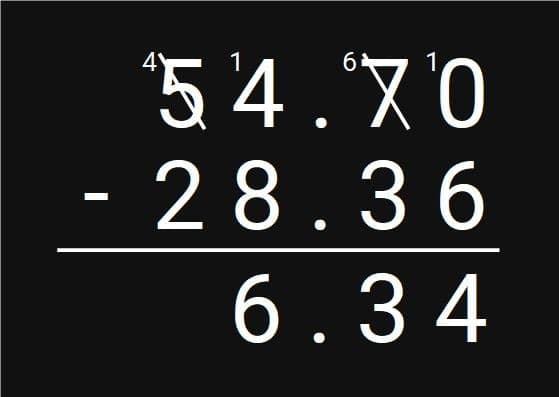
Work out 18.6 + 24 - 5.73.

A two-stage layout showing that the mixed calculation is worked from left to right.

A two-stage mixed calculation: first add 18.60 and 24.00, then subtract 5.73 from 42.60.

  1. Start with the addition: 18.6 + 24. Write 18.6 as 18.60 and 24 as 24.00.

  2. Add them: 18.60 + 24.00 = 42.60.

  3. Now subtract 5.73 from 42.60.

  4. Subtract the hundredths: 0 - 3 is not possible, so exchange 1 tenth. The 6 tenths becomes 5 tenths, and the hundredths become 10 hundredths.

  5. Subtract the hundredths: 10 - 3 = 7.

  6. Subtract the tenths: 5 - 7 is not possible, so exchange 1 one. The 2 ones becomes 1 one, and the tenths become 15 tenths.

  7. Subtract the tenths: 15 - 7 = 8.

  8. Subtract the ones and tens to get 36.87.

  9. The answer is 36.87.

Exam technique

In the exam

  1. Copy the numbers carefully, especially decimal points and £ signs.

  2. Line up place values before calculating: decimal points must be underneath each other.

  3. Show your working in columns so you can get method marks even if one digit goes wrong.

  4. Estimate your answer to check it is sensible.

Self review

Check yourself

  • Can you explain why 62 can be written as 62.0 in a decimal subtraction?

  • When do you need to carry in addition?

  • Why should money answers usually have two digits after the decimal point?

Recap questions

1 of 5

Work out 346+78346 + 78346+78.

How was this guide?

Teach Genie

Review Addition and Subtraction by teaching Genie

Teach it back in your own words, spot gaps, and remember it better.

Start teaching
Genie and Baby Genie

Flashcards

Remember key concepts with flashcards

21 flashcards

Practice flashcards

A [     ] is one symbol used to make a number; [     ] means a digit's value depends on its position.

Addition and Subtraction Revision Guide

  1. GCSE
  2. /Maths
  3. /Addition and Subtraction