Probability
x

Revision notes for Eduqas GCSE Maths Probability. Open the guide for explanations and worked examples. Written against the Eduqas GCSE Maths (C300QS) specification, so the content matches what's examinable rather than general Maths background.

Probability

What you'll learn

  • What probability numbers mean, from impossible to certain.
  • How to complete missing probabilities in tables.
  • How to estimate how many times something will happen.
  • How to use ratios, “same as”, “twice as” and real counts.

1. Probability language

When something happens at random, you cannot predict the exact result, but you can describe how likely each result is.

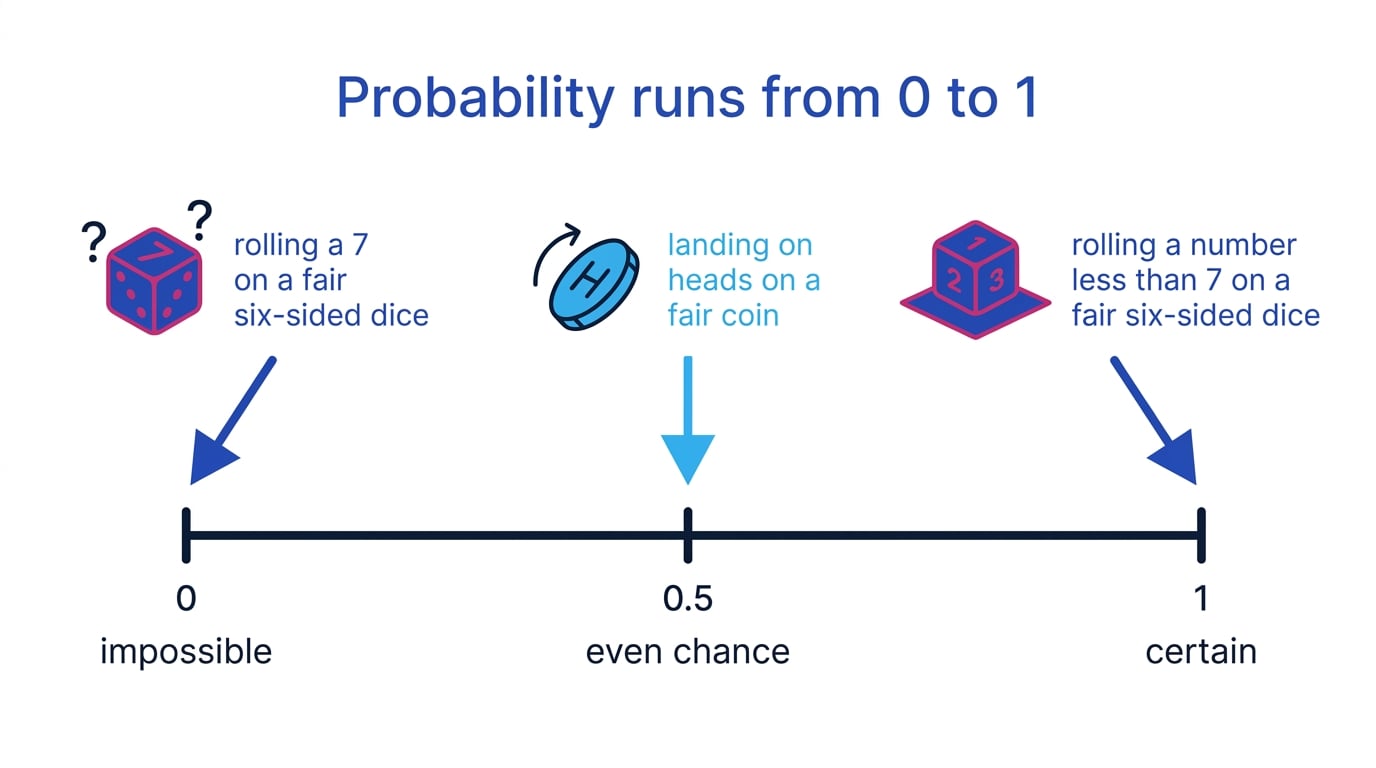
A probability is always between 0 and 1. A probability of 0 means impossible, and a probability of 1 means certain.

A probability scale shows that probabilities run from impossible at 0 to certain at 1.

Definition

Key probability words

  • An outcome is one possible result, such as landing on blue.

  • An event is the result you are interested in, such as “landing on blue”.

  • A probability is a number from 0 to 1 showing how likely an event is.

  • P(red)P(\text{red})P(red) means “the probability of red”.

  • A biased spinner or dice has outcomes that are not all equally likely.

Key Idea

Complete probabilities add to 1

If the outcomes listed are the only possible outcomes, their probabilities must add to 1.

Worked example: finding a missing probability

Example

Completing a probability table

A bag contains only red, blue and white counters. The probability of red is 0.46 and the probability of blue is 0.37. Find the probability of white.

The three probabilities fill one whole, so the missing white probability is the leftover part.

  1. The bag contains only red, blue and white counters, so the probabilities must add to 1.

  2. Add the known probabilities:

    0.46+0.37=0.830.46 + 0.37 = 0.830.46+0.37=0.83
  3. Subtract from 1 to find what is left for white:

    1−0.83=0.171 - 0.83 = 0.171−0.83=0.17
  4. The probability of choosing a white counter is 0.17.

Common Mistake

Forgetting the total is 1

Do not just add the given probabilities and stop. If the table lists every possible outcome, subtract the total from 1 to find the missing probability.

2. Estimating how many times something happens

A trial is one go of an experiment, such as one roll of a dice or one spin of a spinner.

An estimate is a sensible prediction, not a guarantee. If you repeat something many times, you can estimate how often an event happens by multiplying:

estimated number=probability×number of trials\text{estimated number} = \text{probability} \times \text{number of trials}estimated number=probability×number of trials

Worked example: repeated trials

Example

Estimating the number of successes

The probability that a seed grows is 0.88. A gardener plants 50 seeds. Estimate how many seeds will grow.

Multiplying the probability by the 50 trials gives an estimate of how many seeds grow.

  1. Identify the probability and the number of trials.

    • Probability of growing: 0.88
    • Number of seeds: 50
  2. Multiply the probability by the number of trials:

    0.88×50=440.88 \times 50 = 440.88×50=44
  3. The estimate is 44 seeds.

Tip

Quick sense check

If the probability is close to 1, the estimate should be close to the total number of trials. For example, a probability of 0.88 out of 50 should give an answer fairly close to 50.

3. Probability of “this or that”

Sometimes an event includes more than one outcome, such as “landing on 2 or 4”.

Outcomes like landing on 2 and landing on 4 on one spin are mutually exclusive, meaning they cannot happen at the same time. For mutually exclusive outcomes, add the probabilities.

Worked example: adding outcomes, then estimating

Example

Landing on one of two numbers

A biased dice can land on 1, 2, 3, 4, 5 or 6. The probabilities are:

  • 1: 0.12
  • 2: 0.24
  • 3: 0.09
  • 5: 0.16
  • 6: 0.20

The dice is rolled 200 times. Estimate how many times it lands on 2 or 4.

For one roll, landing on 2 and landing on 4 are separate outcomes, so their probabilities can be added before estimating out of 200 rolls.

  1. First find the missing probability for 4 by adding the known probabilities:

    0.12+0.24+0.09+0.16+0.20=0.810.12 + 0.24 + 0.09 + 0.16 + 0.20 = 0.810.12+0.24+0.09+0.16+0.20=0.81
  2. Subtract from 1:

    1−0.81=0.191 - 0.81 = 0.191−0.81=0.19
  3. Add the probabilities for 2 or 4:

    0.24+0.19=0.430.24 + 0.19 = 0.430.24+0.19=0.43
  4. Multiply by the number of rolls:

    0.43×200=860.43 \times 200 = 860.43×200=86
  5. The estimate is 86 times.

Common Mistake

Only add when outcomes cannot overlap

Adding probabilities works here because one roll cannot land on 2 and 4 at the same time.

4. Using ratios in probability tables

A ratio tells you how the amounts compare. If the numbers of counters are in the ratio 5 : 4 : 3, that means there are 5 parts, 4 parts and 3 parts.

To turn a ratio into probabilities, add the parts to find the total number of parts.

Worked example: ratio to probabilities

Example

Counters in a ratio

A bag contains red, blue and white counters in the ratio 4 : 3 : 5. A counter is chosen at random. Find the probability of each colour.

The ratio parts make 12 equal parts altogether, with 4 red parts, 3 blue parts and 5 white parts.

  1. Add the ratio parts:

    4+3+5=124 + 3 + 5 = 124+3+5=12
  2. Write each probability as its parts out of 12:

    P(red)=412=13P(blue)=312=14P(white)=512\begin{aligned} P(\text{red}) &= \frac{4}{12} = \frac{1}{3} \\ P(\text{blue}) &= \frac{3}{12} = \frac{1}{4} \\ P(\text{white}) &= \frac{5}{12} \end{aligned}P(red)P(blue)P(white)​=124​=31​=123​=41​=125​​
  3. The probabilities are red 13\frac{1}{3}31​, blue 14\frac{1}{4}41​ and white 512\frac{5}{12}125​.

5. Sharing the leftover probability

Sometimes you are told that two missing probabilities are the same, or that one is twice or three times another.

Use the probability left over, then split it into equal parts.

  • “The same” means a 1 : 1 split.
  • “Twice” means a 2 : 1 split.
  • “Three times” means a 3 : 1 split.

Worked example: one probability is twice another

Example

Splitting the leftover

A spinner can land on 1, 2, 3 or 4. The probability of 2 is 0.32 and the probability of 4 is 0.17. The probability of 1 is twice the probability of 3. Find the probabilities of 1 and 3.

After the known probabilities are taken out, the leftover probability is split in the ratio 2 : 1 for outcomes 1 and 3.

  1. Add the probabilities you already know:

    0.32+0.17=0.490.32 + 0.17 = 0.490.32+0.17=0.49
  2. Find the probability left for 1 and 3:

    1−0.49=0.511 - 0.49 = 0.511−0.49=0.51
  3. Since 1 is twice 3, split 0.51 in the ratio 2 : 1. There are 3 parts in total:

    0.51÷3=0.170.51 \div 3 = 0.170.51÷3=0.17
  4. Probability of 3 is one part, so it is 0.17. Probability of 1 is two parts:

    0.17×2=0.340.17 \times 2 = 0.340.17×2=0.34
  5. So P(1)=0.34P(1) = 0.34P(1)=0.34 and P(3)=0.17P(3) = 0.17P(3)=0.17.

6. Using probabilities to find actual numbers

If you know a probability and the actual number for that outcome, you can work out the total number.

For example, if 0.15 of the pens are green and there are 30 green pens, then 30 is 0.15 of the total.

Worked example: finding a number of items

Example

Probability and actual counters

A box contains red, blue, black and green pens. The probability of red is 0.37 and the probability of green is 0.15. The probability of black is three times the probability of blue. There are 30 green pens. Work out the number of black pens.

The leftover probability for blue and black is split 1 : 3, then the known 30 green pens scale the probabilities to actual numbers.

  1. Find the leftover probability for blue and black:

    1−0.37−0.15=0.481 - 0.37 - 0.15 = 0.481−0.37−0.15=0.48
  2. Black is three times blue, so split 0.48 in the ratio 3 : 1. There are 4 parts:

    0.48÷4=0.120.48 \div 4 = 0.120.48÷4=0.12
  3. Black is three parts:

    0.12×3=0.360.12 \times 3 = 0.360.12×3=0.36
  4. Use the green pens to find the total number of pens:

    300.15=200\frac{30}{0.15} = 2000.1530​=200
  5. Find the number of black pens:

    0.36×200=720.36 \times 200 = 720.36×200=72
  6. There are 72 black pens.

Exam technique

In the exam

  1. Check whether the outcomes listed are the only possible outcomes; if so, the probabilities add to 1.

  2. For an estimate after many trials, multiply the probability by the number of trials.

  3. When you see “same”, “twice” or “three times”, split the leftover probability into ratio parts.

Self review

Check yourself

  • If three outcomes have probabilities 0.2, 0.35 and a missing value, what calculation finds the missing value?

  • How do you estimate the number of successes from a probability and a number of trials?

  • If one missing probability is three times another, what ratio should you use?

Recap questions

Test yourself with 5 quick questions on this guide. Answer them all correctly to complete it.

You've reached the end

Test yourself on this topic, or move on to the next guide.

Practice questionsTake a quick quiz on this topicFlashcardsSelf-test with active recall
Scatter GraphsUp next

How was this guide?

Probability Revision Guide

  1. GCSE
  2. /Maths
  3. /Probability