- How to translate counter problems into algebraic probability equations.
- How to handle with replacement and without replacement questions.
- How to use ratios like red:blue = 3:1 in probability equations.
- How to solve the resulting linear or quadratic equations and reject impossible answers.
At Grade 8/9, the probability is usually not the hardest part. The challenge is setting up the equation accurately, then solving it cleanly.
Probability
The probability of an event is the number of favourable outcomes divided by the total number of possible outcomes. For two required events in a row, use the product rule: P(A and B)=P(A)×P(B after A)P(A\text{ and }B)=P(A)\times P(B\text{ after }A)P(A and B)=P(A)×P(B after A).
So if a question says “both counters are blue”, that means:
- first counter is blue and
- second counter is blue.
That is why you multiply the two probabilities.
Two counters without replacement
A bag contains 4 red counters and 3 blue counters. Two counters are taken at random without replacement. Find the probability that both are red.

-
There are 7 counters in total.
-
The probability the first counter is red is:
47\frac{4}{7}74
-
If a red counter has been removed, there are now 3 red counters left out of 6 counters.
-
Multiply the probabilities:
47×36=27\frac{4}{7}\times \frac{3}{6}=\frac{2}{7}74×63=72
Main method
- Write the number of each colour before the first pick.
- Decide whether the counter is replaced.
- Write the two probabilities and multiply them.
- Set the product equal to the probability given in the question.
With replacement
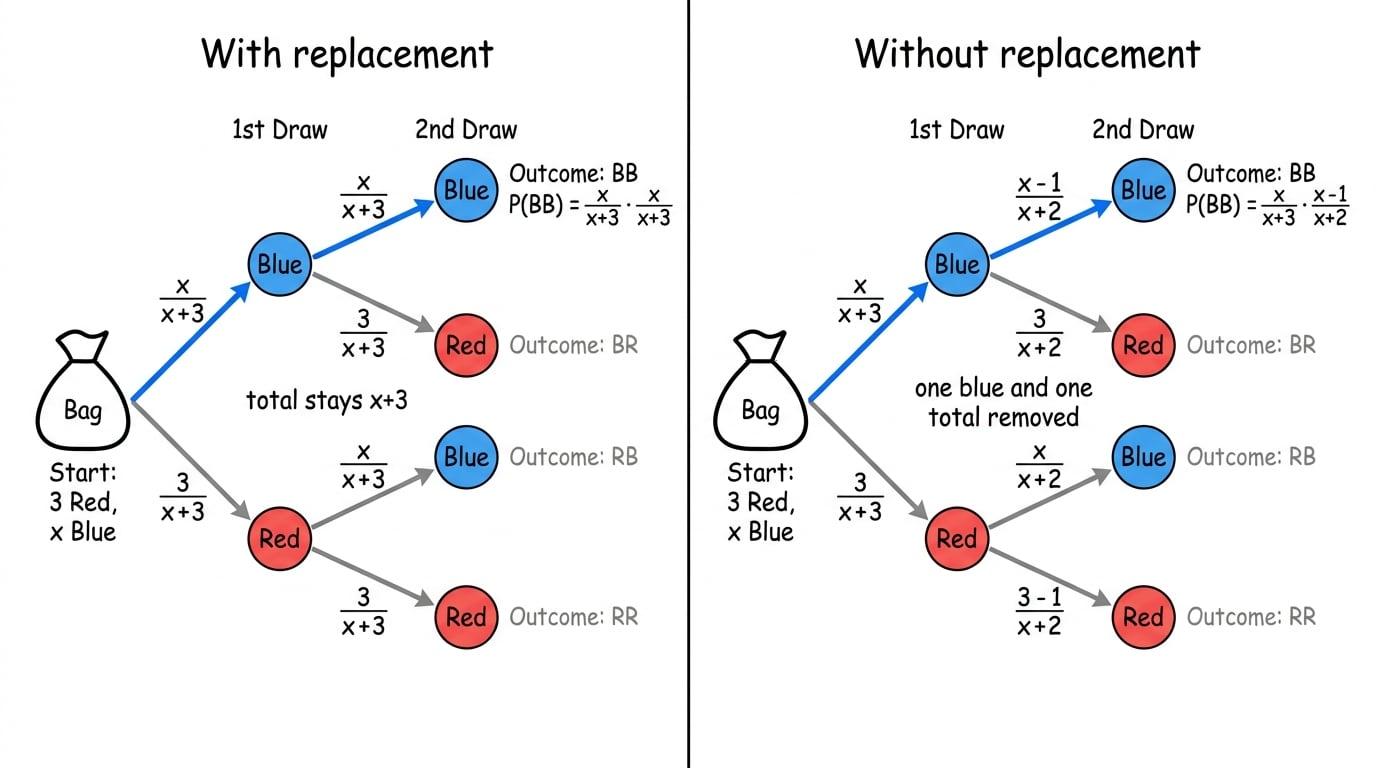
“With replacement” means the first counter is put back into the bag before the second counter is taken, so the total number of counters does not change.

This often creates a squared expression, because the same probability is used twice.
Finding an unknown with replacement
A bag contains 6 red counters and yyy blue counters. A counter is chosen, replaced, and then another counter is chosen. The probability of getting two red counters is 964\frac{9}{64}649. Find yyy.

-
The total number of counters is 6+y6+y6+y.
-
Because the counter is replaced, the probability of red is the same both times:
66+y×66+y=964\frac{6}{6+y}\times \frac{6}{6+y}=\frac{9}{64}6+y6×6+y6=649
-
Write this as a square:
(66+y)2=964\left(\frac{6}{6+y}\right)^2=\frac{9}{64}(6+y6)2=649
-
Take the positive square root of both sides:
66+y=38\frac{6}{6+y}=\frac{3}{8}6+y6=83
-
Cross-multiply and solve:
48=18+3y30=3yy=10\begin{aligned}
48&=18+3y\\
30&=3y\\
y&=10
\end{aligned}4830y=18+3y=3y=10
Square root shortcut
When the same event happens twice with replacement, you may be able to take the square root. Use the positive root because probabilities and numbers of counters cannot be negative.
Without replacement
“Without replacement” means the first counter is not put back, so the total number of counters decreases by 1 before the second pick.

If the first counter was blue, then both the number of blue counters and the total number of counters go down by 1.
Forming and solving a quadratic
A bag contains 3 red counters and xxx blue counters. Two counters are taken without replacement. The probability that both are blue is 514\frac{5}{14}145. Find xxx.

-
The total number of counters at the start is x+3x+3x+3.
-
The probability the first counter is blue is:
xx+3\frac{x}{x+3}x+3x
-
If one blue counter is removed, there are x−1x-1x−1 blue counters left out of x+2x+2x+2 counters.
-
Set up the equation:
xx+3×x−1x+2=514\frac{x}{x+3}\times \frac{x-1}{x+2}=\frac{5}{14}x+3x×x+2x−1=145
-
Clear the fractions by cross-multiplying:
14x(x−1)=5(x+3)(x+2)14x(x-1)=5(x+3)(x+2)14x(x−1)=5(x+3)(x+2)
-
Expand and collect terms:
14x2−14x=5x2+25x+309x2−39x−30=03x2−13x−10=0\begin{aligned}
14x^2-14x&=5x^2+25x+30\\
9x^2-39x-30&=0\\
3x^2-13x-10&=0
\end{aligned}14x2−14x9x2−39x−303x2−13x−10=5x2+25x+30=0=0
-
Factorise:
(3x+2)(x−5)=0(3x+2)(x-5)=0(3x+2)(x−5)=0
-
The solutions are x=5x=5x=5 or x=−23x=-\frac{2}{3}x=−32. A number of counters must be a whole number, so x=5x=5x=5.
Forgetting the removal
For “without replacement”, the second fraction must change. If the first counter was blue, the second blue probability uses x−1x-1x−1 blue counters and one fewer counter in total.
A ratio tells you the relative sizes of the groups, not necessarily the exact numbers.
Ratio multiplier
If red:blue = 3:2, write red counters as 3k3k3k and blue counters as 2k2k2k. The total number of counters is then 5k5k5k.

This turns a ratio question into an algebra question.
Using a ratio in a probability equation
The ratio of red counters to blue counters is 3:2. Two counters are taken without replacement. The probability that both counters are blue is 1495\frac{14}{95}9514. Find the total number of counters.

-
Let the number of red counters be 3k3k3k and the number of blue counters be 2k2k2k.
-
The total number of counters is 5k5k5k.
-
The probability the first counter is blue is:
2k5k=25\frac{2k}{5k}=\frac{2}{5}5k2k=52
-
If one blue counter is removed, the second blue probability is:
2k−15k−1\frac{2k-1}{5k-1}5k−12k−1
-
Set up the equation:
25×2k−15k−1=1495\frac{2}{5}\times \frac{2k-1}{5k-1}=\frac{14}{95}52×5k−12k−1=9514
-
Cross-multiply and solve:
95⋅2(2k−1)=14⋅5(5k−1)190(2k−1)=70(5k−1)380k−190=350k−7030k=120k=4\begin{aligned}
95\cdot 2(2k-1)&=14\cdot 5(5k-1)\\
190(2k-1)&=70(5k-1)\\
380k-190&=350k-70\\
30k&=120\\
k&=4
\end{aligned}95⋅2(2k−1)190(2k−1)380k−19030kk=14⋅5(5k−1)=70(5k−1)=350k−70=120=4
-
The total number of counters is 5k5k5k, so the total is 20.
Sometimes the question asks you to show a particular quadratic equation first, then solve it. Your job is to start from the probability statement and work forward until the given equation appears.
Showing and solving a quadratic
There are nnn counters in a bag. 6 of them are red and the rest are blue. Two counters are taken without replacement. The probability that both counters are blue is 12\frac{1}{2}21.

Show that n2−25n+84=0n^2-25n+84=0n2−25n+84=0, then find nnn.
-
Since there are 6 red counters, the number of blue counters is n−6n-6n−6.
-
The probability the first counter is blue is:
n−6n\frac{n-6}{n}nn−6
-
If one blue counter is removed, the second blue probability is:
n−7n−1\frac{n-7}{n-1}n−1n−7
-
Set up the probability equation:
n−6n×n−7n−1=12\frac{n-6}{n}\times \frac{n-7}{n-1}=\frac{1}{2}nn−6×n−1n−7=21
-
Cross-multiply:
2(n−6)(n−7)=n(n−1)2(n-6)(n-7)=n(n-1)2(n−6)(n−7)=n(n−1)
-
Expand and simplify to get the required equation:
2(n2−13n+42)=n2−n2n2−26n+84=n2−nn2−25n+84=0\begin{aligned}
2(n^2-13n+42)&=n^2-n\\
2n^2-26n+84&=n^2-n\\
n^2-25n+84&=0
\end{aligned}2(n2−13n+42)2n2−26n+84n2−25n+84=n2−n=n2−n=0
-
Factorise the quadratic:
n2−25n+84=(n−21)(n−4)n^2-25n+84=(n-21)(n-4)n2−25n+84=(n−21)(n−4)
-
The possible values are n=21n=21n=21 or n=4n=4n=4. Since there are already 6 red counters in the bag, n=4n=4n=4 is impossible, so n=21n=21n=21.
Valid roots only
A quadratic may give two algebraic solutions, but a probability question needs a sensible counting answer: positive, whole-number, and consistent with the information in the question.
In the exam
-
Define your variable clearly, especially whether it represents one colour or the total number of counters.
-
Check replacement carefully before writing the second fraction.
-
After solving, reject any root that gives a negative, fractional, or impossible number of counters.
Check yourself
-
Can you explain why “both blue” means multiply two probabilities?
-
In a ratio question, can you write red:blue = 4:1 as algebraic expressions?
-
If a quadratic gives two answers, can you justify which one is valid?