- What it means for two triangles to be congruent.
- The four GCSE congruence tests: SSS, SAS, ASA and RHS.
- How to spot useful facts in diagrams involving parallelograms, circles and midpoints.
- How to use congruent triangles to prove angles or sides are equal.
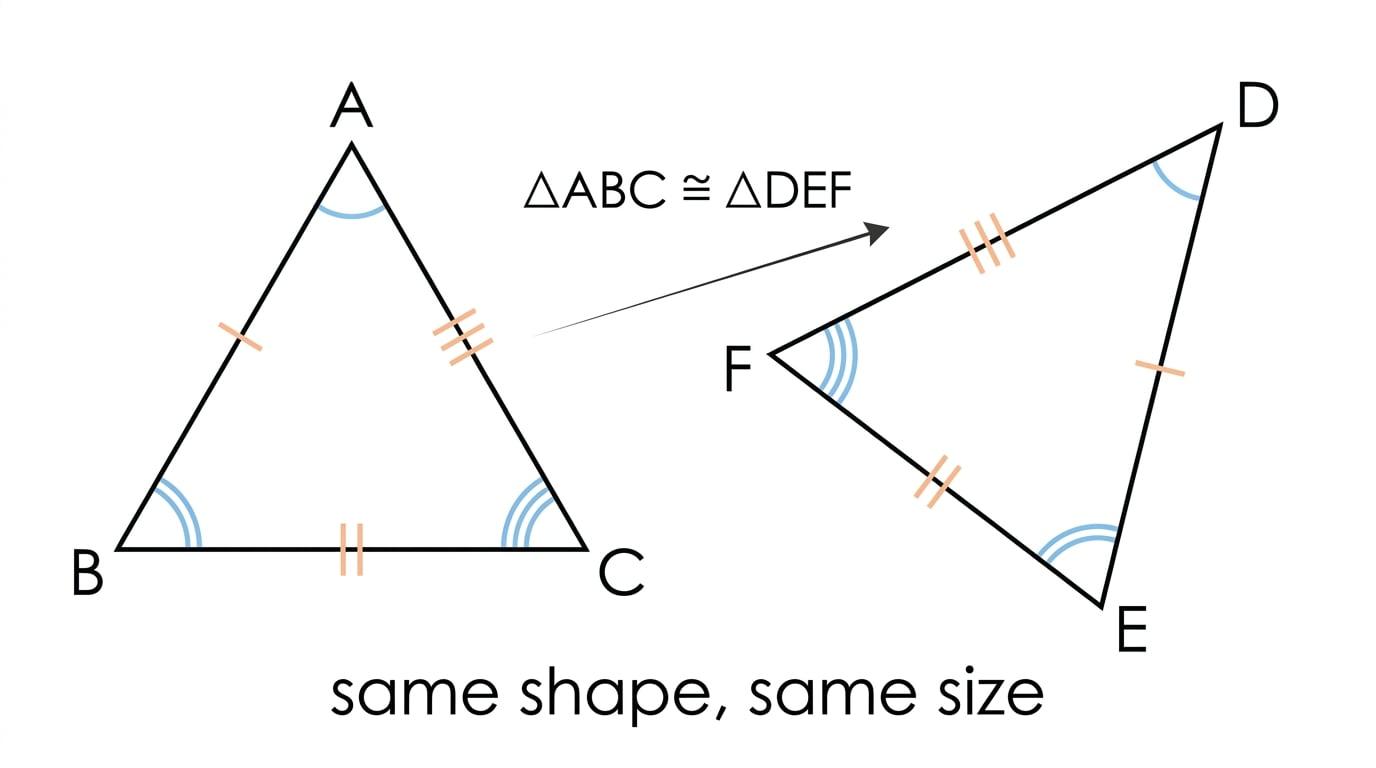
Congruent triangles are exactly the same shape and exactly the same size. They may be rotated, reflected or moved, but every matching side and every matching angle is equal.
Congruent triangles
Two triangles are congruent if all their corresponding sides and corresponding angles are equal. Corresponding means “matching in the same position”. The notation △ABC≅△DEF\triangle ABC \cong \triangle DEF△ABC≅△DEF means A matches D, B matches E, and C matches F.
Reading the matching order
You are told △PQR≅△XZY\triangle PQR \cong \triangle XZY△PQR≅△XZY. Find the angle matching ∠QPR\angle QPR∠QPR and the side matching QRQRQR.

-
Match the letters in order: P matches X, Q matches Z, and R matches Y.
-
The angle ∠QPR\angle QPR∠QPR has Q-P-R, so the matching angle has Z-X-Y.
-
Therefore ∠QPR\angle QPR∠QPR matches ∠ZXY\angle ZXY∠ZXY, and side QRQRQR matches side ZYZYZY.
You do not need to prove all three sides and all three angles. At GCSE, you use a congruence test.
The included angle is the angle between two sides you are using. For SAS, this matters: the angle must be “sandwiched” between the two equal sides.

The four tests
-
SSS: three corresponding sides are equal.
-
SAS: two corresponding sides and the included angle are equal.
-
ASA/AAS: two corresponding angles and one corresponding side are equal.
-
RHS: both triangles are right-angled, with equal hypotenuses and one other equal side.
AAA is not congruence
Three equal angles only prove the triangles are the same shape, not necessarily the same size. That is similarity, not congruence.
Two angles and a shared side
Triangles PQR and SQR share side QRQRQR. You are given ∠QPR=70∘\angle QPR=70^\circ∠QPR=70∘, ∠PQR=45∘\angle PQR=45^\circ∠PQR=45∘, ∠QRS=45∘\angle QRS=45^\circ∠QRS=45∘ and ∠RQS=65∘\angle RQS=65^\circ∠RQS=65∘. Prove the triangles are congruent.

-
In △PQR\triangle PQR△PQR, the missing angle is 65° because angles in a triangle add to 180°.
-
In △SQR\triangle SQR△SQR, the missing angle at S is 70°.
-
Match the angles: 70° with 70°, 45° with 45°, and the side QRQRQR is common to both triangles.
-
Therefore △PQR≅△SRQ\triangle PQR \cong \triangle SRQ△PQR≅△SRQ by ASA.
Most proof marks come from spotting facts that are already hidden in the diagram.
Useful facts include:
- A common side is equal to itself.
- A parallelogram is a four-sided shape with both pairs of opposite sides parallel.
- Opposite sides of a parallelogram are equal.
- Diagonals of a parallelogram bisect each other, meaning they cut each other exactly in half.
- Vertically opposite angles are equal when two straight lines cross.
- Alternate angles are equal on parallel lines.
Parallelogram split by a diagonal
KLMN is a parallelogram. The diagonal KMKMKM is drawn. Prove that triangle KLM is congruent to triangle MNK.

-
Opposite sides of a parallelogram are equal, so KL=MNKL=MNKL=MN and LM=NKLM=NKLM=NK.
-
The side KMKMKM is common to both triangles.
-
The two triangles have three pairs of equal corresponding sides.
-
Therefore △KLM≅△MNK\triangle KLM \cong \triangle MNK△KLM≅△MNK by SSS.
A radius is a line from the centre of a circle to the circumference. A tangent is a line that touches a circle at exactly one point.
Tangent and radius fact
The radius to the point where a tangent touches a circle is perpendicular to the tangent, so it makes a 90° angle.
Two tangents from one point
A circle has centre O. Points P and Q are on the circle. Lines XP and XQ are tangents. Prove that △XPO\triangle XPO△XPO is congruent to △XQO\triangle XQO△XQO.

-
OPOPOP and OQOQOQ are radii of the same circle, so OP=OQOP=OQOP=OQ.
-
A radius meets a tangent at 90°, so ∠XPO=∠XQO=90∘\angle XPO=\angle XQO=90^\circ∠XPO=∠XQO=90∘.
-
XOXOXO is common to both triangles, and it is the hypotenuse in both right-angled triangles.
-
Therefore △XPO≅△XQO\triangle XPO \cong \triangle XQO△XPO≅△XQO by RHS.
A midpoint cuts a line segment into two equal parts. In harder proofs, you often combine midpoint facts with parallelogram facts to create equal sides.
Midpoints inside a triangle
In triangle XYZ, M is the midpoint of XZ, N is the midpoint of XY, and P is the midpoint of YZ. ZMNP is a parallelogram. Prove that the triangle with vertices X, M, N is congruent to the triangle with vertices Y, N, P.

-
N is the midpoint of XY, so XN=NYXN=NYXN=NY.
-
M is the midpoint of XZ, so XM=MZXM=MZXM=MZ. In parallelogram ZMNP, opposite sides are equal, so MZ=NPMZ=NPMZ=NP. Therefore XM=NPXM=NPXM=NP.
-
P is the midpoint of YZ, so YP=PZYP=PZYP=PZ. In parallelogram ZMNP, opposite sides are equal, so MN=PZMN=PZMN=PZ. Therefore MN=YPMN=YPMN=YP.
-
The three pairs of matching sides are XN=NYXN=NYXN=NY, XM=NPXM=NPXM=NP and MN=YPMN=YPMN=YP.
-
Therefore, in matching order, △XMN≅△NPY\triangle XMN \cong \triangle NPY△XMN≅△NPY by SSS.
Once you have proved two triangles are congruent, their matching angles and sides must be equal. This is often the final step in a proof.
A kite-style quadrilateral
Quadrilateral WXYZ has WX=WZWX=WZWX=WZ and YX=YZYX=YZYX=YZ. Prove that ∠WXY=∠WZY\angle WXY=\angle WZY∠WXY=∠WZY.

-
Compare △WXY\triangle WXY△WXY and △WZY\triangle WZY△WZY, because they contain the two angles you want to prove equal.
-
You are given WX=WZWX=WZWX=WZ and YX=YZYX=YZYX=YZ.
-
The side WYWYWY is common to both triangles.
-
Therefore △WXY≅△WZY\triangle WXY \cong \triangle WZY△WXY≅△WZY by SSS.
-
Corresponding angles in congruent triangles are equal, so ∠WXY=∠WZY\angle WXY=\angle WZY∠WXY=∠WZY.
Perpendicular in an equilateral triangle
If a line from a vertex of an equilateral triangle meets the opposite side at 90°, compare the two smaller right-angled triangles: equal hypotenuses, common perpendicular side, then RHS.
In the exam
-
Mark equal sides and angles on the diagram as soon as you identify them.
-
Write the three matching facts clearly, with a reason for each one.
-
Finish with the exact test: “therefore the triangles are congruent by SSS/SAS/ASA/RHS”, then use corresponding angles or sides if needed.
Check yourself
-
Which congruence test uses the hypotenuse?
-
Why are three equal angles not enough to prove congruence?
-
In a parallelogram, which facts might help you prove two triangles congruent?