Best Buy Questions
x

Revision notes for Edexcel GCSE Maths Best Buy Questions. Open the guide for explanations and worked examples. Written against the Edexcel GCSE Maths (1MA1) specification, so the content matches what's examinable rather than general Maths background.

Best Buy Questions

What you'll learn

  • How to compare different pack sizes fairly.
  • How to find a unit cost like pence per roll or pence per 100 ml.
  • How to compare three or more options.
  • How to deal with offers like “extra free” and “money off”.

1. The big idea: compare the same thing

Best buy questions ask which option gives the best value for money. This means you are trying to get the most product for the lowest cost.

The quantity is how much you get: the number of items, kg, grams or ml.

Definition

Unit cost

  • Unit cost means the cost for one item or one equal unit of amount.
  • The word per means “for each”, so “35p per roll” means each roll effectively costs 35p.
Key Idea

Best buy rule

The best value is the option with the lowest unit cost, not always the lowest total price.

Best value is decided by comparing equal units, not just the shelf price.

A useful rule is:

unit cost=total pricequantity\text{unit cost} = \frac{\text{total price}}{\text{quantity}}unit cost=quantitytotal price​
Example

Comparing two packs of rolls

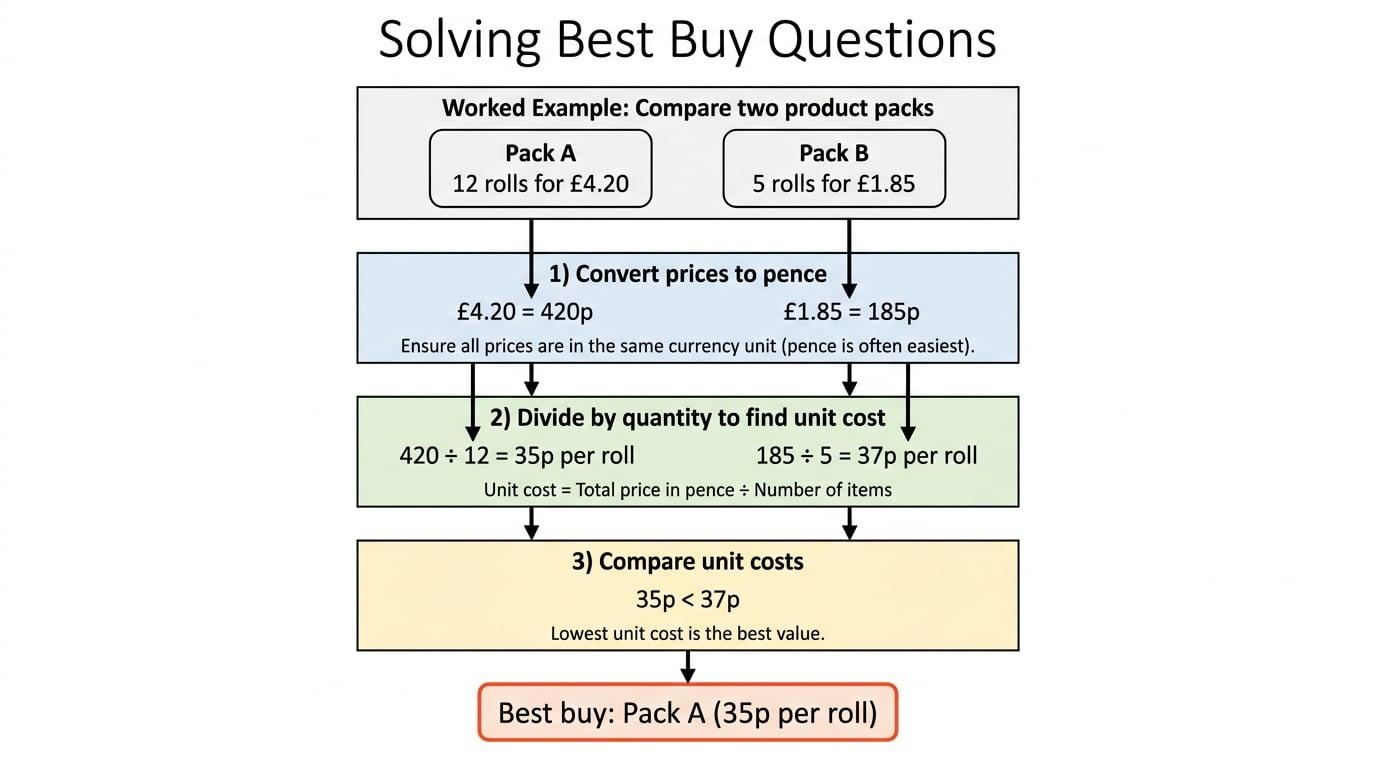
A shop sells 12 kitchen rolls for £4.20 or 5 kitchen rolls for £1.85. Which pack is better value?

Two kitchen roll packs compared by finding the cost per roll rather than choosing the lower total price.

  1. Convert both prices to pence: £4.20 is 420p and £1.85 is 185p.

  2. Find the cost per roll for the pack of 12.

    420÷12=35420 \div 12 = 35420÷12=35
  3. Find the cost per roll for the pack of 5.

    185÷5=37185 \div 5 = 37185÷5=37
  4. Compare the unit costs: the pack of 12 is 35p per roll, and the pack of 5 is 37p per roll. The pack of 12 is better value.

Common Mistake

Choosing the cheaper pack straight away

Do not just pick the pack with the smaller price. A smaller pack often costs less overall but more per item.

2. Working with grams, kg and ml

Sometimes the quantities are weights or volumes, such as coffee in grams or shampoo in ml.

You can choose a sensible unit to compare. For example:

  • potatoes: pence per kg
  • coffee: pence per 100 g
  • shampoo: pence per 100 ml

Using “per 100” is often easier than using “per 1” because the answers are less tiny.

Example

Comparing shampoo bottles

A large bottle has 800 ml of shampoo for £4.80. A small bottle has 350 ml for £2.24. Which is better value?

A large and a small shampoo bottle can be compared fairly using pence per 100 ml.

  1. Convert the prices to pence: £4.80 is 480p and £2.24 is 224p.

  2. Find the cost per 100 ml for the large bottle.

    480800×100=60\frac{480}{800} \times 100 = 60800480​×100=60
  3. Find the cost per 100 ml for the small bottle.

    224350×100=64\frac{224}{350} \times 100 = 64350224​×100=64
  4. Compare the results: the large bottle costs 60p per 100 ml, and the small bottle costs 64p per 100 ml. The large bottle is better value.

Tip

Keep the units the same

If you use pence per 100 ml for one bottle, use pence per 100 ml for the other bottle too. Comparing different units is not fair.

3. Comparing three packs

For three options, do the same thing three times. You can find the unit cost for each option, then choose the lowest.

Sometimes it is easier to compare a common amount. A common amount is the same-sized chunk for each pack, such as the cost per 30 tea bags.

Example

Comparing three packs of tea bags

Three packs are available: Pack A has 180 tea bags for £4.50, Pack B has 150 tea bags for £3.60, and Pack C has 120 tea bags for £3.00. Which is best value?

The three tea-bag packs are split into equal groups of 30 so the same amount is compared each time.

  1. Choose a common amount. Here, all three amounts can be split into groups of 30 tea bags.

  2. Pack A has six groups of 30. Find the cost per 30 tea bags.

    450÷6=75450 \div 6 = 75450÷6=75
  3. Pack B has five groups of 30. Find the cost per 30 tea bags.

    360÷5=72360 \div 5 = 72360÷5=72
  4. Pack C has four groups of 30. Find the cost per 30 tea bags.

    300÷4=75300 \div 4 = 75300÷4=75
  5. Compare the results: Pack A costs 75p per 30, Pack B costs 72p per 30, and Pack C costs 75p per 30. Pack B is best value.

4. Special offers: “extra free” and “money off”

Special offers change either the quantity or the price.

Extra free changes the quantity, whereas money off changes the price.

Definition

Special offer words

  • Extra free means the quantity increases, but the price stays the same.
  • Money off or percentage off means the price decreases, but the quantity stays the same.
Example

Comparing extra free with money off

Pack A has 200 wipes plus 20% extra free for £3. Pack B has 200 wipes with 15% off the normal price of £3. Which is better value?

The extra-free offer increases the number of wipes, while the money-off offer reduces the price.

  1. Work out the extra free wipes in Pack A.

    20% of 200=0.20×200=4020\% \text{ of } 200 = 0.20 \times 200 = 4020% of 200=0.20×200=40
  2. Pack A now has 240 wipes for 300p. Find the cost per wipe.

    300÷240=1.25300 \div 240 = 1.25300÷240=1.25
  3. Work out the discount for Pack B.

    15% of 300=0.15×300=4515\% \text{ of } 300 = 0.15 \times 300 = 4515% of 300=0.15×300=45
  4. The discount is 45p, so Pack B costs 255p for 200 wipes. Find the cost per wipe.

    255÷200=1.275255 \div 200 = 1.275255÷200=1.275
  5. Compare the unit costs: Pack A is 1.25p per wipe, and Pack B is 1.275p per wipe. Pack A is slightly better value.

Common Mistake

Mixing up extra free and money off

“20% extra free” does not mean 20% off the price. It means you get 20% more items for the same price.

Common Mistake

Do not round too early

If two unit costs are close, keep the full answer on your calculator until you have compared them. Round only at the end if needed.

Exam technique

In the exam

  1. Convert prices to pence if it makes the calculation easier.

  2. Compare the same unit, such as pence per roll, pence per kg, or pence per 100 ml.

  3. State the final answer clearly: the best value is the option with the lowest unit cost.

Self review

Check yourself

  • Why is the cheapest total price not always the best value?
  • What changes when an offer says “20% extra free”: the price or the quantity?
  • If you compare shampoo bottles, why might “pence per 100 ml” be useful?

Recap questions

Test yourself with 5 quick questions on this guide. Answer them all correctly to complete it.

You've reached the end

Test yourself on this topic, or move on to the next guide.

Practice questionsTake a quick quiz on this topicFlashcardsSelf-test with active recall
SubstitutionUp next

How was this guide?

Best Buy Questions Revision Guide

  1. GCSE
  2. /Maths
  3. /Best Buy Questions