Quadratic Simultaneous Equations
Teach Genie
Review Quadratic Simultaneous Equations by teaching Genie
Teach it back in your own words, spot gaps, and remember it better.

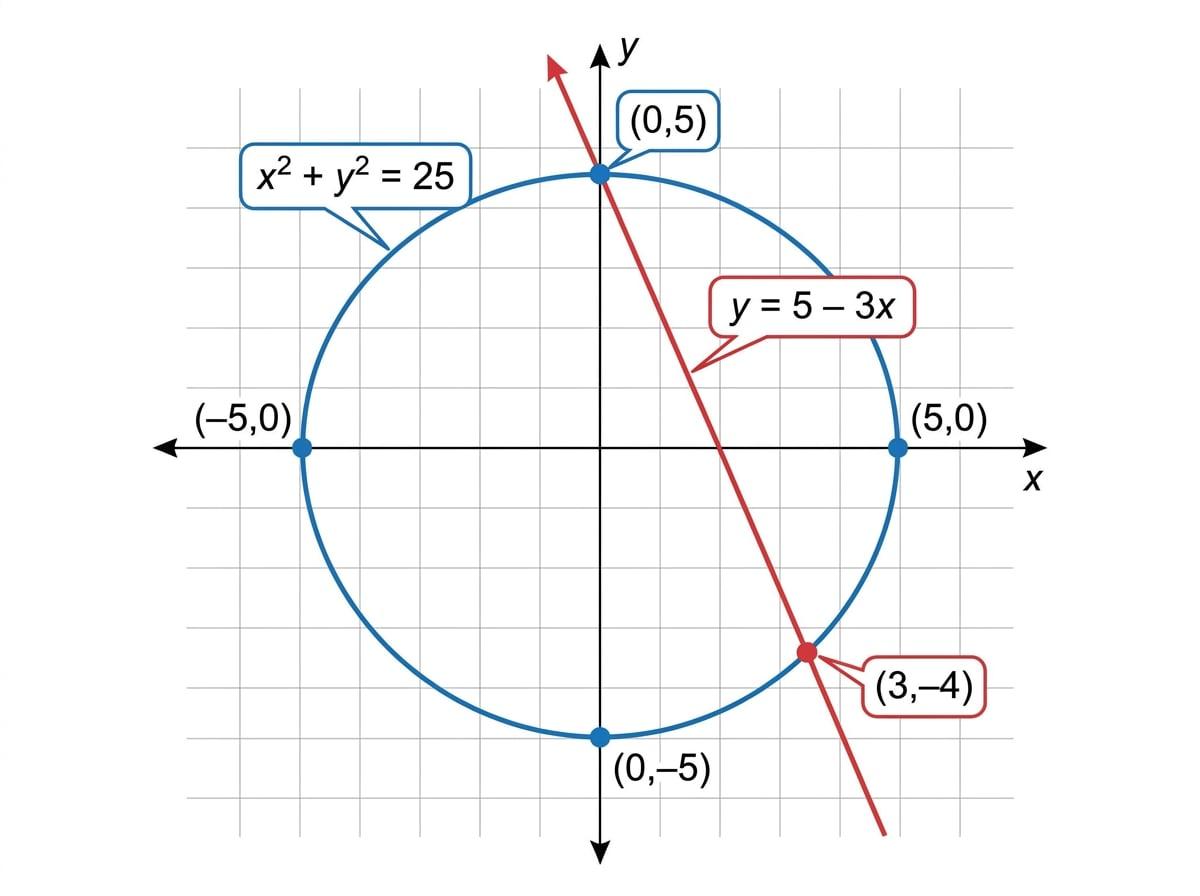
Quadratic simultaneous equations combine a quadratic equation with another equation, often a line. A solution is an ordered pair (x,y)(x, y)(x,y) that makes both equations true at the same time.
On a graph, the solution pairs are the intersection points of the two graphs. That is why there can be 000, 111, or 222 real solutions.
A linear equation such as 3x+y=53x + y = 53x+y=5 has variables only to the first power, so it draws as a straight line. A quadratic equation such as x2+y2=25x^2 + y^2 = 25x2+y2=25 contains a squared term, so its graph is curved.
Question 1
5 marksSolve the simultaneous equations
x2+y2=13 x^2 + y^2 = 13 x2+y2=13 x=y−5 x = y - 5 x=y−5What does a solution to a pair of simultaneous equations represent graphically?
Quadratic Simultaneous Equations Revision Guide
Revision notes for CCEA GCSE Maths Quadratic Simultaneous Equations: explanations and worked examples.