Inverse and Composite Functions
Teach Genie
Review Inverse and Composite Functions by teaching Genie
Teach it back in your own words, spot gaps, and remember it better.

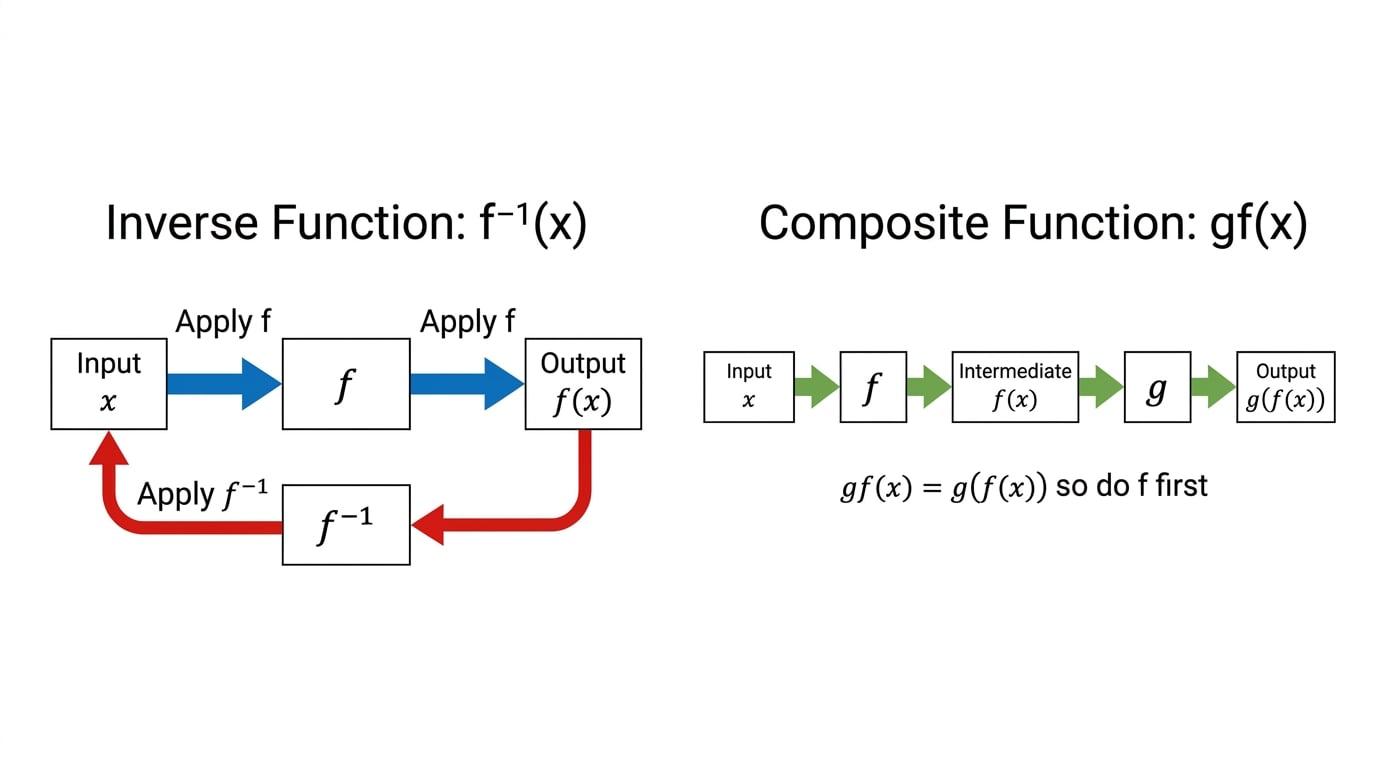
A function is a rule that gives exactly one output for each input. In f(3)f(3)f(3), the 3 is the input and the value you get after applying the rule is the output.
To evaluate a function, replace every xxx with the given input. Use brackets for negative inputs, so h(−4)=2(−4)2−6h(-4)=2(-4)^2-6h(−4)=2(−4)2−6, not 2−42−62-4^2-62−42−6.
Function notation is the language used for inverse and composite functions too. Once substitution is secure, you can start undoing rules with f−1(x)f^{-1}(x)f−1(x) and chaining rules with g(f(x))g(f(x))g(f(x)).
Question 1
2 marksGiven that f(x)=x−4f(x) = x - 4f(x)=x−4 find:
A function is a rule that takes an input and gives exactly [ ] output.
Inverse and Composite Functions Revision Guide
Revision notes for CCEA GCSE Maths Inverse and Composite Functions: explanations and worked examples.