The Cosine Rule
Teach Genie
Review The Cosine Rule by teaching Genie
Teach it back in your own words, spot gaps, and remember it better.

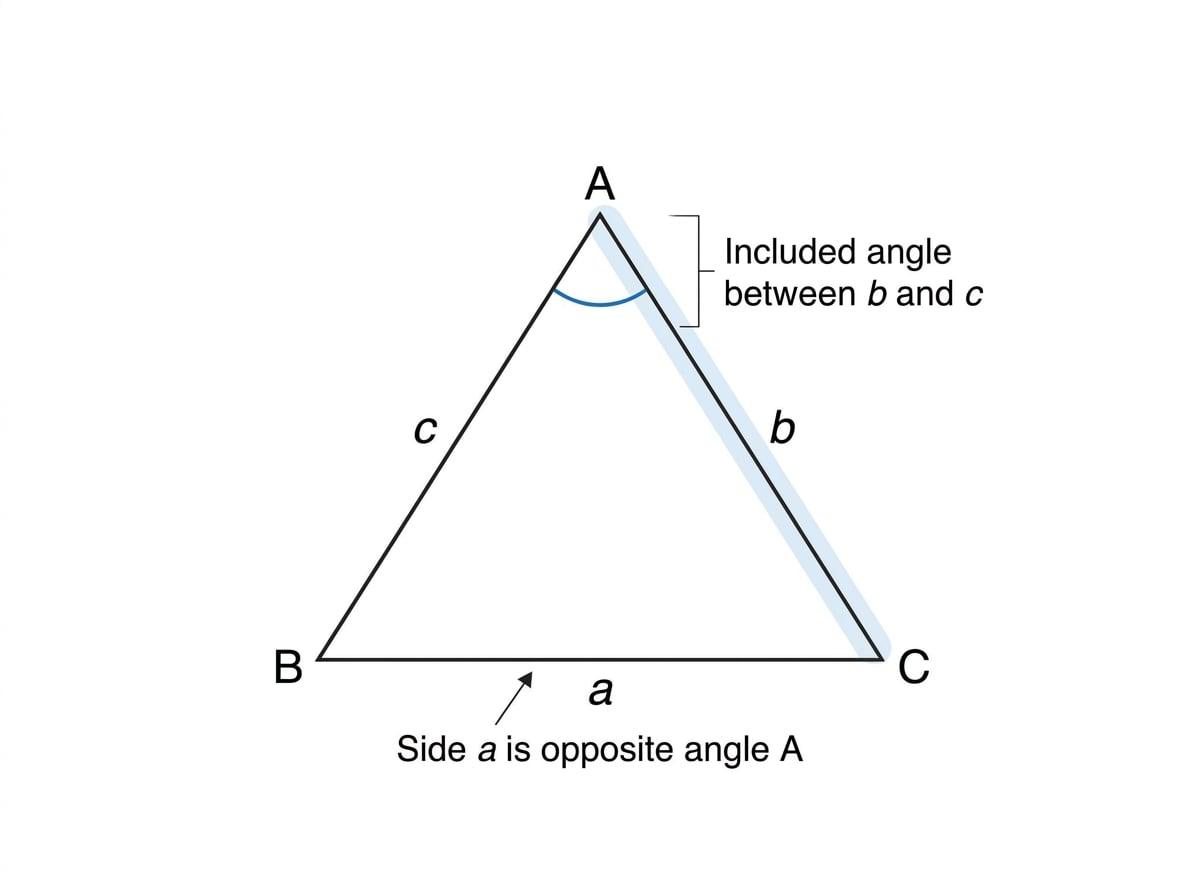
The Cosine Rule is used in a non-right-angled triangle when you know two sides and the included angle, or when you know all three sides. It is the right choice when Pythagoras and SOHCAHTOA do not fit.
In triangle ABCABCABC, side aaa is opposite angle AAA, side bbb is opposite angle BBB, and side ccc is opposite angle CCC. The included angle is the angle between the two known sides.
Question 1
3 marksA surveyor measures the distances between three markers, AAA, BBB, and CCC, placed on a plot of land. The distance AB AB\,AB is 6.4 m, the distance BC BC\,BC is 5.5 m, and the distance AC AC\,AC is 8.1 m.
Which angle must be known to find a missing side using the Cosine Rule?
The Cosine Rule Revision Guide
Revision notes for CCEA GCSE Maths The Cosine Rule: explanations and worked examples.