Parallel and Perpendicular Lines
Teach Genie
Review Parallel and Perpendicular Lines by teaching Genie
Teach it back in your own words, spot gaps, and remember it better.

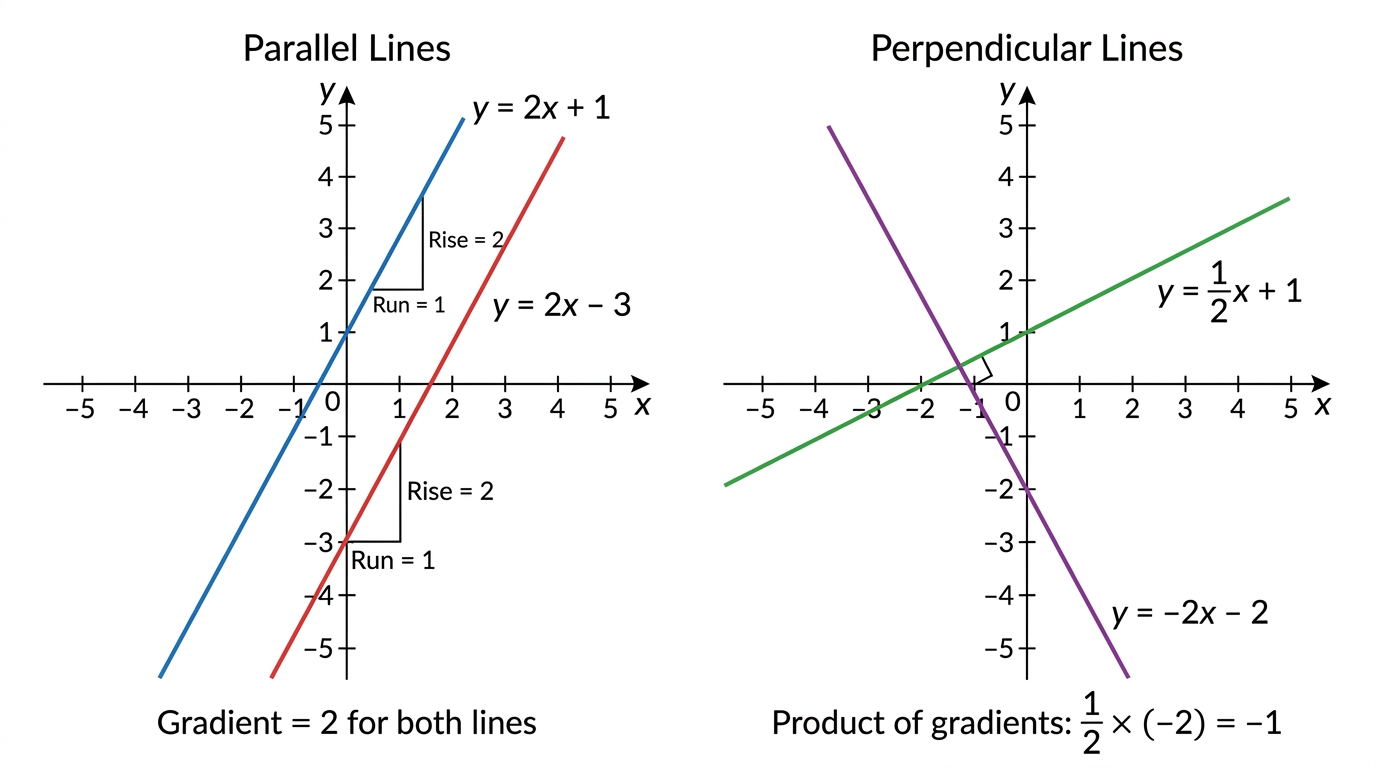
Straight lines are easiest to compare when written in the form y=mx+cy=mx+cy=mx+c. In this form, mmm represents the gradient and ccc represents the y-intercept.
If the equation is not already in this form, you must make yyy the subject first. For example, 6y=3x−126y=3x-126y=3x−12 becomes y=12x−2y=\frac{1}{2}x-2y=21x−2, so the gradient is 12\frac{1}{2}21.
Parallel lines have the same gradient, while perpendicular lines meet at a 90∘90^{\circ}90∘ angle. In most coordinate geometry questions, your first goal is to determine the gradient correctly.
Question 1
1 markWrite down the equation of a line parallel to y=3x+2y = 3x + 2y=3x+2
In the straight-line equation y=mx+cy=mx+cy=mx+c, the [ ] is represented by mmm and the y-intercept is represented by ccc.
Parallel and Perpendicular Lines Revision Guide
Revision notes for CCEA GCSE Maths Parallel and Perpendicular Lines: explanations and worked examples.