Reverse Percentages
Teach Genie
Review Reverse Percentages by teaching Genie
Teach it back in your own words, spot gaps, and remember it better.

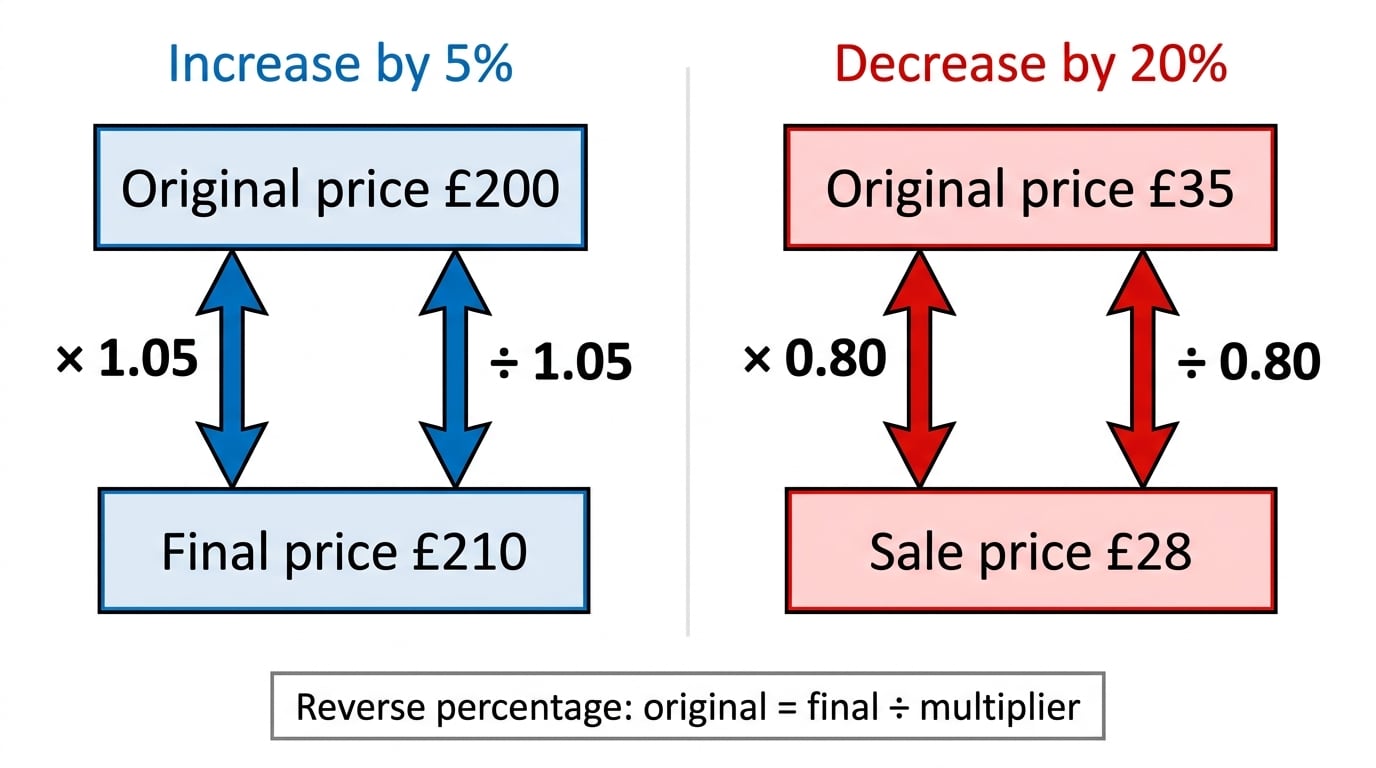
Reverse percentages ask you to find the amount before a percentage change. First identify the original amount, the final amount, and whether the change was an increase or a decrease.
The forward rule is:
F=O×m F = O \times m F=O×mwhere mmm is the multiplier. To work backwards, use the inverse formula:
O=Fm O = \frac{F}{m} O=mFFor an increase, the multiplier is more than 111, like 1.101.101.10 for a 10%10\%10% increase. For a decrease, the multiplier is less than 111, like 0.800.800.80 for a 20%20\%20% decrease.
Question 1
2 marksThe value of a house increased by 6%.
The house then had a value of £265 000
In reverse percentages, the percentage change is based on which amount?
Reverse Percentages Revision Guide
Revision notes for CCEA GCSE Maths Reverse Percentages: explanations and worked examples.