Gradient of a Line
Teach Genie
Review Gradient of a Line by teaching Genie
Teach it back in your own words, spot gaps, and remember it better.

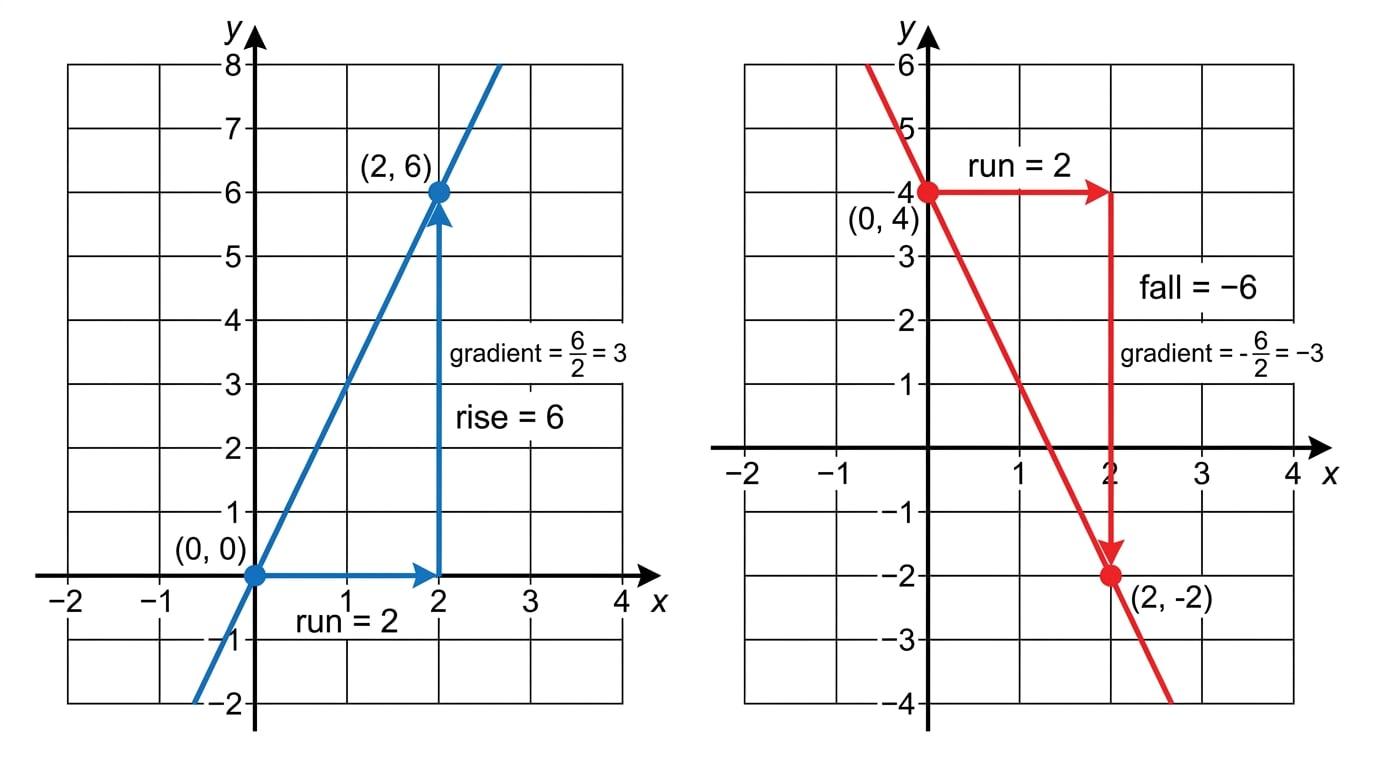
Gradient tells you how steep a straight line is. It compares how much the line goes up or down with how much it goes across.
From left to right, a line that goes up has a positive gradient and a line that goes down has a negative gradient. The bigger the size of the gradient, the steeper the line.
The key idea is rise over run.
m=change in ychange in x m=\frac{\text{change in }y}{\text{change in }x} m=change in xchange in yHere mmm means gradient, with the change in yyy on top and the change in xxx on the bottom.
Question 1
3 marksThe line AB AB\,AB passes through the points A(−6,5)A(-6, 5)A(−6,5) and B(k,17)B(k, 17)B(k,17).
The gradient of AB AB\,AB is 3.
What does the gradient of a straight line represent?
Gradient of a Line Revision Guide
Revision notes for CCEA GCSE Maths Gradient of a Line: explanations and worked examples.