Bearings
Teach Genie
Review Bearings by teaching Genie
Teach it back in your own words, spot gaps, and remember it better.

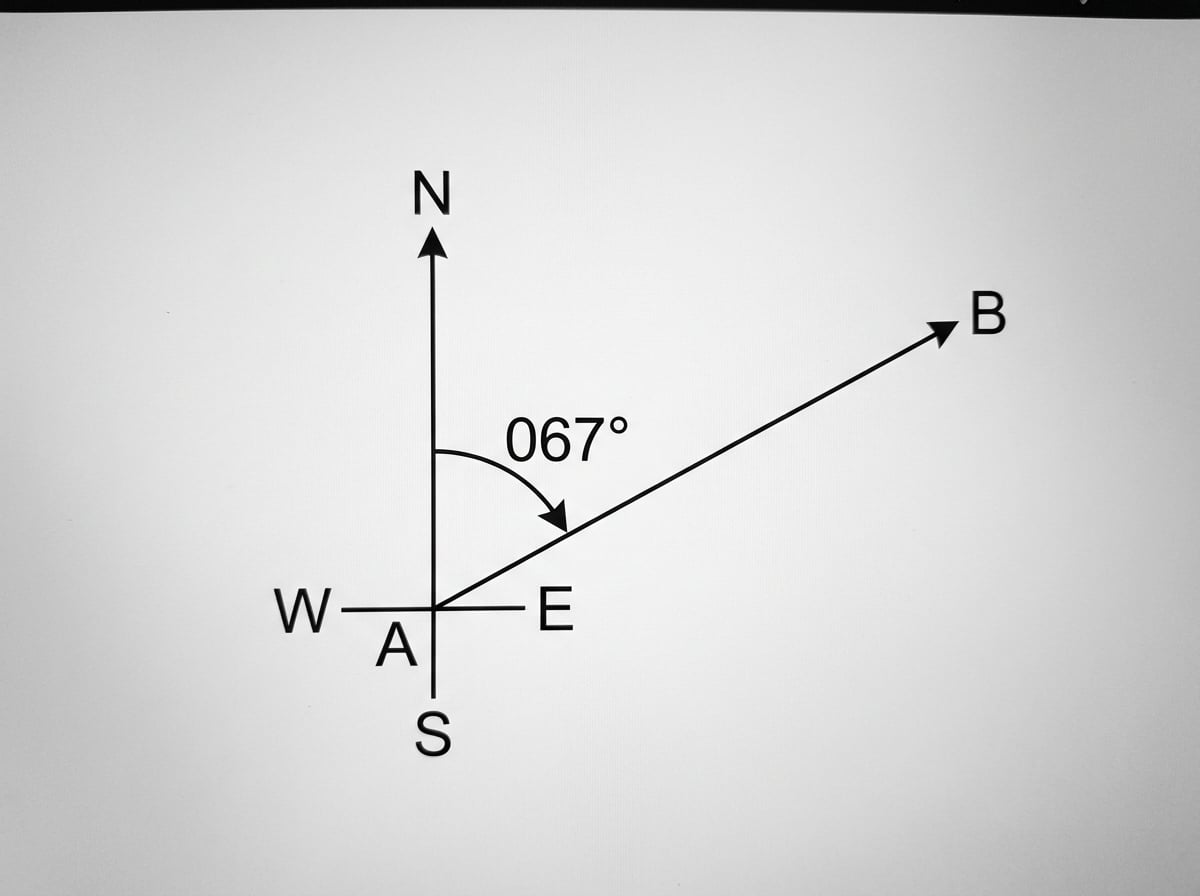 A bearing describes direction using an angle. It is always measured from North, going clockwise, and written with three figures.
A North line is the starting line for every bearing, and clockwise means the same direction as the hands of a clock. So 7∘7^\circ7∘ becomes 007∘007^\circ007∘, 42∘42^\circ42∘ becomes 042∘042^\circ042∘, and 115∘115^\circ115∘ stays 115∘115^\circ115∘.
When you read "the bearing of B from A", the word from tells you where to start. You measure the angle at A, not at B.
Question 1
2 marksThe bearing of London from Liverpool is 090∘ 090^\circ\,090∘
Find the bearing of Liverpool from London.
What line is the starting line for every bearing?
Bearings Revision Guide
Revision notes for CCEA GCSE Maths Bearings: explanations and worked examples.