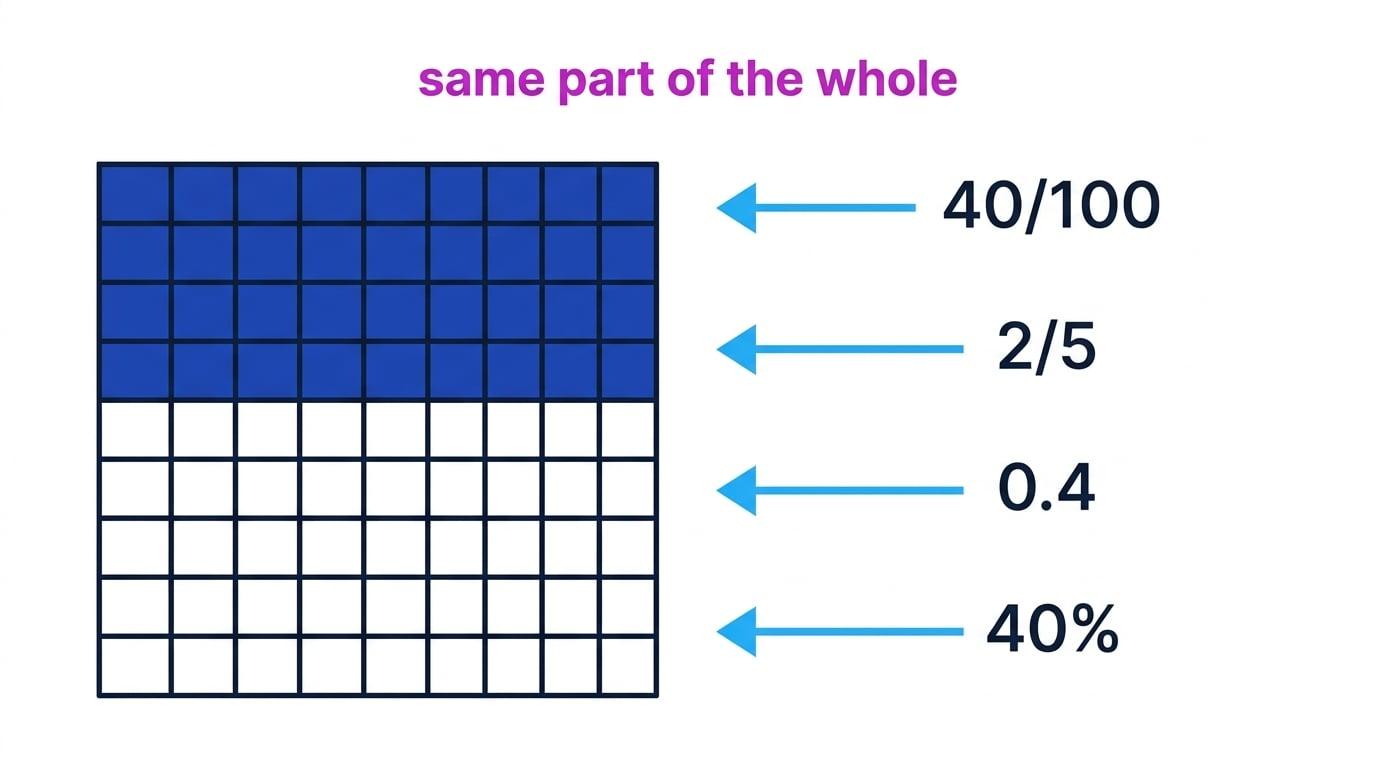
Fractions, Decimals and Percentages are three different ways of expressing a part of a whole.
We can convert between fractions, decimals and percentages.
Converting between Decimals and Percentages
To convert a decimal to a percentage we multiply by 100.
Example 1: Convert 0.7 to a percentage
To convert a decimal to a percentage we multiply by 100.
0.7 × 100 = 70
0.7 = 70%
Example 2: Convert 0.19 to a percentage
To convert a decimal to a percentage we multiply by 100.
0.19 × 100 = 19
0.19 = 19%
To convert a percentage to a decimal we divide by 100
Dividing by 100 is the opposite of multiplying by 100
Example 3: Convert 25% to a decimal
To convert a percentage to a decimal we divide by 100.
25 ÷ 100 = 0.25
25% = 0.25
Example 4: Convert 9% to a decimal
To convert a percentage to a decimal we divide by 100.
9 ÷ 100 = 0.09
9% = 0.09
Try these:
Converting between Percentages and Fractions
A percentage is out of 100. We can re-write any percentage as a fraction by writing it over 100.
Example 5: Convert 11% to a fraction.
A percentage is the same as a fraction out of 100.
We can write 11% as 11⁄100
Example 6: Convert 36% to a fraction. Give your answer in it simplest form.
A percentage is the same as a fraction out of 100.
We can write 36% as 36⁄100
We have written 36% as a fraction, but it is not in its simplest form.
To simplify we need to find a times table that 36 and 100 are both in.
36 and 100 are both in the 2 and the 4 times tables.
4 is the biggest so we will divide the denominator and the numerator by 4.
36 = 4 × 9
100 = 4 × 25
36% = 9⁄25
We could have also halved the top and bottom, and then halved again:
36⁄100 = 18⁄50 = 9⁄25
To convert a fraction to a percentage we can change the denominator to 100.
Example 7: Convert 7⁄20 to a percentage.
To convert the fraction to a percentage we need to make the denominator 100.
We can make the denominator 100 by multiplying by 5.
20 × 5 = 100
We have to multiply the numerator by 5 too keep the fraction equivalent.
7 × 5 = 35
7⁄20 = 35⁄100 = 35%
When the denominator is not a factor of 100 it may be easier to convert the fraction to a decimal first, and then from a decimal to a percentage.
Try these:
Converting between Fractions and Decimals
To convert from a fraction to a decimal we can divide the numerator by the denominator.
Example 8: Convert 3⁄8 to a decimal.
We can convert 3⁄8 to a decimal by calculating 3 ÷ 8.
We can use a calculator or short division to do the calculation.
3 ÷ 8 = 0.375
3⁄8 = 0.375
If we are using a calculator we can also use the SD button.
Example 9 : Convert 7⁄12 to a decimal.
We need to calculate 7 ÷ 12
7 ÷ 12 = 0.583˙0.58\dot30.583˙
The dot above the 3 means that the 3 is recurring (it goes on forever), 0.5833333333333333333...
7⁄12 = 0.583˙0.58\dot30.583˙
To convert a decimal to a fraction we can convert it to a percentage (by multiplying by 100) and then write it is a fraction out of 100.
Example 10: Convert 0.88 to a fraction. Give your answer in its simplest form.
To convert 0.88 to a percentage we multiply by 100.
0.88 × 100 = 88
88% = 88⁄100
We can simplify our answer by dividing top and bottom by 4.
88⁄100 = 22⁄25
0.88 = 22⁄25
If the decimal involves a recurring numbers we can type it into the calculator instead and the calculator will do the conversion for us.
The recurring button looks like this:
It may be found (depending on your calculator) by pressing SHIFT then the square button:

Example 11: Convert 0.73˙0.7\dot30.73˙ to a fraction. Give your answer in its simplest form.
We can type 0.73˙0.7\dot30.73˙ into a calculator by pressing:


The calculator should give an answer of 11⁄15
Try these: