Revision notes for AQA GCSE Maths Venn Diagrams. Open the guide for explanations and worked examples. Written against the AQA GCSE Maths (8300) specification, so the content matches what's examinable rather than general Maths background.
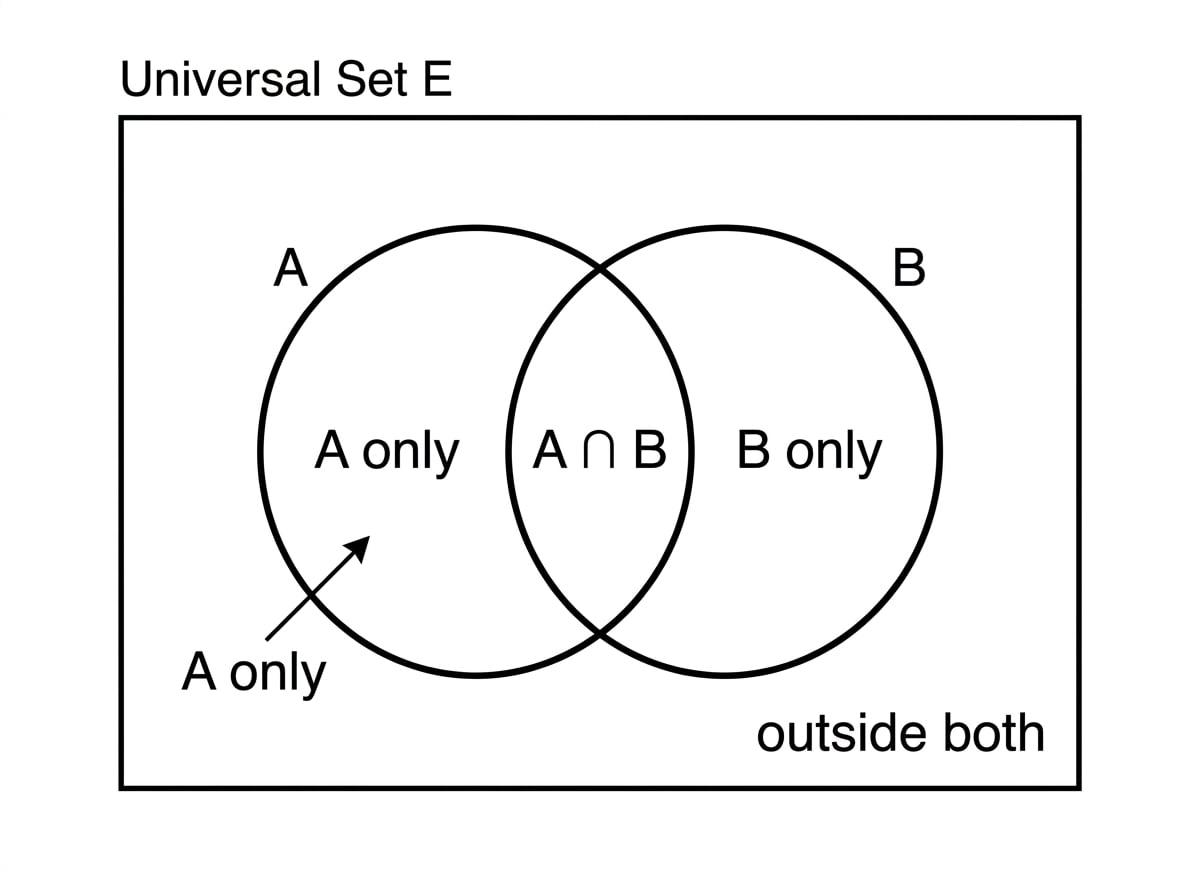
A Venn diagram shows groups inside a rectangle. Each separate part of the diagram is called a region. For example, in a two-circle diagram there is an A-only region, a B-only region, an overlap, and the outside region.

Venn diagram language
A probability is a number from 0 to 1 showing how likely something is. If something is either in AAA or not in AAA, the two probabilities add to 1.
Finding a complement probability
Given P(A)=0.85P(A)=0.85P(A)=0.85, find P(A′)P(A')P(A′).

Recognise that A′A'A′ means “not in AAA”.
Use the complement rule:
P(A′)=1−P(A)P(A')=1-P(A)P(A′)=1−P(A)Substitute the given value:
P(A′)=1−0.85=0.15P(A')=1-0.85=0.15P(A′)=1−0.85=0.15The probability of not being in AAA is 0.15.
When you are asked to shade a region, translate each symbol carefully.
And means overlap, or means join
The symbol ∩\cap∩ means “and”, so look for the common part. The symbol ∪\cup∪ means “or”, so join together all regions that fit at least one condition.
Shading a mixed region
Describe the region represented by A′∪BA' \cup BA′∪B.

Start with A′A'A′. This means everything not in A: the B-only region and the outside region.
The union symbol ∪\cup∪ means add everything in B.
Adding B includes the B-only region and the overlap.
So the shaded part is everything except the A-only region.
Union does not mean just the overlap
For A∪BA \cup BA∪B, do not shade only the middle. The overlap is included, but the A-only and B-only regions are included as well.

In survey questions, each number in a region is a frequency, meaning a count. The word neither means outside both circles, but still inside the rectangle.
Counting notation
n(A)n(A)n(A) means the number of elements in set AAA. For example, n(A∩B)n(A \cap B)n(A∩B) means the number in both AAA and BBB.
Fill the overlap first
If the number who are in both groups is given, put it in the overlap first. Then subtract it from each circle total to get the “only” regions.
Two places visited
48 pupils were asked whether they had visited Wales or Ireland. 26 had visited Wales, 21 had visited Ireland, and 9 had visited both. Complete the Venn diagram.

Put 9 in the overlap because 9 pupils visited both places.
Wales only is 26 - 9 = 17.
Ireland only is 21 - 9 = 12.
The number in at least one circle is 17 + 9 + 12 = 38.
The number outside both circles is 48 - 38 = 10.
Sometimes the “neither” value is given instead of the overlap. Then first find how many are in at least one circle.
Finding the missing overlap
50 people were asked whether they have a dog or a cat. 31 have a dog, 27 have a cat, and 8 have neither. Find the number who have both.

The number in at least one circle is 50 - 8 = 42.
Adding the dog total and cat total gives 31 + 27 = 58. This counts the overlap twice.
Subtract the true “at least one” total to find the overlap:
n(D∩C)=58−42=16n(D \cap C)=58-42=16n(D∩C)=58−42=16So 16 people have both a dog and a cat.
Check the total
At the end, add every region, including the outside. The total should match the number of people or items in the question.
With three sets, the centre is the region in all three circles. Work from the middle outwards.
The usual order is:
Read pair totals carefully
A statement like “18 like rugby and football” usually includes people who also like cricket. But “rugby and football but not cricket” means the pair-only part.
Three sports survey
60 students were asked about rugby, football, and cricket. 7 like all three, 18 like rugby and football, 14 like football and cricket, 16 like rugby and cricket, 30 like rugby, 34 like football, and 28 like cricket. How many like none of the three?

Put 7 in the centre because 7 students like all three.
Find the pair-only regions by subtracting the centre: rugby and football only is 11, football and cricket only is 7, and rugby and cricket only is 9.
Find the single-only regions: rugby only is 3, football only is 9, and cricket only is 5.
Add all the regions inside the circles:
3+9+5+11+7+9+7=513+9+5+11+7+9+7=513+9+5+11+7+9+7=51Subtract from the total:
60−51=960-51=960−51=9So 9 students like none of the three sports.
Sometimes you are given the universal set and the sets as lists. Place each element into exactly one region.
Probability from equally likely choices
If one element is chosen at random from E\mathcal{E}E, and each element has the same chance, the probability is the number of favourable elements divided by the number of elements in E\mathcal{E}E.
Completing from listed sets
Let E={even numbers from 2 to 18}\mathcal{E}=\{\text{even numbers from 2 to 18}\}E={even numbers from 2 to 18}, A={2,4,8,12,18}A=\{2,4,8,12,18\}A={2,4,8,12,18}, and B={4,6,12,14}B=\{4,6,12,14\}B={4,6,12,14}. Find P(A∪B)P(A \cup B)P(A∪B).

List the universal set: 2, 4, 6, 8, 10, 12, 14, 16, 18. There are 9 elements.
The overlap is the numbers in both sets: 4 and 12.
A-only contains 2, 8, and 18.
B-only contains 6 and 14.
Outside both circles are the remaining universal-set elements: 10 and 16.
A∪BA \cup BA∪B contains 7 elements, so:
P(A∪B)=79P(A \cup B)=\frac{7}{9}P(A∪B)=97Reading a completed diagram
For A∩BA \cap BA∩B in a three-circle diagram, include every number inside both A and B, including any number in the centre.
In the exam
Fill the most specific information first: the overlap in two-circle diagrams, or the centre in three-circle diagrams.
Watch for “but not” because it tells you a region is pair-only or single-only.
For probability, count the required region carefully and use the whole universal set as the denominator.
Check yourself
Test yourself with 5 quick questions on this guide. Answer them all correctly to complete it.
Test yourself on this topic, or move on to the next guide.
How was this guide?