What you'll learn
- Work with cones: 3D shapes with a circular base and a point.
- Work with spheres: perfectly round 3D shapes, and hemispheres: half-spheres.
- Calculate volume — the space inside a 3D shape.
- Calculate surface area — the area on the outside of a 3D shape.
Key measurements in diagrams
The letters in the formulas
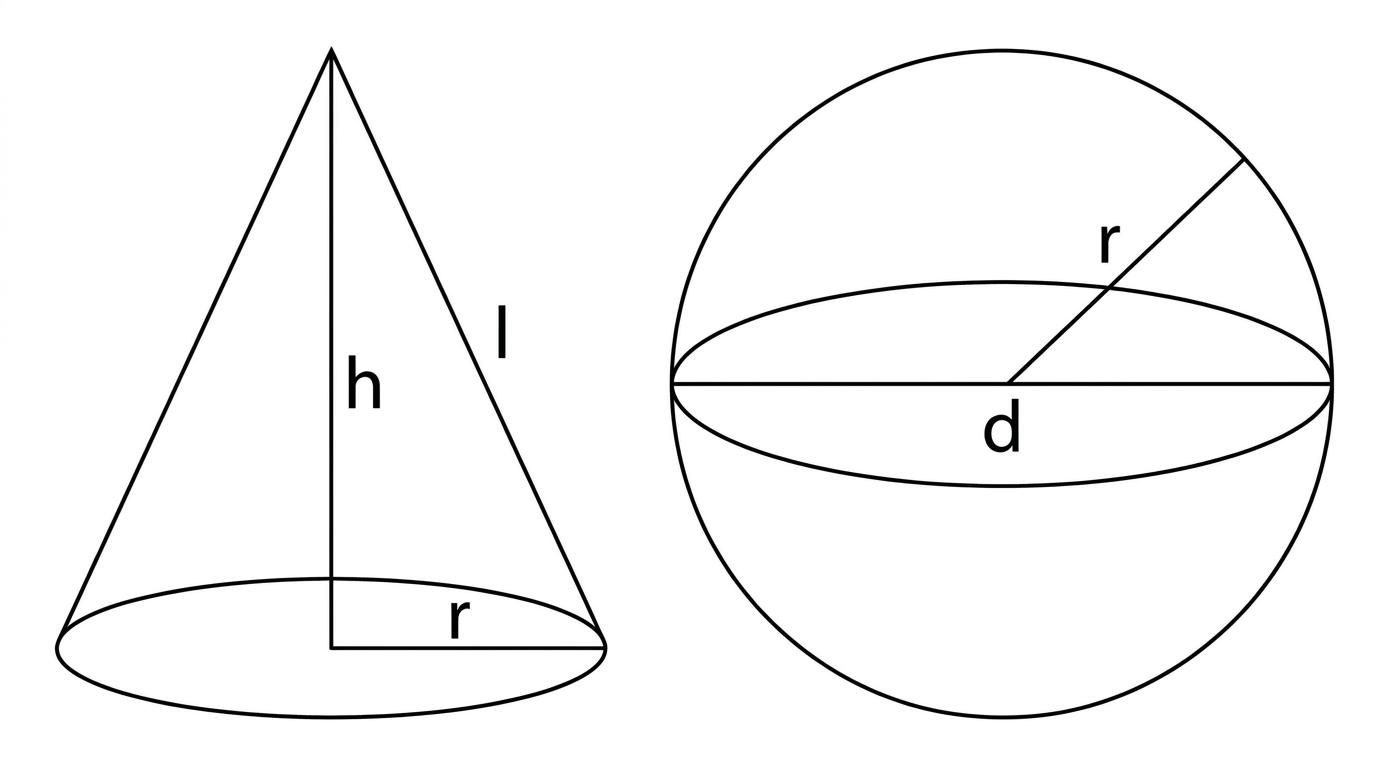
- The radius, rrr, goes from the centre of a circle or sphere to its edge.
- The diameter, ddd, goes all the way across a circle through the centre, so d=2rd=2rd=2r and r=d2r=\frac{d}{2}r=2d.
- The vertical height, hhh, is the straight up-and-down height of a cone.
- The slant height, lll, is the length down the sloping side of a cone.

Find the radius first
Most sphere and cone formulas use the radius, not the diameter. If you are given a diameter, halve it before using a formula.
Reading a cone diagram
A cone has base diameter 14 cm and vertical height 20 cm. Find the values of rrr and hhh.

-
The vertical height is already given.
h=20h=20h=20 -
Halve the diameter to find the radius.
r=142=7r=\frac{14}{2}=7r=214=7 -
Use r=7r=7r=7 and h=20h=20h=20 in any cone formula.
Volume: space inside
For a cone:
Vcone=13πr2hV_{\text{cone}}=\frac{1}{3}\pi r^2hVcone=31πr2hFor a sphere:
Vsphere=43πr3V_{\text{sphere}}=\frac{4}{3}\pi r^3Vsphere=34πr3A hemisphere is half a sphere, so its volume is half the sphere volume.
Volume of a cone
A cone has height 18 cm and base diameter 10 cm. Work out its volume to 3 significant figures.

-
Find the radius.
r=102=5r=\frac{10}{2}=5r=210=5 -
Substitute into the cone volume formula.
V=13π×52×18V=\frac{1}{3}\pi \times 5^2 \times 18V=31π×52×18 -
Calculate.
V=150π≈471.239V=150\pi \approx 471.239V=150π≈471.239 -
The volume is 471 cm³ to 3 significant figures.
Rounding
Do all calculator work first, then round at the end. Rounding too early can make your final answer less accurate.
Surface area: outside area
Surface area words
- Curved surface area means only the curved outside part.
- Total surface area means every outside part, including flat circular bases.
For a sphere:
Asphere=4πr2A_{\text{sphere}}=4\pi r^2Asphere=4πr2For a solid hemisphere, take half the sphere surface area, then add the flat circular base:
Atotal hemisphere=2πr2+πr2=3πr2A_{\text{total hemisphere}}=2\pi r^2+\pi r^2=3\pi r^2Atotal hemisphere=2πr2+πr2=3πr2Total surface area of a hemisphere
A solid hemisphere has radius 7 cm. Work out its total surface area in terms of π\piπ.

-
Use the total surface area formula for a solid hemisphere.
A=3πr2A=3\pi r^2A=3πr2 -
Substitute r=7r=7r=7.
A=3π×72A=3\pi \times 7^2A=3π×72 -
Simplify.
A=147πA=147\piA=147π -
The total surface area is 147π147\pi147π cm².
For a cone:
Acurved cone=πrlA_{\text{curved cone}}=\pi rlAcurved cone=πrlSo for a solid cone:
Atotal cone=πrl+πr2A_{\text{total cone}}=\pi rl+\pi r^2Atotal cone=πrl+πr2Forgetting the flat circle
For a solid cone or solid hemisphere, total surface area includes the flat circular face. Curved surface area alone is not the total surface area.
Finding the slant height
Sometimes a cone question gives the vertical height, not the slant height.
Pythagoras' theorem
In a right-angled triangle, the square of the longest side equals the sum of the squares of the other two sides. In a cone cross-section, lll is the longest side, so l2=h2+r2l^2=h^2+r^2l2=h2+r2.

Cone surface area when height is given
A solid cone has vertical height 8 cm and base diameter 12 cm. Work out its total surface area in terms of π\piπ.

-
Find the radius.
r=122=6r=\frac{12}{2}=6r=212=6 -
Use Pythagoras to find the slant height.
l2=82+62=100l^2=8^2+6^2=100l2=82+62=100 -
Square root to find lll.
l=10l=10l=10 -
Add curved area and base area.
A=π×6×10+π×62=96πA=\pi \times 6 \times 10+\pi \times 6^2=96\piA=π×6×10+π×62=96π -
The total surface area is 96π96\pi96π cm².
Combined shapes
Compound solid
A compound solid is a 3D shape made by joining simpler 3D shapes. For volume, add the volumes of the separate parts.
Cone on a hemisphere
A shape is made from a cone on top of a hemisphere. Both have diameter 8 cm. The cone has height 9 cm. Find the total volume in terms of π\piπ.

-
Find the shared radius.
r=82=4r=\frac{8}{2}=4r=28=4 -
Find the cone volume.
Vcone=13π×42×9=48πV_{\text{cone}}=\frac{1}{3}\pi \times 4^2 \times 9=48\piVcone=31π×42×9=48π -
Find the hemisphere volume.
Vhemisphere=12×43π×43=1283πV_{\text{hemisphere}}=\frac{1}{2}\times \frac{4}{3}\pi \times 4^3=\frac{128}{3}\piVhemisphere=21×34π×43=3128π -
Add the two volumes.
Vtotal=48π+1283π=2723πV_{\text{total}}=48\pi+\frac{128}{3}\pi=\frac{272}{3}\piVtotal=48π+3128π=3272π -
The total volume is 2723π\frac{272}{3}\pi3272π cm³.
In terms of pi
If the question asks for an answer in terms of π\piπ, leave π\piπ in your answer instead of converting to a decimal.
Working backwards from volume
Sometimes you know the volume and need to find the radius. A cube root undoes cubing.
Sphere and cube with equal volume
A cube has side length 6 cm. A sphere has the same volume as the cube. Find the radius of the sphere to 3 significant figures.
-
Find the cube volume.
Vcube=63=216V_{\text{cube}}=6^3=216Vcube=63=216 -
Set the sphere volume equal to 216.
43πr3=216\frac{4}{3}\pi r^3=21634πr3=216 -
Rearrange to find r3r^3r3.
r3=216×34π=162πr^3=\frac{216\times 3}{4\pi}=\frac{162}{\pi}r3=4π216×3=π162 -
Cube root to find rrr.
r=162π3≈3.72r=\sqrt[3]{\frac{162}{\pi}}\approx 3.72r=3π162≈3.72 -
The radius is 3.72 cm.
Water level rise
When a solid sinks fully under water, it pushes up the water by its own volume.
rise=volume of solidarea of container base\text{rise}=\frac{\text{volume of solid}}{\text{area of container base}}rise=area of container basevolume of solidRise in water level
A rectangular container has base 12 cm by 10 cm. A metal sphere of radius 3 cm sinks fully under the water. Find the rise in water level to 3 significant figures.

-
Find the area of the base of the container.
Abase=12×10=120A_{\text{base}}=12\times 10=120Abase=12×10=120 -
Find the volume of the sphere.
V=43π×33=36πV=\frac{4}{3}\pi \times 3^3=36\piV=34π×33=36π -
Divide by the base area.
rise=36π120≈0.942\text{rise}=\frac{36\pi}{120}\approx 0.942rise=12036π≈0.942 -
The water rises by 0.942 cm.
In the exam
- First mark the radius; if you see a diameter, halve it.
- Check whether the question wants volume, curved surface area, or total surface area.
- If a cone surface area question gives vertical height, use Pythagoras to find the slant height.
- Leave answers in terms of π\piπ when asked; otherwise round only at the final step.
Check yourself
- What extra part must you include for the total surface area of a solid hemisphere?
- Which cone formula uses the slant height lll?
- How do you turn a displaced volume into a rise in water level?