Angles in Polygons
x

Revision notes for AQA GCSE Maths Angles in Polygons. Open the guide for explanations and worked examples. Written against the AQA GCSE Maths (8300) specification, so the content matches what's examinable rather than general Maths background.

Angles in Polygons

What you'll learn

  • What interior and exterior angles are.
  • How to find the angle sum of a polygon.
  • How to work out angles in regular polygons.
  • How to use angles around a point when polygons meet.

Key words first

Definition

Polygon language

  • A polygon is a flat 2D shape with straight sides.

  • A vertex is a corner of a shape.

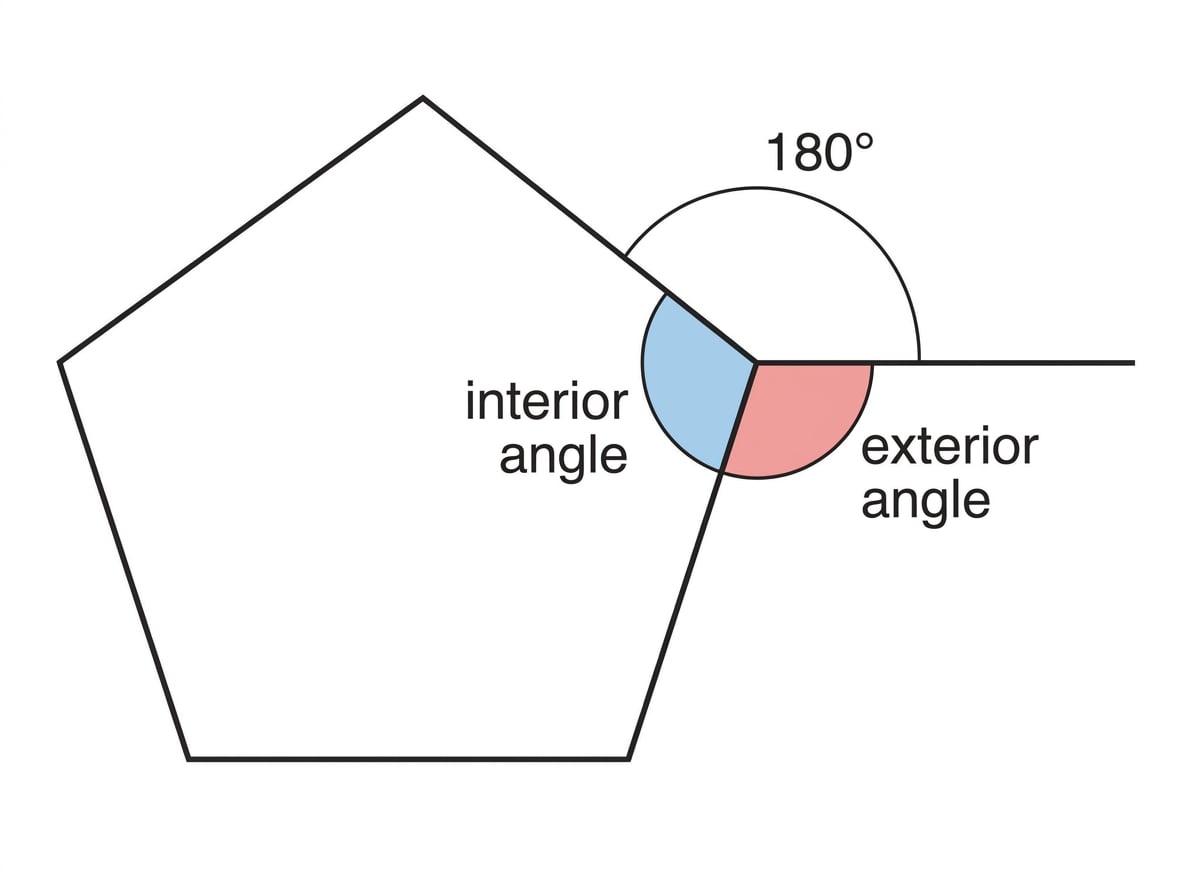
  • An interior angle is an angle inside the polygon at a vertex.

  • An exterior angle is the angle outside the polygon, made by extending one side.

A polygon corner showing the interior angle inside the shape and the exterior angle formed by extending one side.

  • A regular polygon has all sides equal and all interior angles equal.

The angle facts you already need

Before polygons, remember these basics:

  • Angles on a straight line add to 180°.
  • Angles around a point add to 360°.
  • Angles in a triangle add to 180°.
Example

Angles around a point

  1. Three angles meet at a point. Two are 85° and 140°.

Three angles around a point, with the missing angle labelled x.

  1. Angles around a point add to 360°.

  2. Add the known angles: 85 + 140 = 225°.

  3. Subtract from 360°: x=360∘−225∘=135∘x = 360^\circ - 225^\circ = 135^\circx=360∘−225∘=135∘.

Interior angle sum of a polygon

A polygon can be split into triangles. A quadrilateral splits into 2 triangles, a pentagon into 3 triangles, a hexagon into 4 triangles, and so on.

A pentagon split into three triangles from one vertex, illustrating the interior angle sum formula.

Key Idea

Interior angle sum

For a polygon with nnn sides, the sum of the interior angles is (n−2)×180∘(n - 2) \times 180^\circ(n−2)×180∘.

So:

  • Triangle: 180°
  • Quadrilateral: 360°
  • Pentagon: 540°
  • Hexagon: 720°
Example

Missing angle in a pentagon

  1. A pentagon has 5 sides, so its interior angle sum is:

    (5−2)×180∘=540∘(5 - 2) \times 180^\circ = 540^\circ(5−2)×180∘=540∘
  2. Four of the angles are 98°, 121°, 116° and 85°.

A pentagon with four given interior angles and one missing angle x.

  1. Add the known angles: 98 + 121 + 116 + 85 = 420°.

  2. Subtract from the total: x=540∘−420∘=120∘x = 540^\circ - 420^\circ = 120^\circx=540∘−420∘=120∘.

Common Mistake

Using 360° for every polygon

Only quadrilaterals have interior angles adding to 360°. A pentagon adds to 540°, and a hexagon adds to 720°.

Exterior angles of regular polygons

The exterior angles of a polygon add to 360° when you take one exterior angle at each vertex.

For a regular polygon, all exterior angles are equal, so you divide 360° by the number of sides.

Key Idea

Regular exterior angle

For a regular polygon with nnn sides, each exterior angle is 360∘n\frac{360^\circ}{n}n360∘​.

Example

Exterior angle of a regular nonagon

  1. A nonagon has 9 sides, so n=9n = 9n=9.

A regular nonagon with one exterior angle marked.

  1. Each exterior angle is 360∘9\frac{360^\circ}{9}9360∘​.

  2. Work it out: 360∘9=40∘\frac{360^\circ}{9} = 40^\circ9360∘​=40∘.

  3. Each exterior angle is 40°.

Interior angles of regular polygons

At each corner of a regular polygon, the interior angle and exterior angle form a straight line.

That means:

  • interior angle + exterior angle = 180°
  • interior angle = 180° − exterior angle
Example

Interior angle of a regular 12-sided polygon

  1. A regular 12-sided polygon has 12 equal exterior angles.

A regular 12-sided polygon corner showing the interior angle and exterior angle as a straight line pair.

  1. Find each exterior angle: 360∘12=30∘\frac{360^\circ}{12} = 30^\circ12360∘​=30∘.

  2. Interior and exterior angles add to 180°.

  3. Find the interior angle: 180∘−30∘=150∘180^\circ - 30^\circ = 150^\circ180∘−30∘=150∘.

Tip

Quick check

Regular polygons with more sides have bigger interior angles, getting closer to 180°. So a regular octagon should have bigger angles than a regular pentagon.

Finding the number of sides

Sometimes you are given an angle and asked how many sides the regular polygon has.

If you know the exterior angle, use:

n=360∘exterior anglen = \frac{360^\circ}{\text{exterior angle}}n=exterior angle360∘​

If you know the interior angle, first find the exterior angle:

exterior angle=180∘−interior angle\text{exterior angle} = 180^\circ - \text{interior angle}exterior angle=180∘−interior angle
Example

Finding sides from an interior angle

  1. A regular polygon has interior angle 156°.

  2. Find the exterior angle: 180∘−156∘=24∘180^\circ - 156^\circ = 24^\circ180∘−156∘=24∘.

  3. Use n=360∘24∘n = \frac{360^\circ}{24^\circ}n=24∘360∘​.

  4. Work it out: n=15n = 15n=15.

  5. The polygon has 15 sides.

Common Mistake

Dividing by the interior angle

Do not do 360 ÷ interior angle. The exterior angles add to 360°, so you divide 360° by the exterior angle.

Irregular polygons with missing angles

An irregular polygon does not have all angles equal. You can still use the interior angle sum, but you must not divide by the number of sides unless the polygon is regular.

Example

One missing angle is twice the other

  1. A hexagon has four known angles: 126°, 133°, 118° and 133°.

An irregular hexagon with four known interior angles and two missing angles labelled y and 2y.

  1. A hexagon has interior angle sum:

    (6−2)×180∘=720∘(6 - 2) \times 180^\circ = 720^\circ(6−2)×180∘=720∘
  2. Add the known angles: 126 + 133 + 118 + 133 = 510°.

  3. The two missing angles add to 720∘−510∘=210∘720^\circ - 510^\circ = 210^\circ720∘−510∘=210∘.

  4. Let the smaller missing angle be yyy. The larger is 2y2y2y.

  5. So y+2y=210∘y + 2y = 210^\circy+2y=210∘, which means 3y=210∘3y = 210^\circ3y=210∘.

  6. Therefore y=70∘y = 70^\circy=70∘, so the larger angle is 2y=140∘2y = 140^\circ2y=140∘.

Tip

Equal unknown angles

If several angles are equal, give them the same letter. Four equal angles can be written as x+x+x+x=4xx + x + x + x = 4xx+x+x+x=4x.

Regular polygons meeting at a point

When polygons meet at a point, use the fact that angles around a point add to 360°.

Usually, the angles touching the point are interior angles of the regular polygons.

Example

Finding the number of sides of another regular polygon

  1. A square, a regular hexagon and another regular polygon meet at a point.

A square, regular hexagon and unknown regular polygon meeting at one point with their interior angles around the point.

  1. The square contributes 90°.

  2. A regular hexagon has exterior angle 360∘6=60∘\frac{360^\circ}{6} = 60^\circ6360∘​=60∘, so its interior angle is 180∘−60∘=120∘180^\circ - 60^\circ = 120^\circ180∘−60∘=120∘.

  3. Find the interior angle of the other polygon: 360∘−90∘−120∘=150∘360^\circ - 90^\circ - 120^\circ = 150^\circ360∘−90∘−120∘=150∘.

  4. Its exterior angle is 180∘−150∘=30∘180^\circ - 150^\circ = 30^\circ180∘−150∘=30∘.

  5. Find the number of sides: n=360∘30∘=12n = \frac{360^\circ}{30^\circ} = 12n=30∘360∘​=12.

  6. The other regular polygon has 12 sides.

Common Mistake

Using exterior angles at the shared point

When shapes meet at a point, the angles inside the shapes are usually the ones around the point. Use exterior angles only when finding the number of sides.

Exam technique

In the exam

  1. First decide whether the polygon is regular or irregular.

  2. Write down the correct total: pentagon 540°, hexagon 720°, or use (n−2)×180∘(n - 2) \times 180^\circ(n−2)×180∘.

  3. For regular polygons, use exterior angles: they add to 360° and each one is equal.

  4. If polygons meet at a point, make the angles add to 360°.

Self review

Check yourself

  • Can you explain the difference between an interior angle and an exterior angle?

  • If a regular polygon has exterior angle 30°, how would you find the number of sides?

  • When three polygons meet at one point, what should their angles add up to?

Recap questions

Test yourself with 5 quick questions on this guide. Answer them all correctly to complete it.

You've reached the end

Test yourself on this topic, or move on to the next guide.

Practice questionsTake a quick quiz on this topicFlashcardsSelf-test with active recall
Surface AreaUp next

How was this guide?

Angles in Polygons Revision Guide

  1. GCSE
  2. /Maths
  3. /Angles in Polygons