Revision notes for AQA GCSE Maths Conversions and Units. Open the guide for explanations and worked examples. Written against the AQA GCSE Maths (8300) specification, so the content matches what's examinable rather than general Maths background.
A unit tells you what a measurement is counted in, such as cm, metres, litres, pints, kg or seconds.
A conversion means writing the same amount using a different unit.
For example, 1 metre and 100 cm are the same length, just written in different units.
Conversion factor
A conversion factor is the number you multiply or divide by to change from one unit to another. For example, because 1 cm = 10 mm, the conversion factor between cm and mm is 10.
Multiply or divide
If you are changing to a smaller unit, you usually multiply. If you are changing to a larger unit, you usually divide.
Changing metres to centimetres
Write 3.7 m in centimetres.

Use the fact that 1 m = 100 cm.
Metres are bigger than centimetres, so multiply by 100:
3.7×100=3703.7 \times 100 = 3703.7×100=370Write the answer with the new unit: 370 cm.
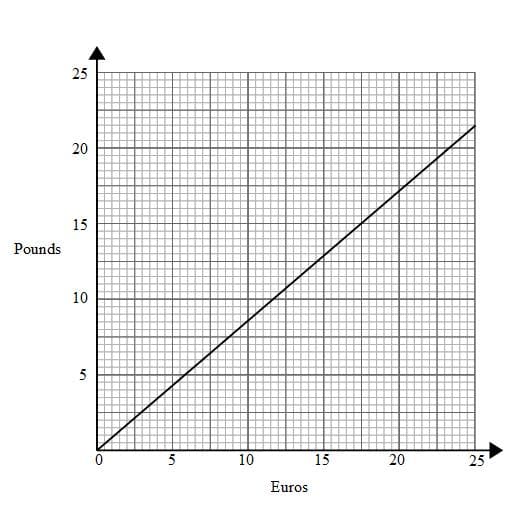
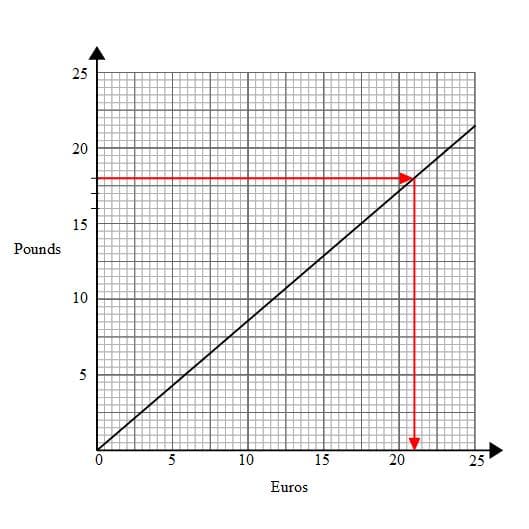
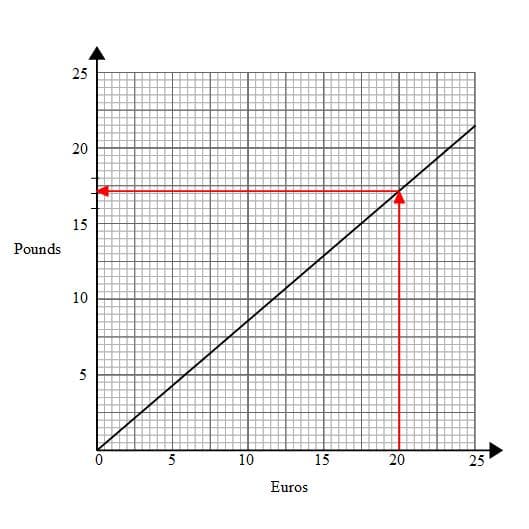
A conversion graph is a straight-line graph that changes one unit into another.
The horizontal line is the x-axis. The vertical line is the y-axis.
For example, a graph might have litres along the bottom and pints up the side.
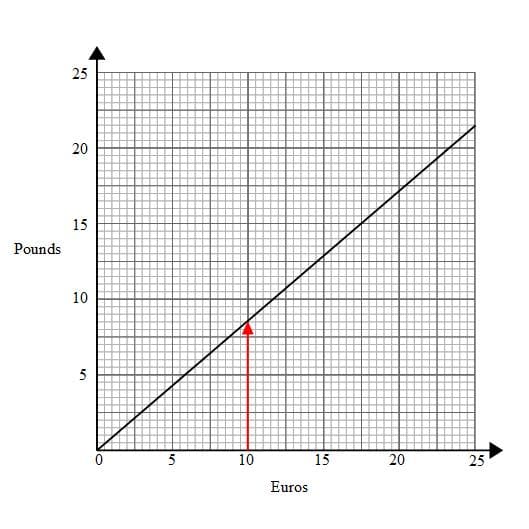
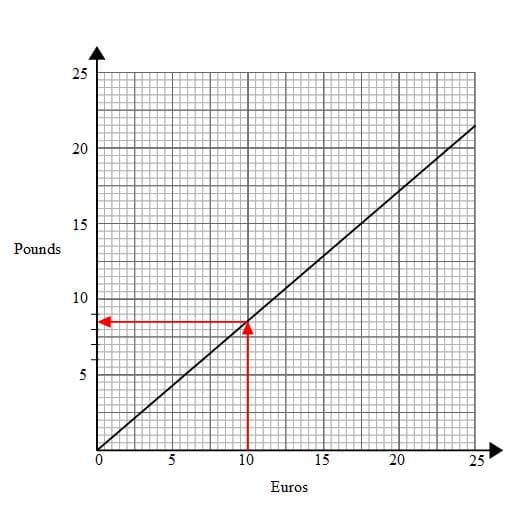
If you are given the value on the bottom axis:
Using a graph from litres to pints
A conversion graph shows that 20 litres is about 35 pints. Use the graph to estimate 12 litres in pints.

Find 12 on the litres axis.
Move straight up until you reach the conversion line.
Move across to the pints axis.
Read the value. It should be about 21 pints.
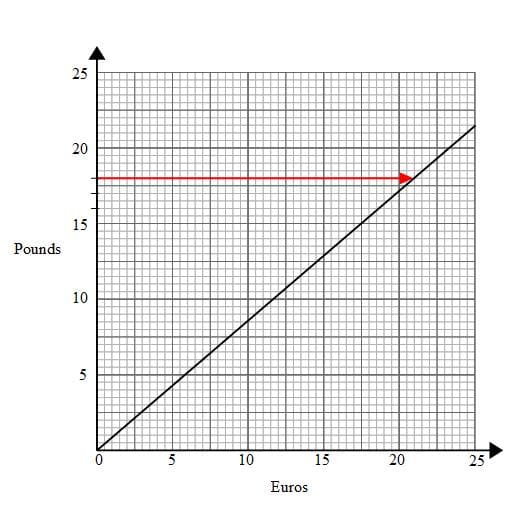
Sometimes you are given the value on the vertical axis. Then you work backwards:
Using a graph from pints to litres
A conversion graph shows litres on the x-axis and pints on the y-axis. Estimate 70 pints in litres.

Find 70 pints on the vertical axis.
Move horizontally across to the conversion line.
Move straight down to the litres axis.
Read the value. Since 35 pints is about 20 litres, 70 pints is about 40 litres.
Check the axes
Before reading a conversion graph, always check which unit is on each axis. The bottom axis and side axis are often different.
Going the wrong way
A common mistake is to read from the wrong axis. If the question gives you cm, start on the cm axis. If it gives you inches, start on the inches axis.
Most conversion graphs are straight lines through zero. This means the units are in direct proportion: doubling one measurement doubles the other.
Direct proportion
Two quantities are in direct proportion if they increase at the same rate. For example, if 5 litres is 8.75 pints, then 10 litres is 17.5 pints.
This helps when the number you want is outside the graph or easier to calculate from a known point.
Using proportion instead of the graph
A conversion graph shows that 10 inches is about 25.4 cm. Estimate 5 inches in centimetres.

Notice that 5 inches is half of 10 inches.
So 5 inches is half of 25.4 cm:
25.4÷2=12.725.4 \div 2 = 12.725.4÷2=12.7The answer is about 12.7 cm.
Area measures the amount of flat space inside a shape. Area units are squared, such as cm², mm² and m².
Squared unit
A squared unit means a unit multiplied by itself. For example, 1 cm² is a square that is 1 cm by 1 cm.

This is important: if 1 cm = 10 mm, then 1 cm² is not 10 mm².
A 1 cm by 1 cm square is the same as a 10 mm by 10 mm square:
10×10=10010 \times 10 = 10010×10=100So 1 cm² = 100 mm².
Area conversion
For area, square the length conversion factor. If the length scale factor is 10, the area scale factor is 100.
Changing square metres to square centimetres
Write 2.8 m² in cm².

Use the length fact: 1 m = 100 cm.
Because this is area, square the conversion factor:
100×100=10000100 \times 100 = 10000100×100=10000Multiply by 10000:
2.8×10000=280002.8 \times 10000 = 280002.8×10000=28000Write the answer: 28000 cm².
Changing square millimetres to square centimetres
Write 450 mm² in cm².
Use the fact that 1 cm = 10 mm.
So 1 cm² = 100 mm².
You are changing from smaller units to larger units, so divide by 100:
450÷100=4.5450 \div 100 = 4.5450÷100=4.5Write the answer: 4.5 cm².
Only multiplying by 10
For area, do not just multiply by the length scale factor. From cm² to mm², multiply by 100, not 10.
Volume measures the amount of space inside a 3D object. Volume units are cubed, such as cm³ and mm³.
Cubed unit
A cubed unit means a unit multiplied by itself three times. For example, 1 cm³ is a cube that is 1 cm by 1 cm by 1 cm.

If 1 cm = 10 mm, then:
1 cm3=10×10×10=1000 mm31\text{ cm}^3 = 10 \times 10 \times 10 = 1000\text{ mm}^31 cm3=10×10×10=1000 mm3Volume conversion
For volume, cube the length conversion factor. If the length scale factor is 10, the volume scale factor is 1000.
Changing cubic centimetres to cubic millimetres
Write 24 cm³ in mm³.
Use the length fact: 1 cm = 10 mm.
Because this is volume, cube the conversion factor:
10×10×10=100010 \times 10 \times 10 = 100010×10×10=1000Multiply by 1000:
24×1000=2400024 \times 1000 = 2400024×1000=24000Write the answer: 24000 mm³.
Speed tells you how far something travels in a certain time.
Compound unit
A compound unit combines two units. For example, kilometres per hour, written km/h, combines distance and time.
To change kilometres per hour into metres per second:
Changing km/h to m/s
Change 72 kilometres per hour into metres per second.

Start with 72 km/h.
Change kilometres into metres:
72×1000=7200072 \times 1000 = 7200072×1000=72000Change 1 hour into seconds: 1 hour = 3600 seconds.
Divide by 3600:
72000÷3600=2072000 \div 3600 = 2072000÷3600=20Write the answer: 20 m/s.
Quick shortcut for km/h to m/s
To change km/h to m/s, divide by 3.6. For example, 72 ÷ 3.6 = 20.
In the exam
Check yourself
Test yourself with 5 quick questions on this guide. Answer them all correctly to complete it.
Test yourself on this topic, or move on to the next guide.
How was this guide?