Time
x

Revision notes for AQA GCSE Maths Time. Open the guide for explanations and worked examples. Written against the AQA GCSE Maths (8300) specification, so the content matches what's examinable rather than general Maths background.

Time

What you'll learn

  • Convert between hours and minutes.
  • Work with half, quarter and three-quarter hours.
  • Add journey times to find an arrival time.
  • Read simple bus and train timetables.

1. Hours and minutes

A minute is a small unit of time. An hour is made from 60 minutes. A unit is the word that tells you what you are measuring, such as minutes or hours.

Definition

Duration

A duration is how long something lasts, such as 20 minutes, 2 hours, or a film lasting 95 minutes.

Key Idea

The key time fact

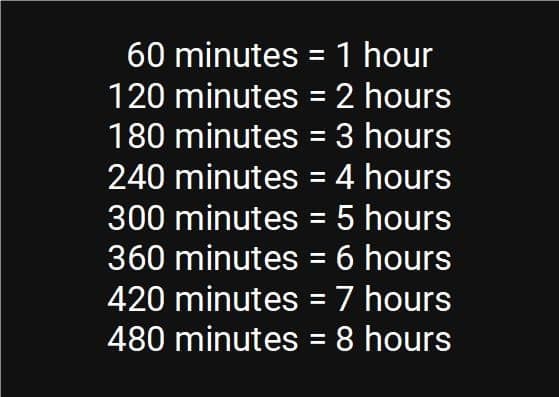
There are 60 minutes in 1 hour. To change hours to minutes, multiply by 60. To change minutes to hours, divide by 60.

A conversion diagram showing that 1 hour equals 60 minutes, with multiply and divide arrows for converting units.

Changing minutes to hours

If you are changing minutes into hours, ask: “How many groups of 60 are there?”

Example

Changing minutes to hours

Change 240 minutes to hours.

A bar model showing 240 minutes split into four equal 60-minute groups, representing 4 hours.

240 minutes split into four equal groups of 60 minutes, showing 4 hours.

  1. One hour is 60 minutes.

  2. Count how many groups of 60 are in 240.

  3. 60, 120, 180, 240 is 4 groups, so 240 minutes is 4 hours.

Changing hours to minutes

If you are changing hours into minutes, use 60 minutes for every hour.

Example

Changing hours to minutes

Change 5 hours to minutes.

Five separate 1-hour blocks show that 5 hours means five groups of 60 minutes.

  1. One hour is 60 minutes.

  2. Five hours means 5 groups of 60 minutes.

  3. 5 groups of 60 minutes is 300 minutes, so 5 hours is 300 minutes.

Common Mistake

Using 100 minutes in an hour

Time is not like money. An hour has 60 minutes, not 100 minutes.

2. Fractions of an hour

Sometimes a time is written using a fraction. A fraction shows part of something. A mixed number has a whole number and a fraction together, like 1121\frac{1}{2}121​.

Useful facts:

A clock face divided into quarters to show that half an hour is 30 minutes, quarter of an hour is 15 minutes, and three quarters is 45 minutes.

  • Half an hour is 30 minutes.
  • Quarter of an hour is 15 minutes.
  • Three quarters of an hour is 45 minutes.
Example

Changing a mixed number of hours

Change 1141\frac{1}{4}141​ hours to minutes.

A whole hour and a quarter hour are shown as 60 minutes and 15 minutes, making 75 minutes in total.

  1. Split 1141\frac{1}{4}141​ hours into 1 hour and a quarter of an hour.

  2. One hour is 60 minutes.

  3. A quarter of an hour is 15 minutes.

  4. Add them together: 60 minutes + 15 minutes = 75 minutes.

  5. So 1141\frac{1}{4}141​ hours is 75 minutes.

Finding the difference between durations

The difference means how far apart two amounts are. When comparing time durations, make sure both are in the same unit first.

Example

Finding a difference in minutes

Find the difference, in minutes, between 40 minutes and 1141\frac{1}{4}141​ hours.

A comparison bar model showing 40 minutes compared with 75 minutes, with the gap marked as the difference.

A comparison bar shows 40 minutes against 75 minutes, with the gap between them labelled as the difference.

  1. Change 1141\frac{1}{4}141​ hours into minutes.

  2. From the previous method, 1141\frac{1}{4}141​ hours is 75 minutes.

  3. Now subtract the smaller duration from the bigger duration: 75 minutes - 40 minutes = 35 minutes.

  4. The difference is 35 minutes.

3. Adding durations to clock times

A clock time is a time of day, such as 10:40 am or 7:15 pm. A start time is when something begins. A finish time or arrival time is when it ends.

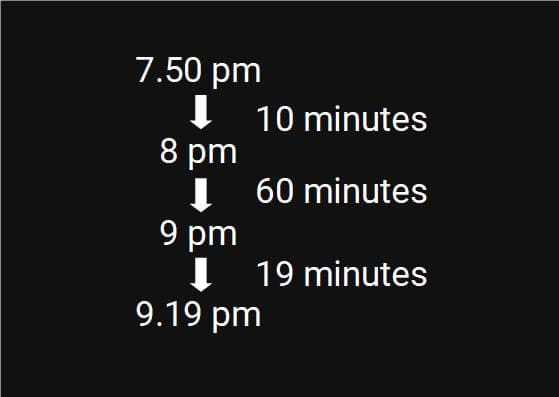
When you add minutes to a clock time, it often helps to get to the next hour first.

Tip

Get to the next hour

Add enough minutes to reach the next “o’clock” time first, then add whatever minutes are left.

Example

Adding several parts of a journey

Nina leaves home at 9:50 am. She walks for 12 minutes, waits for 8 minutes, then walks for another 19 minutes. What time does she arrive?

A timeline showing Nina’s journey from 9:50 am, first reaching 10:00 am, then continuing to the arrival time.

A time line breaks Nina’s 39-minute journey into 10 minutes to the next hour and 29 minutes after 10:00 am.

  1. Add the durations: 12 minutes + 8 minutes + 19 minutes = 39 minutes.

  2. Add 39 minutes to 9:50 am.

  3. From 9:50 am to 10:00 am is 10 minutes.

  4. There are 29 minutes left.

  5. 29 minutes after 10:00 am is 10:29 am.

When the duration is more than 60 minutes

A duration like 85 minutes is more than 1 hour. Split it into 60 minutes and the extra minutes.

Example

A film finishing time

A film starts at 6:50 pm and lasts 85 minutes. What time does it finish?

A clock-time line splitting an 85-minute film into 60 minutes and 25 minutes after the start time.

The 85-minute film duration is split into 60 minutes and 25 minutes on a clock-time line.

  1. Split 85 minutes into 60 minutes and 25 minutes.

  2. Add 60 minutes to 6:50 pm to get 7:50 pm.

  3. Add the remaining 25 minutes.

  4. The film finishes at 8:15 pm.

Common Mistake

Writing impossible clock times

Do not write times like 7:75. Clock minutes go up to 59, then the next hour begins.

4. Reading timetables

A timetable is a list of times for buses, trains, or events. The departure time is when it leaves. The arrival time is when it gets there.

Definition

24-hour clock

The 24-hour clock writes times using hours from 00 to 23. For example, 0745 means 7:45 am and 1540 means 3:40 pm.

In a timetable, read down the same column for one bus or train.

Common Mistake

A dash in a timetable

A dash means that bus or train does not stop there, so you cannot use that entry for that place.

Example

Reading one timetable column

Here is part of a bus timetable.

A timetable diagram highlighting that one journey must be read down a single column from departure to arrival.

PlaceBus ABus BBus C
Green Road071007350800
Market072207470812
Station074008050830

A bus leaves Green Road at 0735. How long does it take to reach Station?

The same timetable column is highlighted from Green Road 0735 down to Station 0805.

  1. Find 0735 on the Green Road row.

  2. Read down the same column to Station.

  3. The bus arrives at Station at 0805.

  4. From 07:35 to 08:00 is 25 minutes.

  5. From 08:00 to 08:05 is 5 minutes.

  6. The journey takes 30 minutes.

5. Latest time questions

The latest time means the last time that still works. A deadline is the time you must arrive by, such as getting to work by 9 am.

For these questions, work backwards from the deadline.

Example

Finding the latest time to leave home

Sam needs to be at work by 09:00. It takes 8 minutes to walk from Town Centre to work. It takes 12 minutes to walk from home to Hill Road bus stop.

A backwards-planning timeline showing how to choose the latest bus and latest leaving time from a deadline.

PlaceBus ABus BBus C
Hill Road080608160826
Town Centre083608460856

What is the latest time Sam can leave home?

A backwards-planning diagram shows the 09:00 deadline, the latest usable bus arrival, and Sam’s walk to the bus stop.

  1. Sam must be at work by 09:00.

  2. The walk from Town Centre to work takes 8 minutes, so the bus must arrive at Town Centre by 08:52.

  3. The arrival times are 0836, 0846 and 0856.

  4. 0856 is too late because Sam would arrive at work after 09:00.

  5. The latest bus that works arrives at 0846.

  6. That bus leaves Hill Road at 0816.

  7. Sam needs 12 minutes to walk to Hill Road, so Sam must leave home at 08:04.

Exam technique

In the exam

  1. Change hours or fractions of hours into minutes before comparing.

  2. When adding a long duration, split it into 60 minutes plus the leftover minutes.

  3. On a timetable, stay in the same column and choose the latest option that still arrives early enough.

Self review

Check yourself

  • How many minutes are in 1121\frac{1}{2}121​ hours?

  • If a show starts at 7:20 pm and lasts 70 minutes, what time does it finish?

  • In a timetable, why should you read down the same column?

Recap questions

Test yourself with 5 quick questions on this guide. Answer them all correctly to complete it.

You've reached the end

Test yourself on this topic, or move on to the next guide.

Practice questionsTake a quick quiz on this topicFlashcardsSelf-test with active recall
Metric ConversionsUp next

How was this guide?

Time Revision Guide

  1. GCSE
  2. /Maths
  3. /Time